

Six months is enough time to replace a salary through freelancing — for professionals who make the right decisions in the right order and stay consistent through the phases that feel the slowest.
It is not enough time for every professional. The timeline depends on your field, your starting rate, the size of your professional network, and how quickly you are willing to hold your rate through early client pushback. But it is a realistic and achievable target for most experienced professionals who approach it as a business rather than a side project — and understanding what drives the income at each stage is what separates the people who reach it from the ones who plateau somewhere in the middle.
This is the complete picture of what salary replacement through freelancing actually requires — the milestones, the decisions, and the specific actions that drive income growth from first client to consistent monthly income that matches or exceeds what an employer used to pay you.
Why Six Months Is the Right Planning Horizon
Most freelance advice operates on one of two timelines — the inspirational "replace your income in 30 days" version that sets expectations no realistic first month can meet, or the conservative "this takes years to build" version that makes salary replacement feel so distant it stops feeling worth pursuing.
Six months sits in the honest middle. It is long enough that the compounding effect of consistent effort becomes visible. It is short enough that the goal feels concrete rather than abstract. And it matches the actual income trajectory that most experienced professionals experience when they position correctly and stay consistent — not the exceptional cases, the typical ones.
The six-month timeline assumes you are starting from zero freelance clients today. It assumes you are working on this seriously but not exclusively — most people building toward salary replacement are simultaneously job searching, managing a household, or both. And it assumes you will make some mistakes — because everyone does — but that you will course-correct quickly rather than abandoning the effort when the first month produces less than you hoped.
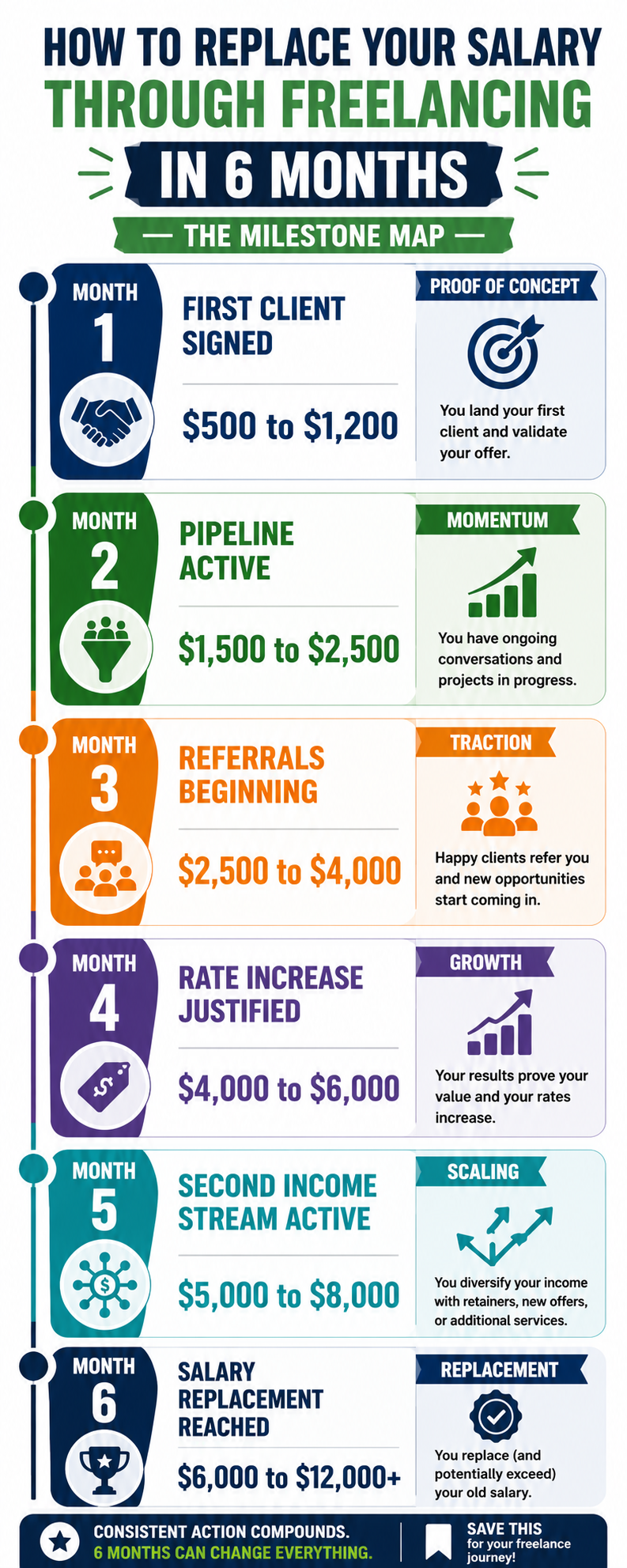
The Month-by-Month Milestone Map
Month One — Proof of Concept ($500 to $1,200)
The goal of month one is not income replacement. It is proof that your offer works in your market — that real people will pay real money for what you do.
The specific activities that drive month one income:
Week one: Positioning decided. Offer written. Rate set. LinkedIn updated. First ten outreach messages sent by Friday.
Week two: Outreach continuing. First discovery calls scheduled. Platform profiles live. Five more targeted messages sent.
Week three: Discovery calls happening. First proposal sent. One conversation in active follow-up. Outreach maintaining minimum three contacts per day.
Week four: First client signed. First invoice sent. Income appears — modest but real. The model is proven in your specific market.
The income number in month one is almost always disappointing relative to expectations — and almost always irrelevant relative to what it represents. A signed first client and a working pipeline is worth more than any specific dollar amount in month one, because everything that follows is built on that foundation.
For the detailed week-by-week approach that produces month one results — the complete plan for building freelance income in the first 30 days covers every action with specific frameworks for each week.
Month Two — Momentum ($1,500 to $2,500)
Month two is where the compound effect of month one's work becomes visible. The outreach that went out in weeks one and two of month one is now converting to signed clients. The first client is generating a referral conversation. The platform profile that was sparse in week one has enough activity to generate occasional inbound interest.
The specific driver that separates high-income month twos from low-income ones is the referral ask at the 30-day mark of the first client relationship. A professional who asks their first client for a referral at exactly day 30 — when the relationship is established but the novelty has not worn off — consistently generates faster second clients than one who waits for referrals to appear organically.
The second major driver is rate consistency. A professional who held their rate through month one's client conversations enters month two with clients who accepted their rate — which means the rate anchor for all subsequent clients is set at the correct level. A professional who discounted in month one enters month two trying to raise rates with existing clients — which is significantly harder than maintaining them from the start.
Month Three — Traction ($2,500 to $4,000)
Month three is the inflection point that most experienced professionals describe as the moment freelancing stopped feeling like an experiment and started feeling like a real business.
Two to three active clients are generating recurring income. Outreach is converting at a higher rate than month one because the positioning has been sharpened by real client conversations. Platform profiles have accumulated reviews that generate inbound interest without active application.
The most important action in month three is the first rate increase discussion. Most experienced professionals can justify a rate increase at the 90-day mark based on demonstrated results for their first clients. Even a modest increase — $15 to $25 per hour — compounds significantly over the following three months when applied across multiple client relationships.
The professionals who reach salary replacement at month six are almost always the ones who increased their rate at month three rather than waiting until the income felt comfortable enough to risk a client objection.
For the income trajectory that connects month three traction to month six salary replacement — what the income trajectory actually looks like in the first 90 days covers the mechanics of income growth at each stage.
Month Four — Growth ($4,000 to $6,000)
Month four is where the income starts to feel like it is approaching something meaningful relative to a previous salary — and where the decisions made about client selection and rate begin to have compounding consequences.
The professionals who reach the highest income levels by month six consistently do two things in month four that lower performers do not.
They become selective about new clients. By month four, most experienced freelancers have enough pipeline activity to evaluate new potential clients based on fit rather than need. Choosing clients who are most likely to generate referrals, to accept rate increases, and to become long-term relationships produces a significantly better income trajectory than accepting every client who says yes.
They add a second income stream. A single client relationship, however well-paying, represents income concentration risk. Month four is when most experienced freelancers add a second service offering, a passive income component, or a platform presence that generates income independent of their primary client relationships.
For the specific ways that AI automation skills can function as a high-income second stream for experienced professionals — how to scale an AI agency from one client to ten covers the income model that experienced freelancers are adding to their primary service offering.
Month Five — Scaling ($5,000 to $8,000)
Month five is where the income trajectory becomes self-reinforcing in a way that months one through four never quite did.
Referrals are now a consistent source of new client conversations rather than an occasional bonus. The platform profile is generating inbound interest that supplements outbound outreach. The professional reputation that was being built through months one through four is now visible enough to attract clients who found you rather than clients you found.
The professionals who reach the high end of the month five range are consistently the ones who invested in exceptional delivery during months one and two — because the referral engine that drives month five income is entirely a function of how well the first two or three clients were served.
For the professionals whose backgrounds are in administration and executive support — how virtual assistants are building six figure businesses from admin skills covers how one of the most common corporate backgrounds is reaching the upper end of these income ranges through specific positioning and client acquisition approaches.
Month Six — Replacement ($6,000 to $12,000+)
Month six looks dramatically different from month one — not because anything sudden happened but because six months of consistent, correctly structured effort has compounded into something that the first week of outreach could not have predicted.
Two to four active clients generating recurring income at rates that reflect your professional expertise level. A referral pipeline that produces new client conversations without requiring the outreach volume of month one. A professional reputation in your specific niche that is beginning to generate inbound interest. And a monthly income figure that is either at or approaching what your former employer used to pay you — for work that you control, at rates you set, on a schedule that you define.
Month six is not a finish line. It is the point where the freelance business stops feeling fragile and starts feeling stable.
The Decisions That Determine Whether You Reach Month Six or Plateau Before It
Not every professional who starts freelancing after a layoff reaches salary replacement at month six. The ones who plateau before it almost always made one of three specific decisions that redirected their income trajectory downward.
They priced below market in month one and could not raise rates fast enough to compensate. The income gap created by month one underpricing is real and persistent — a professional who started at 60 percent of market rate and raised their rate at month three is still earning significantly less at month six than one who started at market rate from the beginning.
They stopped outreach when they reached their first comfortable income level. A plateau at $2,500 per month is almost always caused by stopping active client development when the first two clients filled available capacity. Salary replacement requires continuing to build the pipeline beyond current capacity — so that when clients naturally conclude, the next ones are already in the conversation rather than requiring a restart.
They accepted clients who were wrong fits because they needed the income. A difficult, boundary-testing client who consumes 60 percent of your available client hours while paying below your market rate prevents the capacity development that higher-rate clients would have filled. Being selective — even when income is not yet at replacement level — consistently produces better six-month outcomes than accepting every available client.
What Comes After Month Six
Salary replacement at month six is not the ceiling of what freelancing can produce — it is the foundation. The professionals who reach month six with a stable income base and a working pipeline have three options that employment never offered simultaneously.
They can maintain the freelance practice at salary replacement level — providing the income, autonomy, and professional satisfaction of doing excellent specialized work for clients who value it.
They can scale beyond salary replacement — adding clients, raising rates, or adding complementary income streams that push total income significantly above what employment ever produced.
Or they can use the financial stability of a working freelance practice as the negotiating position from which to re-enter employment on terms that reflect their actual market value rather than the desperation of income-depletion.
All three are good outcomes. All three are better than the alternative of arriving at month six still dependent on a job search process that does not always produce the right result on the right timeline.
For the professionals who want to see what the income trajectory looks like beyond month six — how older workers are already out-earning their previous salaries covers the income levels available to experienced professionals who stay consistent beyond the six-month mark.
The Resources That Make This Timeline Realistic
The Freelance Jumpstart Audio Edition covers the complete six-month strategy — positioning, rate setting, client acquisition, rate increases, referral activation, and income diversification — in audio format that works during any window of available time throughout the six-month building period.
For the structured implementation plan that starts the month one clock immediately — the 7-Day Freelance Jumpstart moves you from skill identification on day one to active client outreach by day four — so the six-month timeline starts this week rather than after you feel ready.
For the specific approach that corporate professionals are using to reach the upper end of these income ranges — how to package corporate experience into a high-income freelance business covers the positioning and service packaging decisions that drive income to the higher end of each monthly range.
Before You Close This Tab
The article that builds most directly on this one is how experienced professionals command premium freelance rates — because the income trajectory in this article assumes expertise market positioning and expert-level rates from month one. If your rate is not yet set at the expert level your background supports, that article is worth reading before you send your next outreach message.
From the Same Series
- You Were Laid Off Now What — How to Build Freelance Income in 30 Days
- How Older Workers Are Out-Earning Their Old Salaries as Freelancers
- What Freelance Income Actually Looks Like in Your First 90 Days
- The Biggest Freelance Mistakes Laid-Off Workers Make and How to Avoid Them
Frequently Asked Questions
Is it really possible to replace a full salary through freelancing in 6 months?
Yes — for experienced professionals who position correctly in the expertise market, set expert-level rates from day one, activate their professional network before cold channels, and maintain consistent outreach and client development through all six months. The professionals who do not reach salary replacement at six months almost always plateau due to underpricing in month one, stopping outreach when first clients fill available capacity, or accepting below-fit clients that prevent higher-rate client development.
What monthly income target represents salary replacement for most professionals?
Salary replacement income varies by previous salary but the calculation is straightforward. Take your previous annual salary and divide by 12 for your monthly target. Add 25 to 30 percent to account for self-employment taxes and business expenses that employment covered through benefits and payroll tax treatment. A professional who earned $75,000 annually needs approximately $7,800 to $8,100 per month in freelance income to achieve true salary replacement after taxes and expenses.
What is the most important decision that determines whether salary replacement happens at month six or later?
Rate setting in month one is the single most impactful decision. A professional who sets their rate at expert market level from the beginning builds toward salary replacement from a fundamentally different starting point than one who starts at entry level and tries to raise rates later. The compounding income difference between an expert-level starting rate and an entry-level one is often the difference between salary replacement at month six and salary replacement at month twelve or beyond.
How many clients does it take to replace a salary through freelancing?
Most experienced professionals reach salary replacement with three to five active client relationships at expert-level rates — not dozens of small clients. A professional billing at $125 per hour working 60 hours per month of client time generates $7,500 per month from a single full retainer relationship. Three clients at more modest engagement levels produce the same result. The quality and rate of each client relationship matters far more than the number of clients.
What happens if I reach month six and have not replaced my salary yet?
Review the three plateau causes covered in this article — underpricing in month one, stopping outreach when first clients fill capacity, and accepting below-fit clients that prevent higher-rate development. Most professionals who have not reached salary replacement at month six can identify which of these three factors slowed their trajectory — and addressing it directly in months seven and eight typically produces rapid income growth. The six-month timeline is a realistic target, not a deadline after which the opportunity expires.
Should I freelance full time or part time while building toward salary replacement?
Most financial advisors recommend pursuing both freelancing and job searching simultaneously during the salary replacement building period — for two reasons. Freelance income covers the financial gap while the job search finds the right opportunity rather than the first available one. And if the freelance income reaches replacement level before the right job opportunity appears, you have created genuine choice about which path to pursue rather than being forced into the first acceptable offer.
What is the Freelance Jumpstart Audio Edition and how does it support the six-month plan?
The Freelance Jumpstart Audio Edition covers the complete strategy for building freelance income from zero to salary replacement — including the positioning decisions, rate-setting frameworks, client acquisition approaches, referral activation strategies, and income diversification options that drive income growth at each stage of the six-month timeline. It is in audio format because most professionals building toward salary replacement are simultaneously managing job searching, household responsibilities, and early freelance client delivery — and audio works during the windows available to people managing all three simultaneously.
Comments ()