

Somewhere between your first job and your most recent one, you built something that most people spend years trying to acquire — a specific, practical, battle-tested understanding of how businesses actually work.
Not theory. Not textbook knowledge. The real thing. What happens when a project falls apart and needs to be saved. How to manage a difficult stakeholder without losing the relationship. What the data actually means when the numbers do not tell the obvious story. How to build a team that delivers consistently rather than sporadically.
That knowledge has a market value significantly higher than what any single employer ever paid you for it — because in a corporate structure, your expertise was purchased as part of a package that included your time, your availability, your compliance with organizational norms, and a hundred other things that diluted what your actual knowledge was worth.
In a freelance structure, you sell the knowledge directly. No package. No dilution. Just the expertise — at rates that reflect its actual market value rather than what fits inside someone else's salary band.
Turning your corporate experience into a freelance business is not a complicated process. But it requires a specific set of decisions made in a specific order — and most people make them in the wrong order, which is why they end up underpricing, underperforming, or abandoning the attempt before it has a real chance to work.
Why Corporate Experience Is the Most Undervalued Asset in the Freelance Market
The freelance market in 2026 has a structural imbalance that creates a significant opportunity for corporate professionals making the transition.
On the demand side — small businesses, startups, and growing companies are desperately seeking the kind of operational, strategic, and functional expertise that corporate organizations develop over decades. They need people who have seen problems at scale, who understand how systems interact, who can anticipate second-order consequences of decisions, and who can communicate complex information to different audiences with different levels of technical understanding.
On the supply side — most of the freelancers offering professional services are either recent graduates with academic knowledge but limited practical experience, or career freelancers who have worked exclusively with small businesses and lack the organizational depth that comes from navigating corporate environments.
The gap between what small and growing businesses need and what the general freelance supply provides is exactly where corporate professionals belong — and the rates that gap supports are significantly higher than what most corporate professionals charge when they first enter the freelance market because they do not yet see their experience as the competitive advantage it is.
For the specific skills that command the highest rates in this gap — which existing skills clients are actively paying for right now covers the full market breakdown of professional backgrounds and their current freelance market rates.
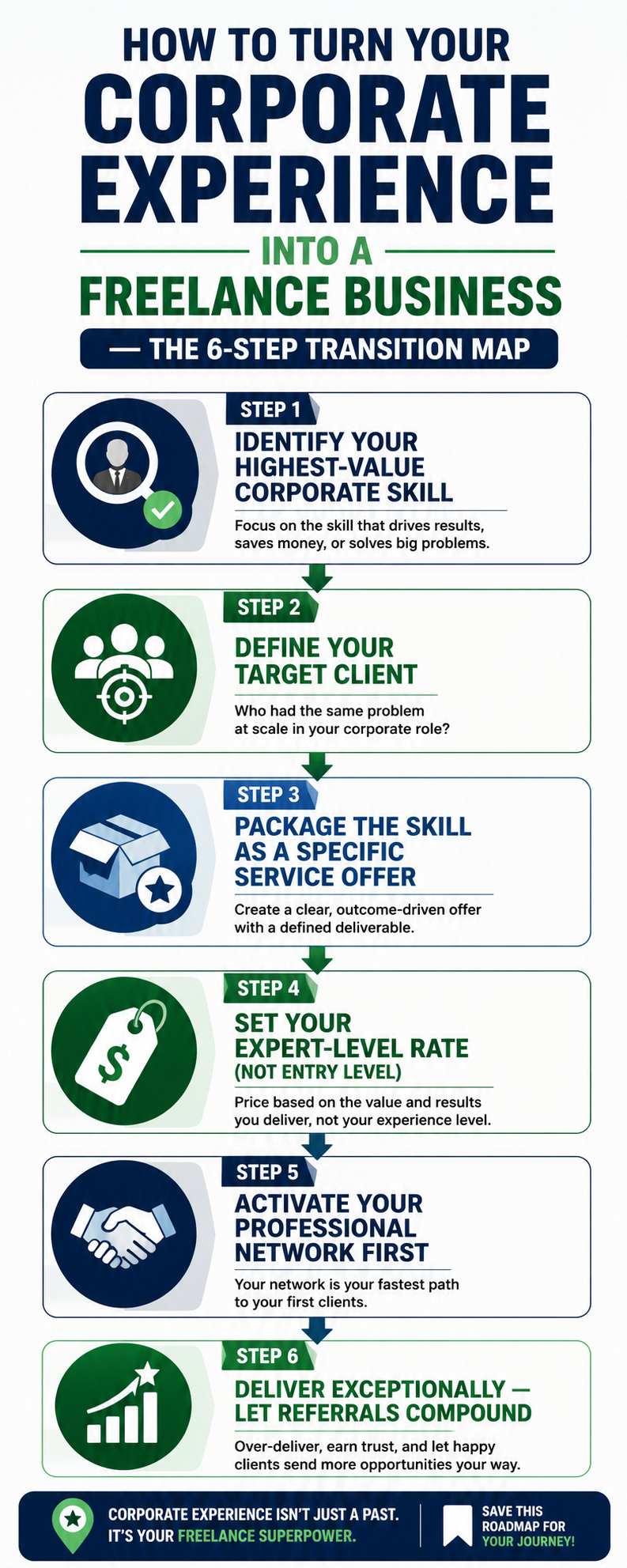
The Six-Step Transition From Corporate Professional to Freelance Business Owner
Step One — Identify Your Highest-Value Corporate Skill
Not everything you did in your corporate career has equal freelance market value. Your first job is identifying which of your skills — when offered as a standalone service to the right client — solves the most expensive problem they face.
Run your professional history through this question: What did my presence make possible that would not have happened without me?
The answer is almost never a task. It is almost always a capability — the ability to bring order to complex situations, the ability to communicate technical concepts to non-technical stakeholders, the ability to build teams that retain high performers, the ability to identify market opportunities that data alone does not reveal.
That capability — not the tasks you used to deliver it — is what you are selling.
Step Two — Define Your Target Client
Your target client is not every small business. It is the specific type of business that is experiencing the problem your highest-value skill solves — at the stage of growth where that problem is most acute and most expensive.
A former marketing director whose highest-value skill is building content strategies that reduce customer acquisition cost has a specific target client — a B2B company with a product-market fit that is scaling sales but finding that their marketing spend is producing diminishing returns. That company is actively experiencing the problem. They have budget to solve it. And they do not have the internal expertise to address it without external help.
The more specifically you can define that target client — their industry, their size, their growth stage, their specific problem — the more effectively your outreach will convert and the more confidently you can price your service.
Step Three — Package the Skill as a Specific Service Offer
Corporate professionals typically resist packaging their work into defined service offerings because corporate work is inherently fluid — the scope changes, the problems evolve, the deliverables emerge from the engagement rather than being specified in advance.
Freelance clients need to understand what they are buying before they commit. A specific service offer — with a defined scope, a defined deliverable or outcome, and a defined timeline — converts client conversations into signed agreements significantly faster than an open-ended consulting arrangement.
Your first service package does not need to be rigid. It needs to be specific enough that a potential client can immediately picture what they are getting — and clear enough that you can deliver it without perpetual scope negotiation.
Example of vague service offer: "I provide marketing consulting for growing businesses."
Example of specific service offer: "I conduct a 30-day marketing audit that identifies your three highest-leverage growth opportunities and delivers a prioritized 90-day action plan with specific tactics, budget allocation, and success metrics."
Same professional. Same background. The second offer converts at a significantly higher rate because the client can immediately evaluate whether they want that specific thing.
Step Four — Set Your Expert-Level Rate
The most financially costly mistake corporate professionals make when entering freelancing is setting their rate based on their hourly salary equivalent rather than the market value of the expertise they are delivering.
Your hourly salary equivalent — your annual salary divided by 2,080 working hours — is the floor of what you should charge, not the ceiling. It represents the minimum value your time had inside a corporate structure that included overhead, benefits, management, and hundreds of other costs that are not present in a freelance engagement.
The expertise market rate for your skills — based on what clients are currently paying for similar outcomes from other senior freelancers — is your actual starting benchmark. For most senior corporate professionals, that rate is two to four times their hourly salary equivalent.
A corporate professional earning $95,000 per year has an hourly salary equivalent of approximately $46 per hour. The expertise market rate for their skills — operations consulting, marketing strategy, financial analysis, HR leadership — is typically $100 to $175 per hour. Setting their rate at $46 because that is what they were worth per hour in employment is leaving 60 percent of their market value on the table before the first client conversation begins.
Step Five — Activate Your Professional Network Before Anything Else
Before you build a website. Before you create a platform profile. Before you write a single piece of content marketing.
Send targeted, personalized messages to the people in your professional network who are most likely to need what you offer or to know someone who does. Former colleagues who moved to smaller organizations. Former managers who started their own businesses. Former clients who may have moved to companies with the problems you solve.
This is your warmest possible market — people who already have direct or secondhand evidence of your professional capability. The conversion rate from professional network outreach is consistently higher than any cold channel, and the income timeline from network activation is consistently shorter.
Ten well-crafted messages to the right ten people in your network will produce more first client opportunities in your first two weeks than any platform profile or content marketing strategy.
For the complete outreach approach — the complete plan for building freelance income after a layoff covers the full 30-day outreach sequence that experienced professionals use to convert their network into paying clients.
Step Six — Deliver Exceptionally and Let Referrals Compound
The corporate professionals who build the highest-income freelance practices within their first year are almost never the ones who marketed most aggressively. They are the ones who delivered most exceptionally for their first one or two clients — and let the referrals from those relationships do the marketing work that outreach alone cannot sustain.
A single deeply satisfied first client who mentions you to three colleagues in their professional network is worth more to your income trajectory than any platform profile, any LinkedIn post, or any cold outreach campaign. The referral arrives with the first client's credibility attached — which means the trust barrier is already lower before the first conversation begins.
Exceptional delivery in your first 60 days of active client work is the highest-leverage investment available to a new freelancer. Everything else compounds on top of it.
The Specific Corporate Backgrounds That Translate Most Directly Into High-Income Freelance Businesses
Not every corporate background translates with equal efficiency into a freelance business. These are the backgrounds where the transition is most direct and the income ramp is fastest.
Operations and process management — The skill of building systems that work predictably is immediately applicable to small and growing businesses that are scaling past the point where founder intuition alone is sufficient. Fractional operations consulting at $100 to $175 per hour is accessible to experienced operations professionals within the first 60 days of active outreach.
Marketing leadership — CMO-level strategic thinking applied fractionally to businesses that cannot afford a full-time marketing leader is one of the fastest-growing segments of the fractional executive market. Experienced marketing directors transitioning to fractional CMO work regularly reach $150 to $250 per hour within their first six months of active practice.
Finance and financial leadership — Fractional CFO and financial consulting work is in consistent demand from growing businesses that need senior financial guidance without full-time financial leadership overhead. Rates of $125 to $200 per hour are standard for experienced finance professionals in this market.
Human resources and people operations — Growing businesses that are hiring for the first time need the HR infrastructure that corporate professionals built as a standard part of their work. Fractional HR consulting at $75 to $150 per hour is accessible to experienced HR professionals without significant additional development.
Project management and program leadership — The ability to manage complex projects and coordinate multiple stakeholders is consistently in demand from businesses that lack the internal project management capability their growth requires. Rates of $85 to $140 per hour for experienced project managers transitioning to freelance work.
For the complete picture of how administrative and executive support professionals are specifically building premium freelance businesses — how admin professionals build premium virtual assistant businesses covers the positioning approach for one of the most accessible transitions from corporate to freelance.
The Income Picture — What to Expect and When
The income trajectory for corporate professionals making this transition follows the same general pattern described in detail for the broader freelance market — with one meaningful difference.
Corporate professionals who enter the freelance market with strong professional networks, specific positioning, and expert-level rates from day one consistently reach the higher end of income ranges at every stage compared to those who start with vague positioning or entry-level rates.
The difference between a corporate professional who starts at $65 per hour and one who starts at $150 per hour is not a $85 per hour gap at month one. It is a $3,400 to $8,500 per month gap at month six when each is working 40 hours per month of client time.
For the complete income trajectory from month one through salary replacement — how older workers are building income that exceeds their previous salaries covers the specific milestones and the decisions that drive income growth at each stage.
Adding AI Automation to Your Corporate Background — The Income Multiplier
One additional transition worth naming specifically — because it is available to corporate professionals from virtually any background and it adds meaningfully to the rate ceiling of every other service offering.
Professionals who layer practical AI automation knowledge on top of their corporate domain expertise are commanding rates at the upper end of every category listed above — because they are offering something that neither pure domain experts nor pure AI specialists can match individually.
A corporate operations professional who also knows how to implement AI automation tools for business processes is not competing with general operations consultants. They are offering something genuinely more valuable — the operational judgment to know what should be automated combined with the practical knowledge to actually build it.
The article on how to start an AI automation agency with no tech background covers how corporate professionals from any background are adding this capability to their service offering — without a technical background and without years of additional development.
The Resources That Support This Transition
The Freelance Jumpstart Audio Edition covers the complete corporate-to-freelance transition — positioning, rate setting, network activation, client acquisition, and income growth — in audio format that works during any available window.
For the structured day-by-day action plan — the 7-Day Freelance Jumpstart moves corporate professionals from identifying their highest-value skill on day one to active client outreach by day four — with specific frameworks for every step of the transition.
For the long-term income vision — how to build a freelance income that replaces your salary in 6 months covers the milestones and decisions that drive the income trajectory from first client through full salary replacement and beyond.
Related
- The Skills You Already Have That Clients Are Paying For Right Now
- How Older Workers Are Out-Earning Their Old Salaries as Freelancers
- What Freelance Income Actually Looks Like in Your First 90 Days
- How to Build a Freelance Income That Replaces Your Salary in 6 Months
One more article that makes this one more useful — how experienced professionals start freelancing after 40 goes deeper on the expertise market positioning that determines whether your corporate experience commands entry-level rates or expert-level ones. Worth reading before you finalize your service offer and rate.
Frequently Asked Questions
How do I turn my corporate experience into a freelance business without starting from zero?
The transition starts with identifying your highest-value corporate skill — the capability that made you irreplaceable in your organization rather than the tasks you performed to deliver it. Then you define the specific type of client who most acutely needs that capability, package it as a specific service offer with a defined scope and deliverable, set a rate that reflects expertise market value rather than corporate salary equivalent, and activate your professional network before approaching any cold channels. That sequence — done in that order — consistently produces faster and higher-income results than the reverse.
What corporate backgrounds translate most easily into freelance businesses?
The corporate backgrounds with the most direct freelance transition paths are operations and process management, marketing leadership and strategy, finance and fractional CFO work, human resources and people operations, and project management and program leadership. All of these involve skills that small and growing businesses need consistently, cannot easily hire full-time for at the quality level that corporate environments develop, and are willing to pay premium rates to access fractionally.
How do I set my freelance rate coming from a corporate background?
Use the expertise market as your benchmark — not your hourly salary equivalent. Research current rates for your specific skill category by searching Upwork for experienced freelancers in your field and filtering for those with strong track records. Research fractional executive rates for your domain — fractional CMOs, COOs, and CFOs all have published rate ranges that give you the upper end of what your experience level can command. Start at a rate that reflects your corporate expertise level rather than your absence of freelance history.
Do I need to tell my former employer that I am freelancing?
Most employment contracts do not restrict former employees from freelancing in their professional field after leaving — the restrictions that typically exist cover working for direct competitors or soliciting the former employer's clients. Review your specific separation agreement and employment contract before assuming either restriction applies. Many non-compete agreements are also unenforceable depending on your state. When genuinely uncertain, a brief consultation with an employment attorney provides clarity before you begin outreach.
How long does it take to replace a corporate salary through freelancing?
Most corporate professionals who position correctly — expertise market positioning, expert-level rates, professional network activation — reach 50 percent of their previous salary within three to four months and full replacement within five to eight months. The timeline is significantly faster for professionals with large active professional networks, high-demand skill sets, and the confidence to hold expert-level rates through early client conversations. The timeline extends for those who start at entry-level rates, use vague positioning, or rely primarily on cold platform applications rather than network activation.
What is the biggest mistake corporate professionals make when starting to freelance?
Pricing based on their hourly salary equivalent rather than the expertise market value of their skills. A corporate professional earning $95,000 per year who sets their freelance rate at $46 per hour — their salary equivalent — is pricing at 30 to 40 percent of what the expertise market would support for their background. This mistake is particularly costly because it is difficult to raise rates significantly with existing clients once they are established — meaning the underpricing decision made in week one affects income for months afterward.
Can I freelance in the same field as my corporate career right away?
Yes — and it is almost always the fastest path to first income because you already understand the industry's problems, speak its language, and have professional relationships within it. The concern that former employers or colleagues will view this negatively is usually unfounded — most professional communities treat a former colleague starting a freelance practice as a positive development rather than a competitive threat. The exception is a specific non-compete agreement that covers client solicitation — which requires careful review before you begin outreach in your former industry.

Comments ()