

For eleven years Denise managed the calendars, coordinated the travel, drafted the communications, and kept the executive team of a mid-size insurance company running without a visible seam. Her annual salary was $48,000.
The first year she ran her virtual assistant business full time she invoiced $94,000.
The skills were identical. The structure was different. And the difference in those two numbers — $46,000 — is what happens when an administrative professional stops selling their time to one employer and starts selling their expertise to multiple clients who each pay for the specific outcomes they need.
Denise is not exceptional. She is the predictable outcome of an administrative professional who understood what her skills were actually worth in the open market — and who built a business around that understanding rather than accepting the income ceiling that employment placed on it.
Why Administrative Professionals Are Built for This Transition
The administrative professional who spends years in a corporate environment develops something that most people entering the VA market spend years trying to acquire — the practical, tested, real-world experience of keeping complex operations running smoothly under pressure.
This is not a soft skill. It is a specific, demonstrable capability that small business owners, entrepreneurs, and executives are actively trying to access — and consistently failing to find at the quality level that a trained administrative professional delivers.
Here is the specific dynamic that creates the income opportunity. A business owner who is scaling their operation has two choices when the administrative overhead becomes more than they can handle alone. They can hire a full-time administrative employee — which costs $45,000 to $65,000 in salary plus benefits, taxes, and management time. Or they can hire a fractional VA with genuine administrative expertise — which costs $2,000 to $4,000 per month for the hours they actually need.
The math makes the VA option obvious for most growing businesses. The supply of VAs who can actually deliver at the level a corporate-trained administrative professional can is genuinely scarce. That scarcity is your competitive advantage — and it is available to you right now based on the experience you already have.
For the complete picture of how corporate experience translates into freelance income — how to turn corporate experience into a high income freelance business covers the positioning strategy that makes the market value of professional experience visible to the clients who need it.
The Income Ceiling Problem — And Why the VA Model Breaks It
The income ceiling in administrative employment is real and well-documented. Senior executive assistants at large organizations earn $65,000 to $85,000 at the top of their range — and reaching that range typically requires decades of seniority in specific industries. The average administrative professional earns significantly less, with limited upward mobility that does not require moving into management roles most admins have no interest in pursuing.
The VA model breaks that ceiling through a mechanism that employment never offers — multiple client relationships at rates that reflect the full market value of your expertise rather than what fits inside one employer's salary band.
Here is what that looks like numerically:
Administrative employment income ceiling: Senior EA at a large company: $65,000 to $85,000 annually Average admin professional: $38,000 to $55,000 annually
VA business income at the same skill level: Three retainer clients at $2,500 per month each: $90,000 annually Four retainer clients at $2,000 per month each: $96,000 annually Two premium clients at $4,000 per month each: $96,000 annually
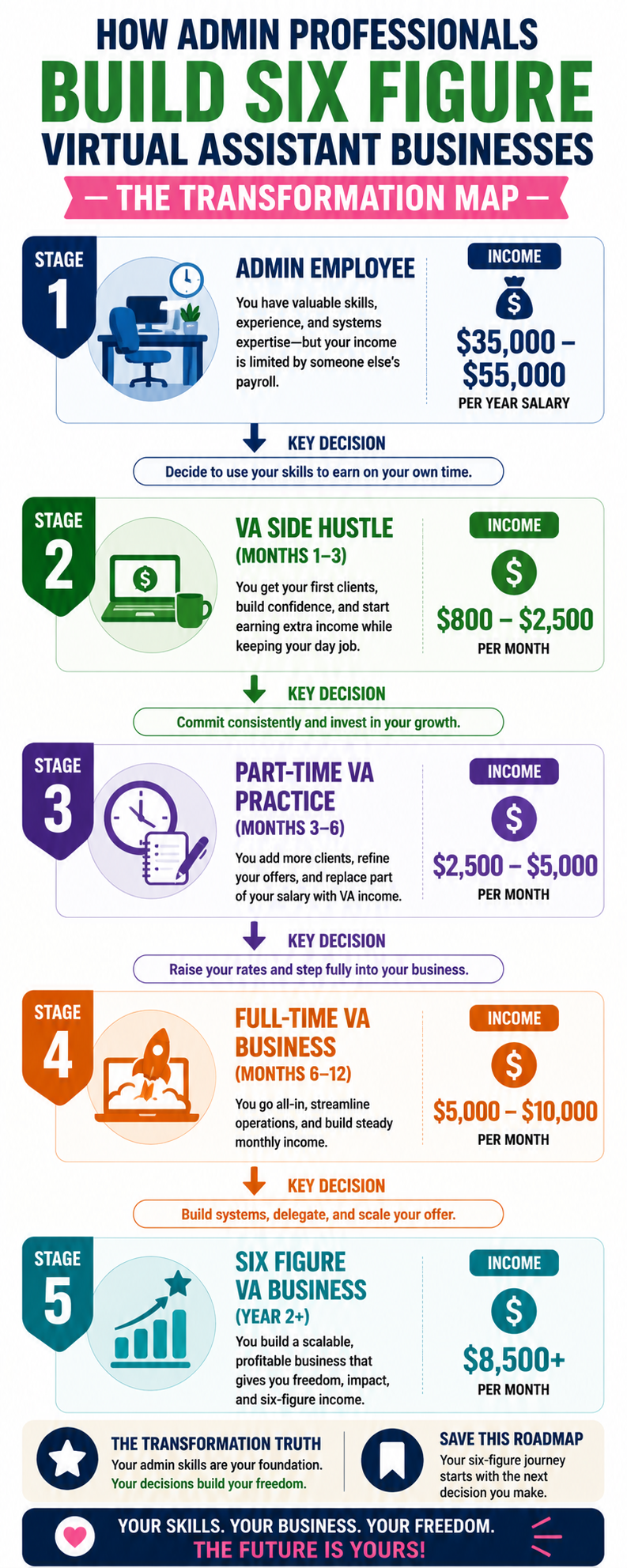
The admin professional who understands this transition and executes it deliberately does not just replace their salary — they surpass it, often within the first twelve months of serious effort.
The Positioning Shift That Makes Six Figures Possible
The gap between a VA earning $25 per hour and one earning $75 per hour with the same administrative background is almost never a skills gap. It is a positioning gap — and closing it is the most financially impactful work you can do before you approach your first client.
The positioning mistake most admin professionals make:
They describe themselves using employment language — job titles, employer names, years of experience — rather than outcome language that tells a potential client what they get when they hire them.
"Former executive assistant with twelve years of experience supporting C-suite executives" is employment language. It describes a history.
"I manage the complete operational environment of founders and executives — calendar, communications, stakeholder relationships, and administrative systems — so they can focus exclusively on the work that drives their business forward" is outcome language. It describes a result.
The first version positions you as a job applicant. The second positions you as a solution. The same background. Completely different market response.
The three positioning decisions that drive premium rates:
Decision one — choose your niche within administration
Executive support, operations coordination, project management, bookkeeping support, client relationship management — each of these is a distinct sub-niche within the broader administrative professional market. Each commands a different rate and attracts a different client type.
The niche that commands the highest rates for admin professionals is fractional executive assistant work — providing EA-level professional support to multiple clients fractionally. This is the niche where the corporate administrative background translates most directly into premium income.
For the complete niche breakdown and current rate ranges — the virtual assistant niches that pay the most in 2026 covers where administrative backgrounds fit across every major VA specialization.
Decision two — price at expertise market rates from day one
Administrative professionals entering the VA market consistently underprice relative to their actual expertise level. The reasons are the same ones that affect every professional entering freelancing — anxiety about client rejection, uncertainty about whether the market will accept the rate, and the tendency to compare to the lowest visible prices rather than the highest justified ones.
The correct benchmark for an experienced administrative professional entering the VA market is not the Upwork average for general VAs. It is the rate that experienced fractional EAs and operations VAs with similar backgrounds are currently billing — which for senior administrative professionals with ten or more years of relevant experience is $65 to $95 per hour.
For the rate setting framework that gets this right from the beginning — how to set your virtual assistant rate without underselling yourself covers the four inputs that determine where your specific background sits in the current market.
Decision three — build retainer relationships rather than hourly arrangements
The path from VA side hustle to six-figure VA business is almost exclusively built on retainer relationships — not hourly billing. Hourly billing creates an income ceiling set by available hours. Retainer relationships create an income floor that is predictable and stable regardless of how each individual week unfolds.
The admin professional who builds three retainer clients at $2,500 per month has $7,500 of predictable monthly income — $90,000 annually — before they consider adding a fourth client or raising rates. That income does not fluctuate based on client usage or personal availability. It exists because the relationship exists.
The Transition Timeline — What Each Phase Actually Looks Like
Phase one — VA side hustle alongside employment (months one through three):
The safest and most common entry point. You begin building your VA practice while still employed — using evenings and weekends to set up your professional presence, reach out to your network, and land your first one or two clients. Income in this phase is $800 to $2,500 per month from your first retainer relationships.
This phase does three things simultaneously — validates the model in your specific market, builds the client base that justifies leaving employment, and provides the financial cushion that makes the transition without desperation possible.
Phase two — transition to full-time VA (months three through six):
The trigger for transition is not a specific income level — it is a specific coverage level. When your VA income consistently covers 80 percent or more of your current salary for two consecutive months — the financial risk of transition has dropped to a level most people can manage comfortably.
Income in this phase typically reaches $2,500 to $5,000 per month as the first retainer clients stabilize and referrals begin producing additional client conversations.
Phase three — established VA practice (months six through twelve):
Two to four retainer clients generating consistent monthly income. Referral pipeline producing new client conversations without requiring the outreach volume of phase one. Rate increases justified by track record and being implemented confidently.
Income in this phase reaches $5,000 to $8,500 per month for most admin professionals who positioned correctly and held their rates through early client conversations.
Phase four — six figure VA business (year two and beyond):
Three to five premium retainer clients at rates that reflect eighteen to twenty-four months of demonstrated VA track record. Inbound referrals representing the majority of new client acquisition. Selective about new clients rather than accepting every engagement that comes in.
Income at this phase consistently exceeds $8,500 per month — the threshold for six-figure annual income — for administrative professionals who stayed consistent through phases one through three.
The Skills That Transfer Most Directly
Not every administrative skill carries equal market value in the VA market. These are the ones that translate most directly into premium client outcomes — and therefore into premium rates.
Executive calendar and schedule management — The ability to manage a complex, competing-priority calendar for a senior leader is the most consistently in-demand VA skill in the executive support market. An admin professional who has managed a C-suite calendar understands what most scheduling VAs do not — that calendar management is a strategic function, not a logistical one. The calendar reflects the executive's priorities. Managing it well requires understanding those priorities at a level that general VAs cannot replicate.
Stakeholder communication on behalf of a principal — Drafting communications, managing relationships, and representing a business owner or executive in their interactions with clients, partners, and vendors requires the kind of professional judgment and tonal awareness that corporate administrative experience specifically develops. This skill is genuinely scarce in the VA market and genuinely valued at premium rates by clients who need it.
Process documentation and system building — The admin professional who can observe how a business operates, document those processes clearly, and build simple systems that a team can follow is solving an expensive problem that most growing businesses do not even know they need solved until someone shows them what it looks like. This capability positions you as an operations VA rather than a task VA — which is a meaningfully higher rate category.
Board and meeting management — Agenda creation, pre-read document preparation, meeting facilitation support, action item tracking, and follow-up coordination. This is specialized work that most VAs cannot offer — and that executive clients pay premium rates to access reliably.
Building Your Client Base as an Admin Professional
The client acquisition approach for admin professionals entering the VA market follows the same principles that work across every professional service transition — but with one meaningful advantage that most admin professionals underestimate.
Your professional network is unusually well-positioned relative to your target client. You have spent years working alongside and supporting the exact type of person who is your ideal VA client — executives, business owners, senior leaders who are perpetually behind on administrative work and who trust the judgment of someone with your professional background implicitly.
A message to fifteen carefully selected people from your professional history — former executives you supported, colleagues who left to start their own businesses, clients from organizations you managed relationships with — consistently produces faster first VA clients than any platform application strategy.
For the complete outreach approach that admin professionals use to activate their professional network — the complete guide to becoming a virtual assistant in 2026 covers the full client acquisition sequence from first outreach through signed retainer agreement.
The Resources That Support This Transition
The Admin to VA System is built specifically for this transition — covering the positioning decisions, rate-setting framework, client acquisition approach, and retainer building strategy that move an administrative professional from employment to six-figure VA income. It is not a general VA course repurposed for admins. It is built around the specific context of an administrative professional who has real expertise to sell and needs a clear path to selling it at the rates it actually commands.
The Virtual Assistant Side Hustle covers the complete VA business infrastructure — from tool setup through client acquisition and income scaling — for professionals building their VA practice alongside existing employment in phase one of the transition.
For the income trajectory that admin professionals can realistically expect — how older workers are out-earning their previous salaries as freelancers covers the real numbers from experienced professionals who made this transition and what drove their income growth beyond salary replacement.
If You Found This Useful
- How to Become a Virtual Assistant in 2026 — The Complete Beginner Guide
- Virtual Assistant Niches That Pay the Most in 2026
- How to Set Your Virtual Assistant Rate Without Underselling Yourself
- How to Build a Virtual Assistant Business Without Burning Out
The article that makes this one more actionable is the virtual assistant tools every beginner needs in 2026 — because the professional infrastructure behind your VA practice is what makes the income trajectory in this article feel real rather than theoretical to the clients you are approaching. Having the right tools in place before your first client conversation is part of the positioning that commands premium rates.
Frequently Asked Questions
Can an admin assistant really build a six figure virtual assistant business?
Yes — and it happens with enough consistency to be a pattern rather than an exception. The mechanism is straightforward. Administrative professionals in employment are paid within salary bands that cap their income regardless of their expertise level. In a VA business structure those same professionals serve multiple clients at rates that reflect the full market value of their expertise. Three to five retainer clients at $2,000 to $3,000 per month each produces six-figure annual income from the same skills that employment paid $48,000 to $65,000 for.
How long does it take an admin professional to build a six figure VA business?
Most admin professionals who position correctly and maintain consistent client development reach salary replacement within six to nine months and six-figure income within twelve to eighteen months. The timeline accelerates significantly for professionals who start with strong network activation, expert-level positioning, and retainer pricing rather than hourly billing. The professionals who take longest are those who start at entry-level rates and try to grow from there — because the rate anchor is genuinely difficult to raise with existing clients.
What admin skills are most valuable in the VA market?
Executive calendar and schedule management, stakeholder communication on behalf of a principal, process documentation and system building, and board and meeting management are the highest-value administrative skills in the VA market. These are the capabilities that most require professional judgment developed through real corporate experience — and therefore the ones that are most scarce in the VA market and most consistently command premium rates.
How does an admin professional position themselves for premium VA rates?
The transition from employment language to outcome language is the most impactful positioning shift. Instead of describing your job title and years of experience — describe the operational problem you solve and the result you produce. An admin professional who positions as someone who manages the complete operational environment of executives so they can focus exclusively on growth-driving work is competing in a different market than one who positions as an experienced assistant available for administrative tasks. Same background. Dramatically different client response.
Should an admin professional leave their job before building a VA client base?
Almost always no. Building your VA practice alongside employment — using evenings and weekends to set up your professional presence and land your first one or two clients — is the safest and most common entry point. The transition to full-time VA work is most financially sound when your VA income consistently covers 80 percent or more of your current salary for two consecutive months. That trigger point removes the financial desperation that causes premature transitions and the poor client decisions that financial pressure produces.
What is the Admin to VA System and who is it for?
The Admin to VA System is built specifically for administrative professionals — executive assistants, office managers, operations coordinators, and administrative specialists — who want to transition their existing professional background into a premium VA business rather than competing at entry-level VA rates. It covers the specific positioning decisions, rate-setting frameworks, client acquisition strategies, and retainer building approaches that determine whether an administrative background commands $25 per hour or $85 per hour in the VA market.
How many clients does an admin VA need to reach six figures?
The number depends on your rate and package structure. At $2,500 per month per client — which is accessible to experienced admin professionals at 20 hours per month at $125 per hour — four clients produces $120,000 annually. At $2,000 per month per client — 20 hours at $100 per hour — five clients produces $120,000. At $1,500 per month per client — 20 hours at $75 per hour — seven clients produces $126,000. Most experienced admin VA practitioners reach six figures with three to five clients rather than large client volumes — which is what makes the income sustainable alongside the delivery quality that generates referrals.
Comments ()