
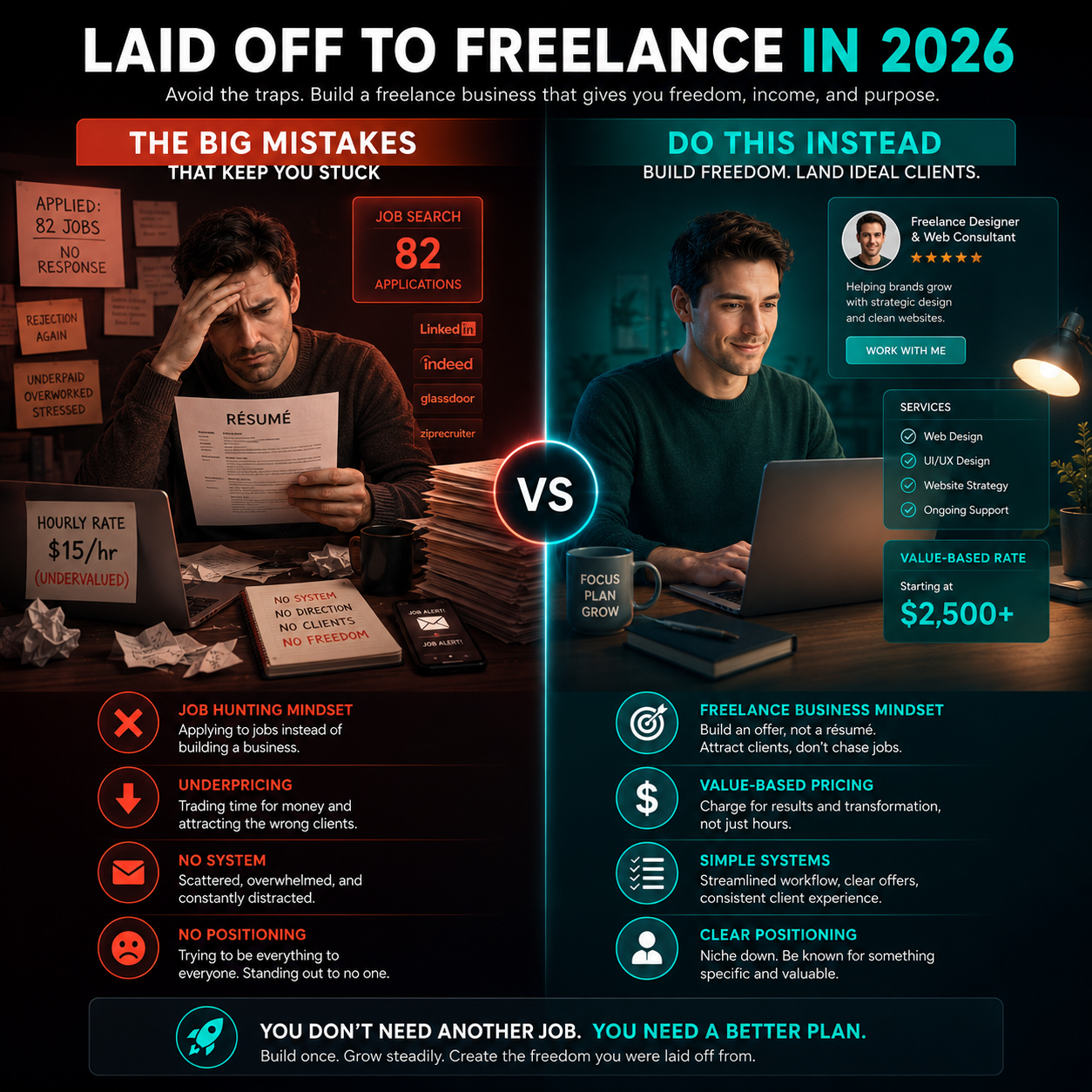
There is a version of starting to freelance after a layoff that works — and a version that produces three months of frustrating effort, inconsistent income, and the quiet conclusion that freelancing just was not for you.
The difference between those two versions is almost never skill. It is almost never market demand. It is almost never bad timing or bad luck.
It is a small number of specific, avoidable mistakes that derail most freelance attempts before they have a genuine chance to work — mistakes that look reasonable in the moment but quietly undermine the income trajectory that consistent, correctly structured effort would have produced.
The professionals who build real freelance income after a layoff are not more talented or more experienced than the ones who give up in month two. They just avoided these mistakes — either because someone told them what to watch for or because they had the persistence to work through the consequences and course-correct before it was too late.
This covers the six biggest mistakes that laid-off workers make when starting to freelance — what they look like, why they happen, and exactly what to do instead.
Why Laid-Off Workers Are Specifically Vulnerable to These Mistakes
The emotional context of a layoff creates specific decision-making conditions that make these mistakes more likely — and understanding that context is part of avoiding the mistakes themselves.
Financial pressure creates urgency that produces bad decisions. When savings are depleting and income needs to appear quickly, the temptation to price low to win clients faster, to say yes to scope that exceeds what was agreed, or to accept the first offer rather than the right one is genuine and understandable.
Confidence disruption creates self-doubt that produces underpricing. When an employer has just communicated — implicitly or explicitly — that you were no longer worth keeping, the internal voice that says your skills are not worth premium rates gets louder. The result is rate decisions that reflect how you feel about your value rather than what the market will actually pay for your expertise.
Isolation creates a lack of strategic feedback. In employment, colleagues and managers provide a constant stream of professional context. In early freelancing after a layoff, you are often making strategic decisions alone — without the feedback that would catch positioning errors, rate mistakes, or outreach problems before they compound.
Understanding these conditions does not make the mistakes inevitable. It makes them recognizable — which is the first step to avoiding them.
Mistake One — Leading With a Vague Offer
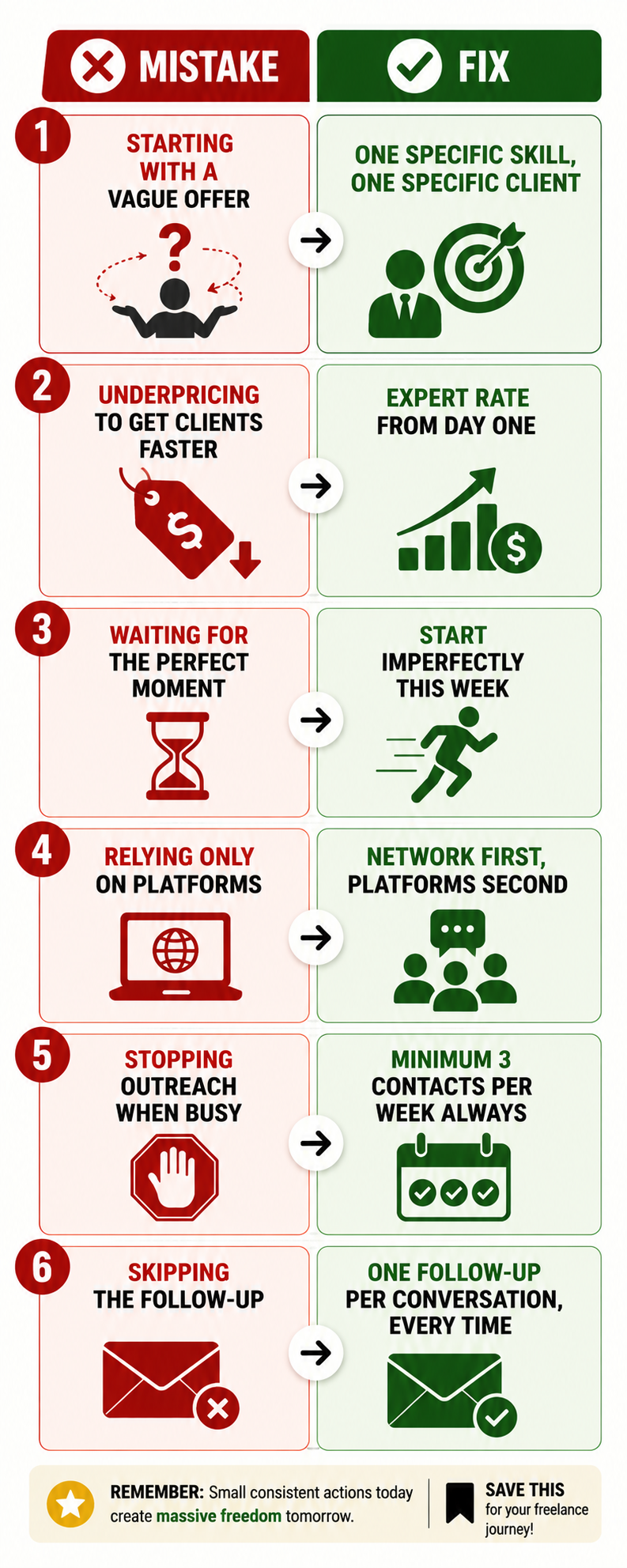
The most common first mistake — and the one with the most immediate impact on income — is entering the freelance market with an offer so broad that potential clients cannot evaluate whether it fits their specific need.
"Experienced professional available for consulting and project work" is not an offer. It is an availability announcement. It tells a potential client that you exist and that you are looking for work — neither of which is useful to someone trying to decide whether to pay you.
The vague offer produces three outcomes, all of them bad. It forces the potential client to do the positioning work that you should have done — figuring out how your background applies to their specific situation. It signals that you do not have a clear sense of your own value. And it makes you compete in the commodity market against every other generalist — regardless of how much more qualified you actually are.
What to do instead: Define a specific service offer before you approach a single client. One skill. One target client type. One problem solved. One deliverable or outcome produced. Write it as a single sentence that a potential client can immediately evaluate as relevant or irrelevant to their situation. The more specifically you define who you help and what you do for them — the more efficiently your outreach converts and the higher the rate your offer supports.
For the complete framework for building a specific offer from your professional background — how experienced professionals position themselves for premium freelance rates covers the expertise market positioning approach that separates high-converting offers from generic ones.
Mistake Two — Underpricing to Win Clients Faster
Financial pressure after a layoff makes underpricing feel logical. A lower rate means fewer objections. Fewer objections mean faster clients. Faster clients mean faster income. The logic is seductive — and it is wrong in a way that costs significant income over the following six months.
The clients who accept below-market rates are almost never the best clients. They are the ones who have been rejected by correctly-priced freelancers and are looking for someone who needs the work badly enough to accept less. They tend to be more demanding, less respectful of professional boundaries, and most resistant to rate increases when you eventually try to raise them.
More importantly — a below-market starting rate sets an anchor in your client relationships that is genuinely difficult to move. A client who started paying you $45 per hour experiences a rate increase to $95 per hour as a 111 percent increase — which feels dramatic regardless of how justified it is. A client who started paying you $95 per hour and receives a rate increase to $120 per hour experiences it as a 26 percent increase — which feels reasonable.
The financial damage of underpricing compounds over months in a way that the short-term income from a lower-priced first client never compensates for.
What to do instead: Set your rate based on expertise market research before your first client conversation — not based on how urgently you need income. Research current rates by searching your skill category on Upwork filtered by experienced freelancers. Research fractional executive rates for your domain. Set a rate that reflects your professional experience and hold it through early client conversations. The clients who accept your rate without prolonged negotiation are almost always better long-term clients than the ones who negotiated hardest.
Mistake Three — Waiting Until Everything Is Perfect Before Starting
Perfectionism is the most socially acceptable form of procrastination — and it is particularly common among corporate professionals who are accustomed to working within organizations where professional standards are high and mistakes have visible consequences.
The LinkedIn profile that is not quite right yet. The service offer that needs one more revision. The rate that has not been fully decided. The website that needs to be built before outreach begins. Each individual item feels like a legitimate prerequisite — and the accumulation of legitimate prerequisites produces weeks or months of delay before a single outreach message is sent.
Every week of delay in starting outreach is a week of lag added to the income timeline that cannot be recovered later. The lag between outreach and income is unavoidable — it starts the moment you start outreach. Delaying the start of outreach does not reduce the lag. It just pushes the entire income timeline further into the future.
What to do instead: Set a 48-hour setup deadline. In 48 hours — your offer is defined, your rate is set, your LinkedIn headline is updated, and your first outreach message is sent. None of those things need to be perfect. They need to be good enough to start generating feedback from real client conversations — which is the only feedback that actually improves your positioning.
For the 7-day framework that moves corporate professionals from setup to active outreach in a single structured week — how to get your first freelance client in 7 days covers the complete day-by-day approach.
Mistake Four — Relying Primarily on Platforms Instead of Your Professional Network
Platforms like Upwork and Contra are legitimate client acquisition channels — but they are the slowest and most competitive channels available to experienced professionals entering the freelance market. Leading with platforms rather than professional network activation consistently produces longer timelines to first income and lower starting rates.
The reason is structural. Platform listings attract dozens of applications from freelancers at every experience level. The filtering process favors established profiles with reviews — which new freelancers do not have. And the clients on most platforms are optimizing for value rather than expertise — which means the commodity market dynamics that undermine experienced professional rates are built into the platform's client base.
Your professional network, by contrast, already has the trust barrier eliminated. The people who know your work do not need to be convinced of your credibility — they need to know that you are available and for what.
What to do instead: Send targeted personalized outreach to your professional network before you create a single platform profile. Ten well-crafted messages to the right people in your network will produce more first client opportunities in two weeks than a platform profile produces in six. Build platform profiles as a supplementary channel — not your primary one.
Mistake Five — Stopping Outreach When You Land Your First Client
Landing your first client feels like the moment the business is working — and it often triggers a reduction in outreach activity that plants the seed of the feast-or-famine cycle.
The first client takes focus and energy to deliver well. The outreach that was happening during setup and launch gets deprioritized. And four to six weeks later — when the first client engagement concludes or when you have capacity for additional work — the pipeline that was building during month one has gone cold. You restart outreach from zero instead of building on momentum.
The professionals who build the most stable freelance incomes do not stop outreach when they land a client. They reduce it — to a sustainable minimum that keeps the pipeline warm rather than letting it go cold between engagements.
What to do instead: Define your minimum weekly outreach commitment before you land your first client — and hold it as a non-negotiable regardless of how busy client delivery makes you. Three outreach contacts per week is a sustainable minimum for most freelancers. It is enough to keep the pipeline warm and produce a steady flow of new client conversations without consuming the time and energy that client delivery requires.
That single habit protects your income from the feast-or-famine cycle that derails most freelance businesses before they reach their potential.
Mistake Six — Skipping the Follow-Up
Most client relationships that do not convert from a first conversation do not convert because the potential client decided against hiring a freelancer. They do not convert because the freelancer did not follow up — and the potential client moved on to solving the problem a different way.
The follow-up is where most client conversions actually happen. A potential client who had a good discovery call but has not yet responded to a proposal is not a lost lead. They are a busy person who needs one more contact to make the decision they were already leaning toward.
Laid-off workers are specifically prone to skipping follow-ups because following up feels like imposing — and the emotional context of a layoff makes anything that feels like asking for something more uncomfortable than it would otherwise be.
What to do instead: Build one follow-up into every open client conversation as a non-negotiable step — not optional, not conditional on how confident you feel about the lead. A brief, professional, low-pressure follow-up sent five to seven days after a proposal or discovery call produces conversions that silence would never generate. The language is simple: "Just following up on our conversation from last week — happy to answer any questions before you make a decision." Nothing more is needed.
What the First 90 Days Look Like When You Avoid These Mistakes
The professionals who avoid the six mistakes above consistently describe their first 90 days in terms that sound almost unremarkable — because the income comes in steadily rather than dramatically.
Week three produces a first client conversation. Week four produces a first signed agreement. Month two produces two to three active client relationships and first referrals. Month three produces income that meaningfully exceeds month one with less outreach effort required.
That trajectory is not glamorous. It is reliable — and reliability is what builds the freelance income foundation that salary replacement is built on.
For the complete income picture across the full first year — what freelance income actually looks like in the first 90 days covers the realistic numbers and the specific factors that drive income growth at each stage.
The Resources That Help You Avoid These Mistakes From Day One
The 7-Day Freelance Jumpstart is structured specifically to prevent mistakes one through four — by moving you from skill identification to specific offer to active client outreach in a single week, before the perfectionism, underpricing, and platform dependency patterns have time to establish themselves.
For the audio version that covers the complete mistake-avoidance framework — the Freelance Jumpstart Audio Edition walks through each of these decisions in a format you can absorb during any available window.
For the parallel experience in a different income category — what every new medical courier gets wrong in their first 90 days covers the same mistake patterns playing out in a completely different business context — which reinforces how universal these errors are across income-building paths.
And for building the freelance business sustainably beyond the first 90 days — how to build a virtual assistant business without burning out covers the operational boundaries and systems that keep a growing freelance practice from consuming the professional who built it.
Pick Up Where This Leaves Off
The natural follow-on to this article is the complete plan for building freelance income after a layoff — which takes the mistake-avoidance framework from this article and builds a complete 30-day action plan around it so you know not just what not to do but exactly what to do instead, week by week.
From the Same Series
- How to Get Your First Freelance Client in 7 Days Without a Portfolio
- What Freelance Income Actually Looks Like in Your First 90 Days
- How to Turn Your Corporate Experience Into a Freelance Business
- How to Build a Freelance Income That Replaces Your Salary in 6 Months
Frequently Asked Questions
What is the biggest mistake laid-off workers make when starting to freelance?
The single most financially damaging mistake is underpricing to win clients faster. The clients attracted by below-market rates are almost always the most demanding and least professional — and the below-market anchor they establish is genuinely difficult to raise later. A first client signed at 60 percent of the market rate for your skills costs significantly more in long-term income than the short-term income from landing them quickly ever compensates for.
Why do most freelance attempts fail in the first 90 days?
Most first 90 day freelance failures trace to one of three causes — vague positioning that prevents outreach from converting, underpricing that attracts the wrong clients and undermines income trajectory, or stopping outreach when the first client is signed which causes the pipeline to go cold and restarts the client acquisition process from zero every time a client engagement ends. All three are avoidable with the right structure from day one.
How do I avoid the feast-or-famine cycle as a new freelancer?
The feast-or-famine cycle is almost entirely caused by stopping outreach when client delivery is busy. The fix is defining a minimum weekly outreach commitment — typically three to five contacts per week — and holding it as a non-negotiable regardless of how busy existing client work makes you. Three outreach contacts per week sustained consistently is enough to keep the pipeline warm and produce a steady flow of new client conversations without consuming the focus that client delivery requires.
Should I build a website before starting to freelance after a layoff?
No — and the time spent building a website before you have clients is almost always time that would produce more income invested in direct outreach instead. A polished LinkedIn profile and a clear one-sentence service offer are sufficient for first client acquisition. Build a website with the income from your first two or three months of client work — by which point you will have a much clearer sense of what your business actually is and what the website should communicate.
How do I handle the emotional challenge of following up after a layoff?
The reframe that helps most is recognizing that follow-up is a professional service to the potential client — not an imposition on them. A potential client who had a good discovery call with you and has not yet made a decision genuinely benefits from a professional follow-up that gives them a low-friction way to move forward. The follow-up serves their interest as much as yours. That reframe makes the follow-up feel like professional courtesy rather than asking for something — which changes both how it feels to send and how it reads to the recipient.
Is it possible to freelance successfully without any prior freelance experience?
Yes — and the professionals who succeed most quickly at freelancing after a layoff are often those with no prior freelance experience but strong professional backgrounds and clear positioning. Clients in the expertise market are evaluating your professional track record and domain expertise — not your freelance history. The absence of freelance experience is only a disadvantage in the commodity market where reviews and platform ratings drive client decisions. In the expertise market where experienced professionals belong, professional background is the primary evaluation criterion.
What resources help most with avoiding these mistakes from the start?
The 7-Day Freelance Jumpstart is structured specifically to prevent the most common mistakes — by moving you through positioning, offer building, rate setting, and active outreach in a single structured week before the perfectionism and underpricing patterns have time to establish themselves. The Freelance Jumpstart Audio Edition covers the complete strategic framework for avoiding these mistakes across the full first year of freelancing — in audio format that works during any window of available time.

Comments ()