

There is a story that does not get told enough — not because it is rare but because it contradicts the dominant narrative about age and career value in 2026.
It is the story of the 52-year-old marketing director who was let go in a restructuring and now earns $18,000 per month consulting for three clients — more than double her previous salary. The 58-year-old operations manager who took a buyout and built a fractional consulting practice that generates $11,000 per month working 25 hours per week. The 47-year-old HR professional who was replaced by a younger, cheaper hire and now earns more per hour than she ever did inside the organization that let her go.
These are not exceptional cases. They are the predictable outcome of experienced professionals who stopped letting their age define their market value and started letting their expertise do it instead.
This is how they are doing it — and how you can start this week.
Why the Freelance Market Rewards Experience Differently Than Employment Does
The employment market and the freelance market price experience completely differently — and understanding that difference is the foundation of everything that follows.
In the employment market, experience has a ceiling. Salary bands cap what any role will pay regardless of the individual's specific expertise level. Seniority creates both financial rewards and financial risk — the senior employee costs more, which makes them a target when costs need to be cut. Age bias, documented extensively in hiring research, makes re-entering employment at the same level progressively more difficult after certain career stages.
The freelance market operates on entirely different logic. There are no salary bands. There is no HR department comparing your compensation to a benchmark. There is no organizational incentive to replace you with someone cheaper because you do not have a fixed overhead cost — you are paid for what you produce.
In the freelance market — specifically the expertise market where experienced professionals belong — your rate is a function of the value you deliver and the confidence with which you present it. A professional with twenty years of domain expertise who positions correctly and reaches the right clients earns significantly more per hour than the salary structure of any single organization would have allowed.
That is not aspiration. That is arithmetic. And it is what is driving the income trajectory that older workers across multiple fields are experiencing right now.
For the foundational positioning strategy that makes these income levels accessible — how experienced professionals start freelancing after 40 covers the expertise market approach that separates the high earners from those who compete at entry-level rates.
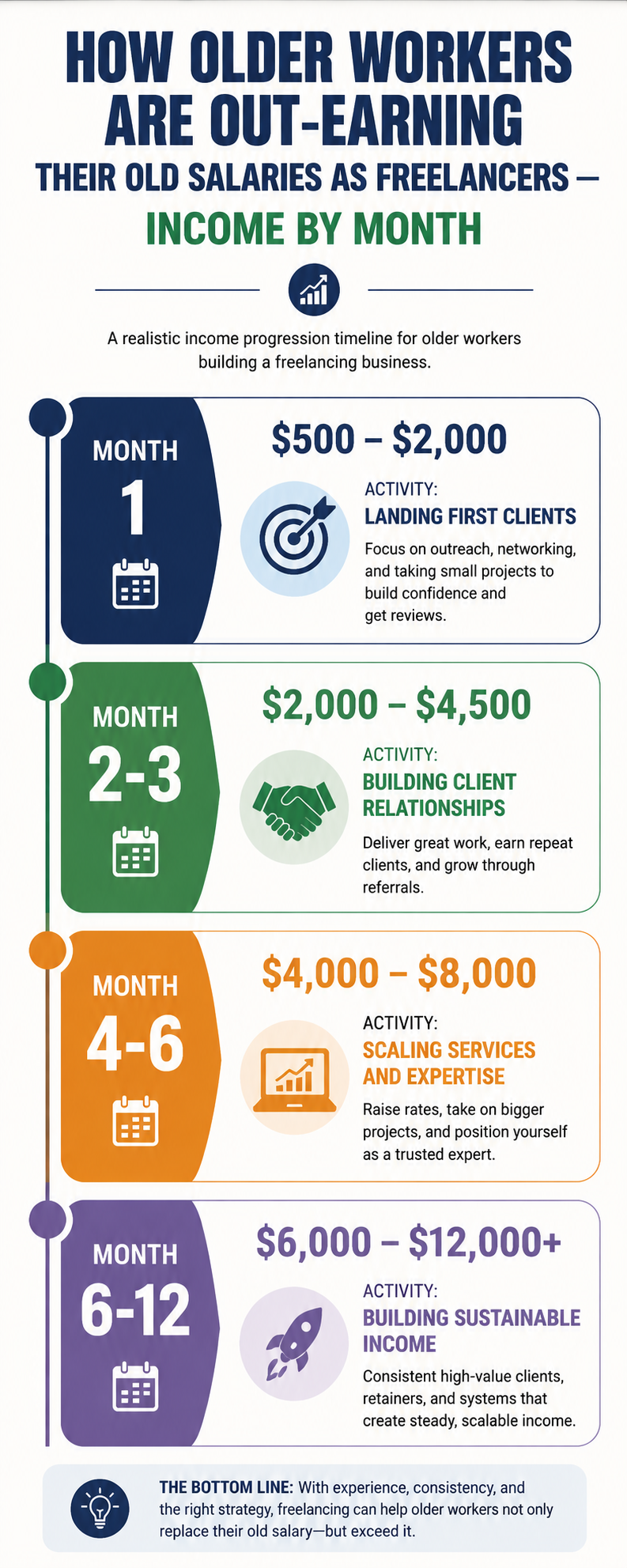
The Income Trajectory — What It Actually Looks Like Month by Month
The income trajectory for older workers entering freelancing is not linear — it follows a pattern that is consistent enough to be useful for planning even though the specific numbers vary by field and individual.
Month one — foundation and first clients: Most experienced professionals generate $500 to $2,000 in their first month. This is not salary replacement — it is proof of concept. The first client conversation, the first signed agreement, the first invoice. The income is modest because the outreach and conversion process is still being learned. The significance of this month is not the dollar amount — it is the validation that the market exists and is accessible.
Months two and three — building momentum: Income typically grows to $2,000 to $4,500 as the outreach process becomes more efficient, first clients refer others, and platform profiles begin generating inbound interest. This is the phase where most experienced freelancers start to see that the income ceiling they experienced in employment was an organizational constraint — not a market constraint.
Months four through six — compounding growth: For experienced professionals who stayed consistent and positioned correctly — income in this phase typically reaches $4,000 to $8,000 per month. The client acquisition process has become natural. Rates have often increased from the initial level as the track record justifies them. Referrals are now a meaningful source of new business rather than a hoped-for bonus.
Months six through twelve — established practice: This is where the income comparison to previous salaries becomes most striking. Experienced professionals who reached this phase consistently — working 25 to 35 hours per week — often generate $6,000 to $12,000 or more per month. At 30 hours per week at $150 per hour — a rate that senior marketing, operations, finance, and HR professionals regularly achieve in the expertise market — the monthly income is $18,000.
The person who was earning $85,000 per year in a senior corporate role — roughly $7,100 per month — is now generating $18,000 per month working fewer hours with more autonomy. That comparison is what drives the "why did I not do this sooner" reaction that so many experienced freelancers describe.
The Four Factors That Drive High Income for Older Freelancers
Not every experienced professional who enters freelancing reaches these income levels. The ones who do have four things in common.
Factor One — Expertise Market Positioning
The experienced professionals generating the highest freelance incomes are not competing on platforms as generalists. They are positioned as specialists with a specific problem to solve for a specific type of client — and they reach that client through targeted outreach and professional network activation rather than commodity platform listings.
The difference between "experienced marketing professional available for projects" and "I help Series A technology companies build content strategies that reduce their customer acquisition cost" is the difference between competing at $35 per hour and billing at $150 per hour. Same professional. Same background. Different positioning.
For the skill-by-skill breakdown of which professional backgrounds command the highest expertise market rates — which existing skills clients are actively paying for right now covers the full rate landscape across every major professional domain.
Factor Two — Professional Network as First Market
The experienced freelancers who reach salary replacement fastest almost universally activate their professional network before they approach any platform or send any cold outreach. The people who already know their work quality — former colleagues, former managers, former clients — are the warmest possible first market.
A message to fifteen carefully selected professional contacts — explaining what you now offer and for whom — consistently produces faster first clients than any platform strategy. The trust barrier is already lower. The credibility is already established. The conversation starts from a different place than any cold introduction can.
Factor Three — Rate Confidence From Day One
The older workers who build the highest freelance incomes almost never start at entry-level rates to build their platform rating. They start at expert-level rates and hold them — because they understand that the clients worth having are not selecting the cheapest option.
A senior operations professional who starts at $45 per hour because they are nervous about not getting clients will have a very different income trajectory than one who starts at $120 per hour based on market research and their professional background. Both may land similar numbers of clients — but the income gap after six months is enormous.
Factor Four — Consistent Business Development Alongside Client Delivery
The freelancers who build to the highest income levels maintain consistent outreach and business development activity even when they are busy with existing clients. They do not stop marketing when they are at capacity — they build a pipeline that gives them the ability to be selective about which new clients they take on.
This consistency is what produces the inbound referral flow that eventually makes outreach largely unnecessary — but it requires months of consistent effort before the referral engine runs independently.
The Fields Where Older Workers Are Earning the Most as Freelancers
Some professional backgrounds translate more directly into high freelance income than others. These are the fields where experienced professionals in 2026 are generating the highest rates.
Fractional executive roles — Fractional CMOs, COOs, CFOs, and CHROs serving growing businesses that need senior leadership without full-time executive overhead. Rates range from $150 to $400 per hour depending on industry and scope.
Operations and process consulting — Experienced operations professionals helping growing businesses build the systems and processes that scale efficiently. Rates of $100 to $175 per hour are common for professionals with a decade or more of relevant experience.
Marketing strategy and brand consulting — Senior marketing professionals providing strategic direction rather than execution. Rates of $85 to $175 per hour for professionals who can demonstrate measurable business impact from their previous work.
HR and organizational development consulting — People operations professionals helping growing businesses build hiring systems, performance frameworks, and organizational culture. Rates of $75 to $150 per hour for experienced practitioners.
Financial consulting and fractional CFO work — Financial professionals providing strategic financial guidance, cash flow management, and financial system building for businesses without full-time finance leadership. Rates of $100 to $200 per hour for senior financial professionals.
AI automation implementation — This is the fastest-growing high-rate category and the one most accessible to experienced professionals from any background. Professionals who layer AI tool knowledge on top of their domain expertise are commanding rates of $100 to $200 per hour for implementation work that combines their operational understanding with practical AI tool fluency. The article on why an AI agency pays more than traditional freelancing covers this opportunity in detail for professionals who want to understand the income ceiling available.
What the Highest-Earning Older Freelancers Did Differently in Year One
The pattern across experienced professionals who reach salary replacement within their first year of freelancing is consistent enough to be instructive.
They chose a specific niche rather than offering everything they had done. They reached out to their professional network before they built any platform presence. They held their rate when clients pushed back on it. They delivered exceptionally well for their first clients — generating referrals that reduced their dependence on outbound outreach. They raised their rate after their first three months rather than waiting for permission to do so.
And perhaps most importantly — they started before they felt ready. The income that compounded into salary replacement in month six started with an outreach message sent in week two of month one — before the positioning was perfect, before the website was built, before they felt confident enough to call themselves a freelancer.
For the complete long-term income strategy — how to build a freelance income that replaces your salary in 6 months covers the milestones and decisions that drive the income trajectory from first client to full replacement.
The Resources That Accelerate This Trajectory
The Freelance Jumpstart Audio Edition covers the complete strategy for experienced professionals building freelance income — positioning, rate setting, client acquisition, and income growth — in audio format built for people who need flexibility in when and how they learn.
For the structured day-by-day plan — the 7-Day Freelance Jumpstart gives you a concrete action plan from skill identification on day one to active client outreach by day four — built for experienced professionals who want momentum immediately rather than a theoretical framework.
For the specific approach that administrative and executive support professionals are using to build premium income — how admin professionals are building six figure virtual assistant businesses covers the positioning and client acquisition strategy for one of the most accessible high-income freelance paths for experienced professionals.
Worth Reading Next
The article that builds most directly on what we covered here is why freelancing is the best financial response to a layoff — which puts the income numbers from this article into the context of what they mean practically for someone navigating a job loss right now.
If You Found This Useful
- You Were Laid Off Now What — How to Build Freelance Income in 30 Days
- How to Start Freelancing After 40 Without Starting From Zero
- The Skills You Already Have That Clients Are Paying For Right Now
- How to Build a Freelance Income That Replaces Your Salary in 6 Months
Frequently Asked Questions
Can older workers really out-earn their corporate salaries through freelancing?
Yes — and it happens consistently enough to be a pattern rather than an exception. The mechanism is straightforward. Corporate salary structures cap what any role pays regardless of individual expertise. The freelance expertise market has no cap — your rate is a function of the value you deliver and the confidence with which you position it. Senior professionals who position correctly in the expertise market regularly bill at rates that produce monthly income significantly above their previous annual salary divided by twelve.
How long does it take an older worker to replace their salary through freelancing?
Most experienced professionals who position correctly and maintain consistent outreach replace 50 percent of their previous salary within three to four months and reach full replacement within five to eight months. The timeline depends on their field, their professional network size, their starting rate, and the consistency of their business development activity. Professionals who start with strong network activation and expert-level positioning reach salary replacement faster than those who start at entry-level rates or rely primarily on cold platform applications.
What fields produce the highest freelance income for workers over 50?
The highest-earning fields for experienced older freelancers in 2026 are fractional executive roles (CMO, COO, CFO, CHRO) at $150 to $400 per hour, AI automation implementation at $100 to $200 per hour, operations and process consulting at $100 to $175 per hour, marketing strategy at $85 to $175 per hour, financial consulting at $100 to $200 per hour, and HR and organizational development at $75 to $150 per hour. Professionals who combine domain expertise with AI tool fluency command rates at the upper end of these ranges.
Do older freelancers face the same age discrimination as older job seekers?
Freelancing involves significantly less age-based discrimination than traditional employment because the evaluation criteria are different. Clients in the expertise market are evaluating whether you can solve their specific problem — which they assess through the quality of your conversation, the specificity of your experience, and the results you describe. Your age is not visible on a freelance profile in the way it can be inferred from an employment timeline — and even when it is apparent, expertise market clients are specifically looking for the professional judgment and domain knowledge that comes with experience.
What is the most important thing an older worker can do to maximize their freelance income?
Start with expert-level positioning rather than entry-level rates. The single biggest income difference between experienced freelancers who reach salary replacement and those who plateau at modest income levels is their starting rate and positioning. Professionals who start at rates that reflect their experience and hold them through early client conversations build a completely different income trajectory than those who start low to "get clients" and struggle to raise rates later.
How do older workers find their first freelance clients without a portfolio?
Professional network activation is the highest-converting first client channel for experienced professionals — specifically because the trust barrier with people who already know your work is significantly lower than with cold prospects. A targeted message to fifteen carefully selected professional contacts explaining what you now offer consistently produces faster first clients than any platform application or cold outreach strategy. The full approach is covered in the complete plan for building freelance income after a layoff.
What resources are most helpful for older workers starting to freelance?
The Freelance Jumpstart Audio Edition covers the complete strategy for experienced professionals — positioning, rate setting, client acquisition, and income growth — in audio format that works during any window of available time. The 7-Day Freelance Jumpstart provides the structured day-by-day action plan for moving from skill identification to active client outreach within a single week. Both are built for experienced professionals rather than beginners starting from scratch — which makes them specifically relevant for workers over 40 or 50 making this transition.

Comments ()