

Most articles about freelance income show you the ceiling. The $10,000 months. The testimonials from people who replaced their salary in 30 days. The screenshots of invoices that make it look like clients appear the moment you decide to start.
None of that is what most people experience in their first 90 days — and the gap between those stories and the actual experience of building freelance income from scratch is the reason so many people give up at exactly the moment they are about to break through.
This article covers what freelance income in the first 90 days actually looks like — the honest numbers, the slow start that almost everyone experiences, the week where most people talk themselves out of continuing, and what drives the income growth that makes month three look so different from month one.
If you are in your first 90 days right now and wondering if this is working — read this before you decide it is not.
Why the First 90 Days Feel Harder Than They Should
The first 90 days of freelancing carry a specific psychological challenge that nobody warns you about before you start — the lag between the work you put in and the income that work produces.
In employment, the relationship between showing up and getting paid is direct and immediate. You work the week, you get paid at the end of it. The feedback loop is short and reliable.
In freelancing, the relationship between effort and income has a delay built into it. The outreach messages you send this week may not convert to a client conversation until next week. That conversation may not convert to a signed agreement until the week after. That agreement may not produce an invoice until the week after that. And that invoice may not produce payment for another 15 to 30 days depending on your payment terms.
The work that generates your month two income was done in week one of month one. Most people quit in week three — right when the work from week one is starting to convert.
Understanding this lag is not just psychologically useful — it is strategically important. It means that the consistency of your effort in the first 30 days determines your income in days 45 through 90. Slowing down in week two because week one produced no income is the most common reason first 90 days underperform.
The Honest Month-by-Month Breakdown
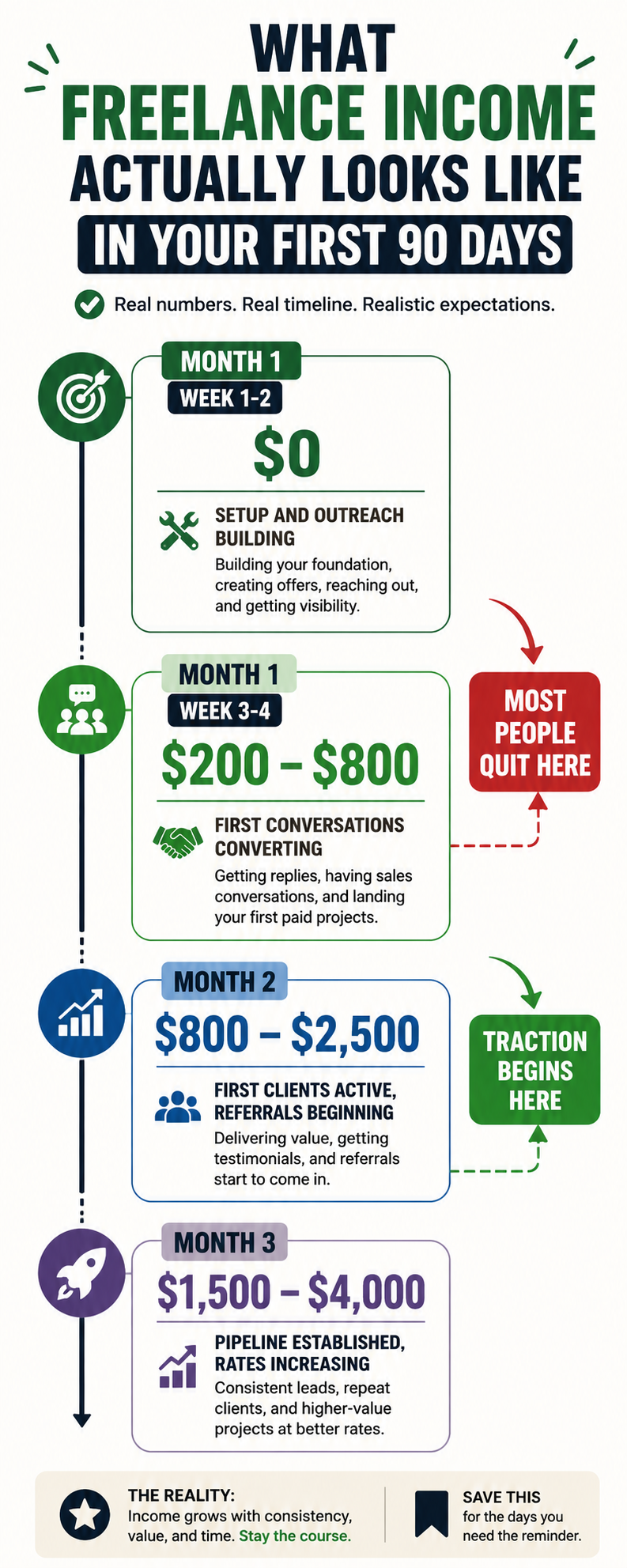
Month One — Foundation, Not Income
The most important reframe for month one is this — the goal is not income. The goal is a functional pipeline with at least one active client conversation and ideally one signed first client by the end of the month.
Week one: Zero income. Full focus on positioning, offer building, and getting your professional presence live. Your LinkedIn headline updated. Your rate decided. Your outreach list built. Your first ten messages sent by Friday.
Week two: Zero to minimal income. Outreach responses beginning to come in. First discovery call scheduled. Platform profiles receiving initial views. The work feels productive but unrewarded — and this is where the psychological challenge begins for most people.
Week three: This is the week that determines everything. Most people either build momentum here or begin to slow down. First discovery calls are happening. One or two conversations are in active follow-up. A first client may be close to signing. For the people who push through the discomfort of this week consistently — month two looks dramatically different than month one.
Week four: First income appears for most people who started consistently in week one. A signed first client generating initial invoice. Dispatch platform income if you applied there early. The number is modest — $200 to $800 for most people — but it is proof. The model works in your market. The outreach converts. Now you build on it.
Month one realistic income range: $200 – $1,200 for most experienced professionals following a structured approach.
Month Two — Momentum Builds
Month two is where freelancing starts to feel like a real business rather than an experiment.
The first client is delivering work and generating an invoice. The outreach that has been running since week two of month one is now producing a second and third conversation. Platform profiles have accumulated enough activity to generate occasional inbound interest. And the most important thing — you now have a track record to reference in new client conversations that you did not have 30 days ago.
"I have been working with a client for the past four weeks on [specific problem] and produced [specific result]" is a sentence you can say in month two that you could not say in month one. That sentence changes how client conversations go — because it converts abstract credibility into demonstrated capability.
What drives income growth in month two:
- First client referrals to their network — the single fastest income accelerator available in this phase
- Platform profiles generating inbound inquiries from accumulated activity
- Outreach converting at a higher rate because your pitch has been refined by real conversations
- Rate confidence increasing as you see that clients accept your rate without prolonged negotiation
Month two realistic income range: $800 – $2,500 for most experienced professionals who stayed consistent in month one.
For the strategies that accelerate income growth specifically in this phase — how older workers are building income that exceeds their previous salaries covers the four factors that separate high earners from those who plateau.
Month Three — The Traction Phase
Month three is where the compounding effect of consistent effort becomes visible in a way that month one and two did not fully show.
The professional who stayed consistent through the discomfort of weeks two and three — who kept sending outreach when no one was responding, who followed up on discovery calls that went quiet, who held their rate when a client pushed back — is now operating with a pipeline that runs partially on its own.
Referrals from month one and two clients are generating inbound conversations. The platform profile that was sparse in week one now has reviews and a rating that attract clients without active application. The positioning that felt uncertain in month one has been sharpened by real client conversations into something that converts more reliably.
What month three looks like in practice:
- Two to three active clients generating recurring income
- First inbound inquiry that came without any active outreach
- Rate increase discussion with at least one client as track record justifies it
- Outreach continuing but representing a smaller percentage of total new client acquisition as referrals grow
Month three realistic income range: $1,500 – $4,000 for experienced professionals who maintained consistency through months one and two.
The Moment Most People Quit — And Why It Is the Worst Possible Time to Do So
Week three of month one is where most people talk themselves out of continuing freelancing. The outreach has been running for two weeks. Some responses have come in but no signed clients yet. The income column is empty or close to it. And the story that starts forming in their head sounds like: "This is not working."
The data says the opposite. Two weeks of consistent outreach producing discovery call conversations is not evidence that freelancing does not work — it is evidence that the pipeline is functioning exactly as it should. The conversations scheduled for week three are the direct result of the work done in week one. Stopping in week three means stopping precisely when that work is about to convert.
The professionals who build real freelance income are not the ones who experienced faster results than everyone else. They are the ones who understood that the lag is normal — and kept going anyway.
What Actually Drives Income Growth in the First 90 Days
Understanding the mechanics of income growth in this period helps you direct your effort where it produces the most return.
Outreach volume in weeks one and two — This is the single most important driver of month two income. The outreach you do in week one converts to conversations in week two and clients in week three and four. Reducing outreach in week one because it feels premature is the most common reason month two income underperforms.
Discovery call quality over quantity — One well-prepared discovery call where you listen deeply, ask the right questions, and connect your specific experience to their specific problem produces more income than five calls where you pitch generically. For the discovery call framework that converts — how to land your first freelance client in 7 days covers the five questions that make every discovery call productive.
Referral activation at the 30-day mark — Asking your first client for a referral at exactly 30 days of active work — not before, not indefinitely after — is one of the highest-leverage actions available in the first 90 days. A single referral from a satisfied first client can generate more income in month two than all of your cold outreach combined.
Rate holding under pressure — The income trajectory of freelancers who hold their rate through early client pushback is consistently higher at the 90-day mark than those who discount to close faster. Discounting signals uncertainty. Holding signals expertise. The clients who accept your rate without prolonged negotiation are almost always better long-term clients than the ones who negotiated hardest.
What the 90-Day Mark Should Look Like
A professional who started consistently and stayed consistent through the first 90 days should have at the end of month three:
- Two to three active client relationships generating recurring income
- A platform profile with at least one or two reviews
- A referral from at least one satisfied client
- A rate that has held or increased from the starting point
- A pipeline that includes both active outreach prospects and inbound interest
- Monthly income that is meaningfully higher than month one
That is not salary replacement for most people at 90 days. But it is a real, growing business with a clear trajectory — and it is the foundation that salary replacement is built on in months four through six.
For the strategy that takes you from 90-day traction to full income replacement — the complete plan for building freelance income after a layoff covers the full arc from week one through month six.
The Mistakes That Extend the Timeline Unnecessarily
Most of the factors that make the first 90 days take longer than they need to are avoidable — and they almost always fall into one of three categories.
Starting outreach too late. Every week of delay in starting outreach is a week of lag added to the income timeline. The lag between outreach and income is unavoidable — but it starts the moment you start outreach, not the moment you feel ready to start outreach.
Inconsistent outreach volume. Five outreach messages in week one, two in week two, none in week three because a discovery call went well — this pattern consistently underperforms five messages per week sustained across all twelve weeks. Consistency beats intensity every time in freelance client acquisition.
Accepting a first client at a below-market rate. A first client signed at 60 percent of your target rate sets an anchor that is hard to raise. The time spent serving an underpriced client is time not spent pursuing correctly priced ones.
The article that covers each of these mistakes in full detail — the mistakes that slow most freelancers down in their first 90 days — is worth reading before you reach week three rather than after.
The Resources That Shorten This Timeline
The 7-Day Freelance Jumpstart compresses the positioning, offer building, and outreach launch process into a single structured week — so the lag period starts as early as possible and your month two income reflects work done in week one rather than week four.
For the audio version that covers the complete 90-day picture — the Freelance Jumpstart Audio Edition walks through every phase of the income growth process in a format that works during the windows most available to people who are simultaneously job searching and building freelance income.
For the tools that help virtual assistants and service-based freelancers manage more clients once the pipeline starts converting — the tools every virtual assistant needs to manage more clients covers the operational infrastructure that makes scaling beyond the first 90 days efficient rather than chaotic.
And for the professionals who want to understand what the fastest-growing freelance income category looks like beyond traditional service freelancing — how to get your first AI agency client in 30 days covers the income trajectory available to professionals who add AI automation implementation to their service offering.
From the Same Series
- You Were Laid Off Now What — How to Build Freelance Income in 30 Days
- How to Start Freelancing After 40 Without Starting From Zero
- How Older Workers Are Out-Earning Their Old Salaries as Freelancers
- The Biggest Freelance Mistakes Laid-Off Workers Make and How to Avoid Them
The article that pairs most directly with this one is how experienced professionals position themselves for premium freelance rates — because the income trajectory in this article assumes expertise market positioning from day one. If your positioning is not there yet, that article is worth reading before you send your next outreach message.
Frequently Asked Questions
How much can you realistically make freelancing in your first 90 days?
Most experienced professionals following a structured approach generate $200 to $1,200 in month one, $800 to $2,500 in month two, and $1,500 to $4,000 in month three. The specific numbers depend on your field, your starting rate, and the consistency of your outreach. Month one income is almost always the lowest — not because the market is not there but because the lag between outreach and payment means that work done in week one converts to income in weeks three through six.
Why is freelance income so low in the first month?
The lag between outreach effort and income receipt is built into the freelance client acquisition process — and it is unavoidable regardless of how much effort you put in. Outreach in week one converts to conversations in week two, to signed agreements in week three, to invoices in week four, and to payment 15 to 30 days after that. Understanding this lag prevents the premature conclusion that low month one income means freelancing is not working — it almost always means the pipeline is functioning normally.
When does freelance income start to feel consistent?
Most experienced professionals describe month three as the point where income starts to feel consistent rather than unpredictable. By month three the pipeline typically includes two to three active clients, at least one referral source, and some inbound interest from platform profiles or professional network activity. The income is not yet salary replacement for most people at 90 days — but it has a clear upward trajectory and a foundation that makes the next phase of growth feel inevitable rather than uncertain.
What is the most important thing to do in the first 30 days of freelancing?
Start outreach as early as possible — ideally in week one alongside your positioning and profile setup — because the lag between outreach and income means that the work you do in week one is what generates income in weeks three through six. Every week of delay in starting outreach is a week of lag added to your income timeline that cannot be recovered by intensifying effort later.
How do I know if my freelancing approach is working in the first 90 days?
The leading indicators of a working approach are discovery call conversations — not income. If your outreach is generating responses and converting to conversations, the approach is working even if no income has appeared yet. If your outreach is generating no responses after two weeks of consistent effort, the message itself needs review before the volume is increased. Income follows conversations — and conversations follow outreach. Track all three separately to understand which part of the process needs attention.
What causes most freelancers to give up in their first 90 days?
Week three of month one is the most common abandonment point — because the outreach has been running for two weeks without visible income results and the story that "this is not working" becomes compelling enough to believe. The data almost always says the opposite — two weeks of consistent outreach producing discovery call conversations is evidence that the pipeline is functioning, not evidence that it is failing. The professionals who push through week three consistently are the ones whose month two income reflects the work done in week one.
Is the 7-Day Freelance Jumpstart useful for someone already in their first 90 days?
Yes — the 7-Day Freelance Jumpstart is useful at any point in the first 90 days where outreach feels inconsistent, income is lower than expected, or the pipeline feels stalled. The structured daily framework helps reset a scattered approach into a consistent one — and consistency is the variable that determines income growth more than any other factor in the first 90 days.

Comments ()