
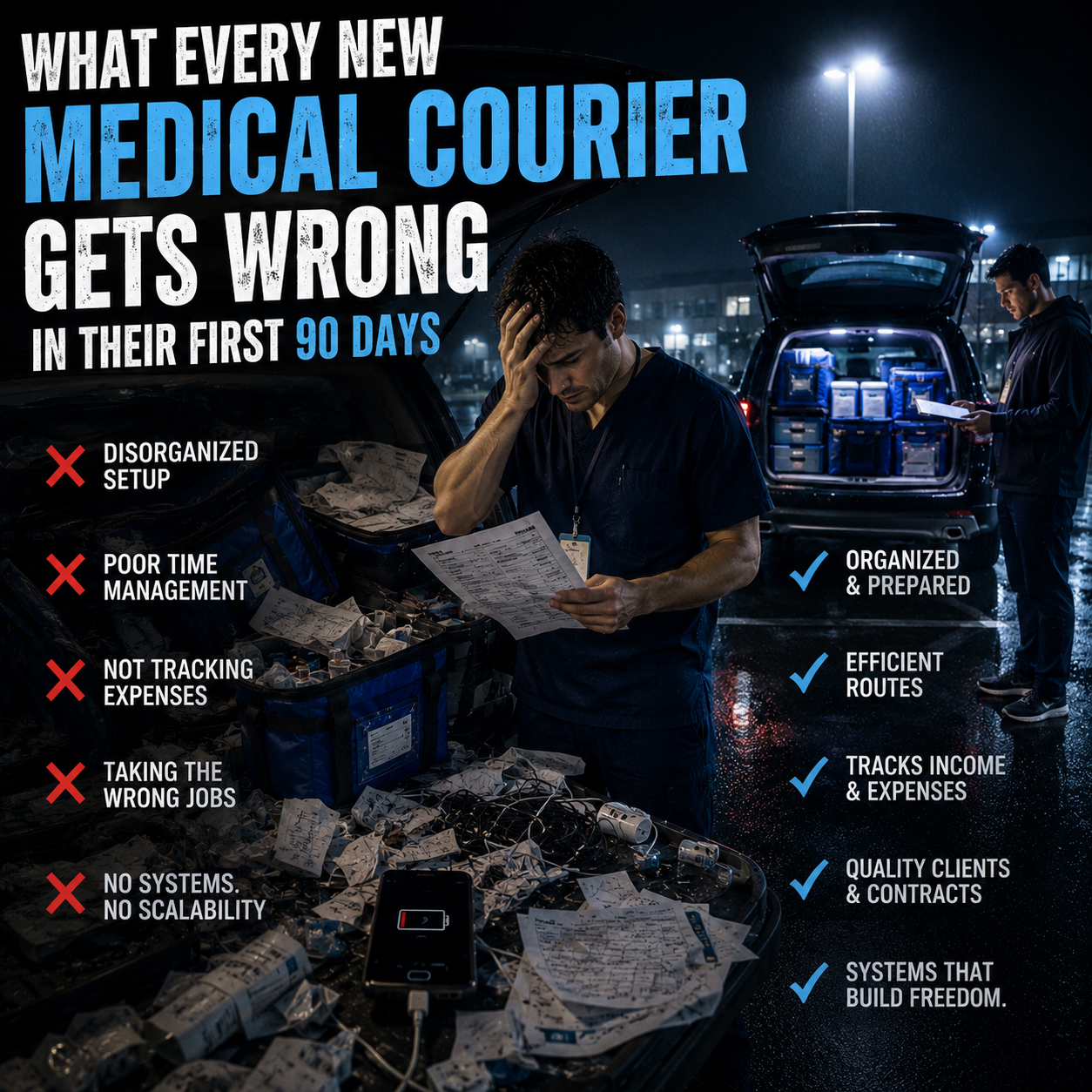
The first 90 days of a medical courier business are when most of the expensive lessons happen. Not expensive in the catastrophic sense — but expensive in the quieter way where avoidable mistakes cost you time, clients, and income that you did not have to lose.
Most new medical couriers make the same errors. Not because they are careless or uninformed — but because nobody told them specifically what to watch for before they started. The mistakes that slow new couriers down in their first 90 days are almost always fixable once you know what they are. The goal of this article is to make sure you know before they happen to you rather than after.
These are the ten most common errors new medical couriers make — what they look like, why they happen, and exactly what to do instead.
Why the First 90 Days Define Your Long-Term Success
The client relationships, professional habits, and operational systems you establish in your first 90 days become the foundation everything else is built on. A courier who sets clear contract terms, communicates professionally, and delivers reliably in the first three months builds a reputation that generates referrals for years. A courier who underprices, overcommits, and handles documentation inconsistently spends the next year trying to recover from a weak start.
The good news is that the mistakes below are all preventable — and reading this article before you start puts you significantly ahead of the couriers who discovered each one the hard way.
For the story of what the first 90 days look like when things go right — how one person lost their job and built a medical courier business from scratch covers the real timeline from day one to consistent income.
Mistake 1 — Starting Outreach Before the Compliance Package Is Ready
The most common first-90-day mistake is beginning client outreach before your compliance documentation is complete and ready to send.
Here is why this matters more than most new couriers realize: healthcare facility decision-makers move fast when they find a courier who fits their needs. If a lab director responds to your outreach on Tuesday and asks for your documentation — and you tell them it will be ready in a few days — you have lost the momentum of that conversation. By the time your documentation is ready, they have moved on or found someone else.
The professional standard is having your compliance package — insurance certificate, LLC registration, HIPAA certificate, background check results, driver's license copy — ready to email within 60 seconds of being asked. That means completing all setup before you make your first outreach call.
What to do instead: Follow the setup sequence in the article on what it actually costs to start a medical courier business — complete compliance first, outreach second. Never in the other order.
Mistake 2 — Underpricing to Win the First Contract
New couriers underprice out of fear — the fear that a higher rate will lose them the contract before they have proven themselves. The result is a client relationship that starts at a rate that is difficult to raise later and that signals to the client that you either do not know your value or you are desperate enough to accept anything.
Healthcare facilities that have worked with professional couriers know what professional courier rates look like. A rate that is significantly below market does not make you more attractive — it makes you look less professional.
What to do instead: Research current rates in your market by contacting two or three dispatch platforms for their contractor pay rates. Use direct contract rates of $28 to $40 per hour as your starting benchmark for standard specimen and pharmaceutical runs. Start at a rate that reflects your professional compliance investment — not one designed to beat everyone else on price.
Mistake 3 — Accepting Runs Without a Signed Contract First
Verbal agreements feel fine at the beginning of a professional relationship. They become problems the moment a dispute arises about what was agreed to.
New couriers accept their first run on verbal agreement because the excitement of a first client overrides the instinct to slow down and formalize the arrangement. Three weeks later — when the client asks for runs outside the agreed schedule at the same rate, or when an invoice goes unpaid with no clear payment terms to reference — the verbal agreement provides no protection.
What to do instead: Send your service agreement before the first run. Every time. Without exception. The article on how to write a medical courier contract that protects you covers every clause you need in plain language — and the Medical Courier Launch Kit includes a ready-to-use contract template you can customize and send immediately.
Mistake 4 — Saying Yes to Everything in the First Month
The excitement of early traction makes new couriers say yes to every request — additional runs, new locations, out-of-scope tasks, after-hours calls outside their stated availability. It feels like excellent client service. It is actually the fastest path to burnout and resentment before the business has found its footing.
Overcommitment in the first 90 days creates a client expectation of unlimited availability that is impossible to sustain — and walking back that expectation is harder than setting appropriate boundaries from the beginning.
What to do instead: Define your availability windows before your first run and hold them consistently from day one. When requests come in outside your defined scope — acknowledge them professionally and offer the additional services rate defined in your contract: "That falls outside our current arrangement — I am happy to cover that at my additional services rate of $X per hour. Would you like me to add it to this week's invoice?"
Mistake 5 — Inconsistent Chain of Custody Documentation
Chain of custody documentation feels bureaucratic until the day a client disputes a delivery or a specimen is reported missing. At that point — your documentation is either your complete professional protection or your complete vulnerability.
New couriers complete documentation inconsistently — thoroughly when they remember, skipped when they are running behind schedule. Every undocumented run is a liability with no paper trail.
What to do instead: Complete your run log at every pickup and delivery point — not at the end of the day from memory. Five minutes of documentation per run is a non-negotiable professional standard. The run log template included in the Medical Courier Launch Kit makes this process fast and consistent from your first run forward.
For the full professional protocol — how to run your first medical courier route like a professional covers documentation standards alongside every other first-run professional practice.
Mistake 6 — Relying Entirely on Dispatch Platforms for Income
Dispatch platforms are a legitimate starting point — they provide immediate income while your direct contract pipeline develops. The mistake is treating them as a permanent income strategy rather than a bridge.
Dispatch platform income is capped by the platform's rate structure and route assignment volume. Direct contract income is negotiated by you, grows with your client relationships, and compounds as your professional reputation develops. A courier who is still 100 percent dispatch-platform-dependent at month six has spent six months building someone else's client relationships rather than their own.
What to do instead: Begin direct outreach to healthcare facilities in week two of your launch — while dispatch platform work is generating early income — and maintain consistent outreach until you have two to three direct contracts running. The goal is to have dispatch platform income represent less than 30 percent of your total revenue by month six. For the outreach strategy that builds your direct contract base — how to market your medical courier business without spending money covers every zero-cost channel in detail.
Mistake 7 — Neglecting Route Optimization
New couriers drive their routes in whatever order feels logical rather than the order that is most time and fuel efficient. The result is routes that take 30 to 45 minutes longer than they need to — which either reduces your effective hourly rate on fixed-price contracts or eats into personal time on hourly arrangements.
At five runs per week with 35 minutes of unnecessary driving per run — inefficient routing costs you nearly three hours of avoidable wasted time every week. At a $35 per hour contract rate that is more than $100 per week in lost income.
What to do instead: Pre-plan every route using a multi-stop optimizer — Google Maps route optimization for simple routes, Circuit Route Planner for more complex multi-stop sequences. For the complete tool breakdown — how route optimization and AI tools help medical couriers earn more per hour covers every option with realistic time and income impact estimates.
Mistake 8 — Skipping the Post-Run Confirmation Message
Most couriers complete their deliveries and move on to the next run or the rest of their day without sending a delivery confirmation to their client. This small omission is consistently cited by healthcare facility contacts as one of the differences between couriers they trust and couriers they replace.
A delivery confirmation message takes 60 seconds to send and communicates three things simultaneously — that you completed the run, that you are organized enough to document it, and that you value the client relationship enough to close the loop professionally.
What to do instead: Build a one-sentence confirmation message into your post-run routine: "Good morning [Name] — all specimens from this morning's route have been delivered to [location]. Delivery completed at [time]. Please reach out if you need anything else today." Sixty seconds. Every run. Without exception.
Mistake 9 — Waiting Too Long to Ask for Referrals
Satisfied healthcare clients know other healthcare facility contacts who need reliable courier support. New couriers wait — for the relationship to feel established enough, for the right moment, for an organic opportunity to mention it. That moment rarely arrives on its own because clients do not volunteer referrals without being asked.
The right moment to ask for a referral is at the 30-day mark of a contract that is running smoothly. Not before. Not indefinitely after. At 30 days — when the client has experienced your reliability firsthand and can speak to it credibly.
What to do instead: At the 30-day mark of every direct contract — send a brief message: "I have really enjoyed working with [Facility Name] this first month. If you know of any other facilities in the area that might benefit from reliable courier support, I would genuinely appreciate an introduction. Thank you for the trust you have placed in my service." Simple, professional, direct.
Mistake 10 — Not Planning for the Business Beyond the First Contract
The most consequential first-90-day mistake is treating the first contract as the destination rather than the foundation. Couriers who stop outreach when they land their first contract wake up at month four with one client, one income stream, and no pipeline — and have to restart the outreach process from zero.
Consistent outreach — even reduced outreach — needs to continue throughout your first 90 days regardless of whether your current contracts feel like enough. The second and third contracts come from the seeds planted while the first contract is running well.
What to do instead: Maintain a minimum of two to three outreach contacts per week throughout your first 90 days — even during weeks when your existing routes are running smoothly. The goal is a pipeline that always has conversations in progress so your income grows toward rather than stalling at your first contract level. For the scaling roadmap that takes you from first contract to full business — how to turn your medical courier side hustle into a full business covers the complete growth trajectory.
The Resource That Prevents These Mistakes From Day One
The Medical Courier Launch Kit is built specifically to prevent every mistake covered in this article — with a compliance checklist that ensures your documentation is ready before outreach begins, contract templates that protect you from verbal agreements and scope creep, run log documentation that makes chain of custody consistent from your first pickup, and outreach scripts that position your rate professionally from the first client conversation.
For the complete business foundation — the Medical Courier Business System covers the systems and strategies that prevent these mistakes from compounding as your operation grows beyond your first contracts.
You Might Also Like
- How to Run Your First Medical Courier Route Like a Professional
- How to Write a Medical Courier Contract That Protects You
- How to Market Your Medical Courier Business Without Spending Money
- How to Make Your First 1000 Dollars as a Medical Courier in 30 Days
Ready to take the next step? Read how to turn your medical courier side hustle into a full business — so once your first 90 days are behind you, you have a clear roadmap for what comes next.
Frequently Asked Questions
What is the biggest mistake new medical couriers make in their first 90 days?
According to experienced medical courier operators, the most costly first-90-day mistake is starting client outreach before the compliance package is complete and ready to send. Healthcare facility decision-makers move quickly when they find a courier who fits their needs — a courier who cannot provide documentation immediately loses the momentum of that conversation. Completing all compliance setup before the first outreach call prevents this entirely.
How do new medical couriers avoid underpricing their services?
Research current market rates before your first client conversation by contacting two or three dispatch platforms for their contractor pay rates. Use $28 to $40 per hour as your starting benchmark for direct healthcare facility contracts covering standard specimen and pharmaceutical runs. Set your rate before your first outreach call and hold it confidently — a rate that reflects your professional compliance investment signals credibility rather than desperation.
Should new medical couriers use a written contract from the start?
Yes — without exception and before the first run. A signed service agreement that defines scope of services, rate, payment terms, HIPAA compliance obligations, and termination terms protects both parties from the misunderstandings that almost always arise when arrangements are only verbal. Healthcare facilities expect professional contractors to have service agreements — presenting one signals professionalism rather than creating an obstacle.
How do new medical couriers handle scope creep from clients?
Address scope creep immediately and professionally by referencing the scope of services clause in your service agreement. When a client requests runs or services outside your defined scope — acknowledge the request and offer your additional services rate: "That falls outside our current arrangement — I am happy to cover that at my additional services rate of $X per hour." Treating out-of-scope requests as automatic complimentary additions trains clients to expect unlimited availability at the base rate.
How long should new medical couriers continue outreach after landing their first contract?
Outreach should continue throughout the first 90 days at a minimum — even if reduced to two or three contacts per week once the first contract is running smoothly. The second and third contracts come from seeds planted while the first contract is running. Stopping outreach after the first contract means restarting from zero when that contract ends or when capacity allows for additional business.
What documentation mistakes do new medical couriers make most often?
The most common documentation mistake is completing chain of custody forms inconsistently — thoroughly when time allows and skipped when running behind schedule. Every undocumented run is a liability with no paper trail. Completing the run log at every pickup and delivery point — not at the end of the day from memory — is the professional standard that protects against client disputes and compliance questions.
How do new medical couriers build referrals from their first clients?
Ask directly at the 30-day mark of a contract that is running smoothly. Satisfied healthcare clients know other facility contacts who need reliable courier support — but they rarely volunteer referrals without being asked. A brief professional message at 30 days — acknowledging the relationship and specifically asking for introductions to other facilities — converts satisfied first clients into active referral sources far more effectively than waiting for the organic opportunity to arise.
Comments ()