

She had fifteen years of executive administrative experience and had just quoted a potential client $22 per hour. The client said yes immediately — without a single question. She hung up the phone and felt two things simultaneously: relief that she had landed her first VA client and a quiet, creeping suspicion that she had just sold fifteen years of expertise for significantly less than it was worth.
She was right. And the anchor she set that day took her eight months to raise — because the client who said yes at $22 per hour said no firmly when she tried to move to $55.
Setting your virtual assistant rate is one of the most financially consequential decisions you make in your VA business — not because it is difficult to get right but because the consequences of getting it wrong compound quietly over months before most people realize what happened.
This covers exactly how to set your rate correctly from the start — so you never have to untangle the financial damage of underpricing after the fact.
Why VA Rate Setting Feels So Hard — And Why That Feeling Is Misleading
The discomfort most people feel when setting their VA rate comes from a specific internal conflict — the professional part of them knows their experience is worth significantly more than entry-level rates, and the anxious part of them is terrified that asking for what they are worth will cost them clients they have not yet landed.
That anxiety is understandable. It is also the primary driver of the single most expensive mistake new VAs make — and it is worth naming directly before we get into the numbers.
The anxiety says: Start low. Get clients first. Raise rates later.
The market says: The clients you attract at low rates are the hardest to raise rates with later. The clients who accept premium rates from the beginning are the ones who value the outcome rather than the hourly cost.
Those are not the same client pool. And once you have spent three months building relationships with the first group — you have to either accept below-market income indefinitely or go through the genuinely difficult process of raising rates with clients who chose you specifically because you were the most affordable option.
The anxiety that makes you underprice is not protecting you. It is setting a trap you will spend months trying to escape.
For the complete picture of how experienced professionals position themselves for premium rates — how experienced professionals position themselves for premium freelance rates covers the expertise market approach that applies directly to VA rate setting.
The Two Markets — And Why Your Rate Determines Which One You Compete In
Before the numbers — understanding this distinction changes how you think about pricing permanently.
The commodity VA market operates on volume and price comparison. Clients browse listings, compare rates, and select based on who offers the most for the least. Your rate in this market is a competitive variable — and the competitive pressure is almost always downward.
The expertise VA market operates on capability and fit. Clients are looking for someone who understands their specific operational context and can handle their specific needs without extensive supervision. Your rate in this market is a credibility signal — a low rate does not attract these clients, it repels them.
The rate you set determines which market you compete in — before a single client conversation happens.
A $20 per hour rate puts you in the commodity market regardless of your professional background. A $65 per hour rate puts you in the expertise market — where the clients who are looking specifically for experienced, judgment-capable VAs will find you and the clients optimizing for the cheapest option will scroll past.
Both markets have clients. The expertise market has better ones.
The Rate Framework — What to Actually Charge
Your rate is not a number you pick arbitrarily or copy from what you saw someone else charging. It is the output of four specific inputs — each of which has a meaningful effect on where your rate should sit.
Input One — Your Professional Background
The most important rate input. Not your freelance experience — your professional experience.
A VA with twelve years of corporate executive assistant experience is not the same as a VA who completed an online course last month — and the rate should reflect that difference immediately.
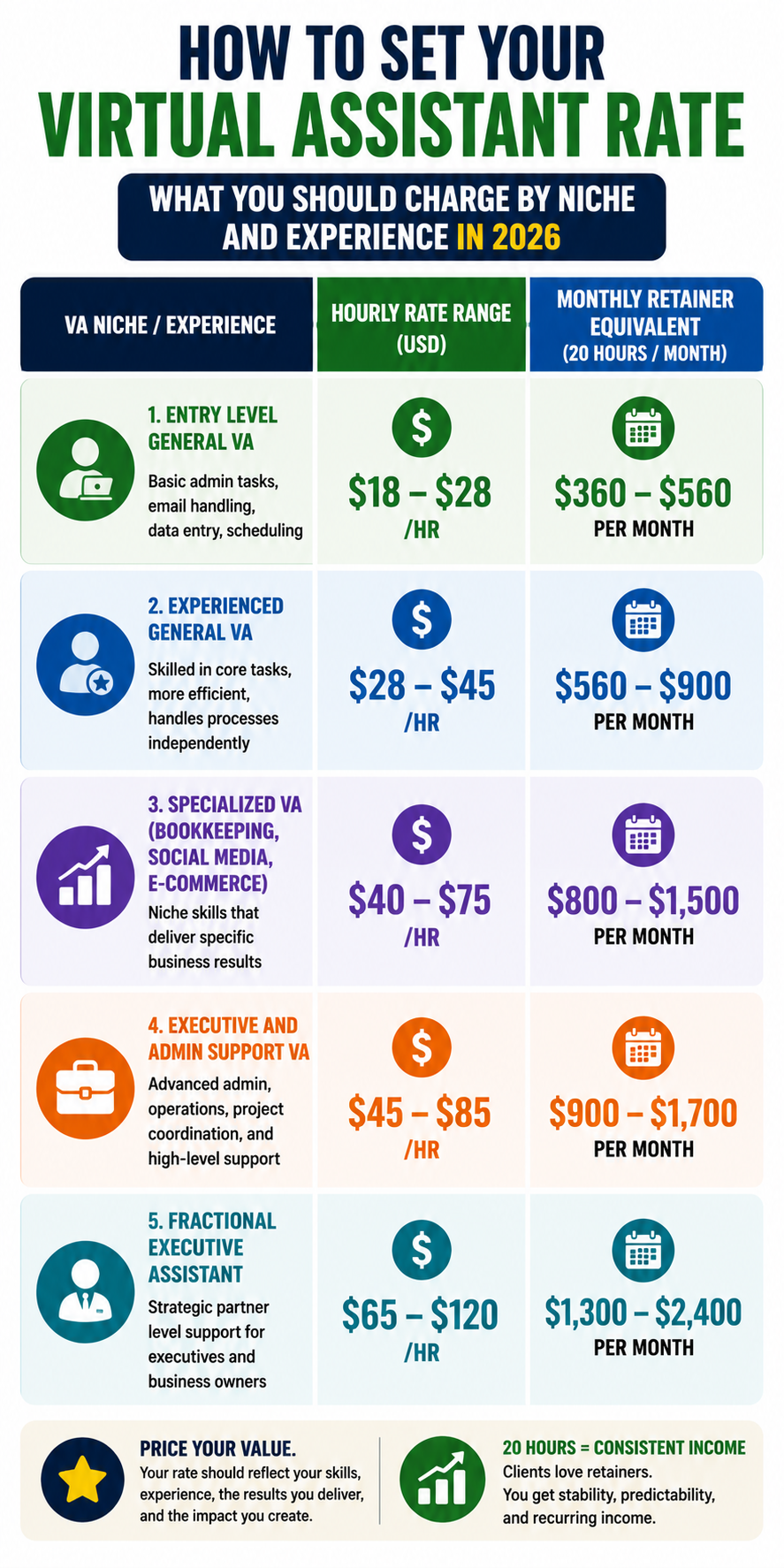
Here is how professional background maps to rate ranges in 2026:
No relevant professional background — general task support: $18 – $28 per hour
One to five years of relevant professional experience: $28 – $42 per hour
Five to ten years of relevant professional experience: $42 – $65 per hour
Ten or more years of relevant professional experience: $60 – $120 per hour depending on specialization
The professionals who land in the lowest range despite significant experience are almost always the ones who described their background in employment terms rather than outcome terms — which is a positioning problem, not an experience problem.
Input Two — Your Niche Specialization
General VA rates sit at the lower end of the market. Specialized VA rates sit significantly higher — because the client pool for specialized work is smaller and the expertise required to serve it is harder to find.
The rate premium by niche:
General administrative support: Base rate Social media and content management: Base rate + 20 to 40 percent E-commerce operations: Base rate + 15 to 30 percent Bookkeeping and financial admin: Base rate + 30 to 60 percent Executive support: Base rate + 40 to 80 percent Fractional executive assistant: Base rate + 80 to 150 percent
A professional with ten years of bookkeeping experience who positions as a general VA earns $35 per hour. The same professional positioned as a specialized bookkeeping VA earns $55 to $75 per hour. Same background. Different positioning. Different rate ceiling.
For the complete niche breakdown with honest rate ranges at every experience level — the virtual assistant niches that pay the most in 2026 covers where your specific background fits in the current market.
Input Three — Your Client Type
The same VA service commands different rates from different client types — not because the work is different but because the value delivered to each client type is different.
Solopreneurs and early-stage businesses: $25 – $45 per hour Established small businesses with revenue: $40 – $70 per hour Executives and high-net-worth individuals: $60 – $120 per hour Corporate fractional arrangements: $75 – $150 per hour
The client type your positioning attracts is largely determined by how you describe your services and where you look for clients. A VA who positions for solopreneurs and a VA who positions for corporate executives are not the same business — even if their underlying skills are identical.
Input Four — Your Market Research
Before you finalize your rate — spend 30 minutes on market research that anchors your number in actual current data rather than estimates or assumptions.
Search Upwork for your specific niche. Filter by experienced freelancers with strong ratings. Note the rate range at the top of that market — not the average. The average includes people who are underpricing for reviews and people in lower-cost markets. You want the rate that experienced, well-rated VAs in your niche are commanding — because that is where your background positions you.
Search LinkedIn for fractional or part-time roles in your niche. Many companies post these with salary ranges. Convert those ranges to hourly rates and compare to your Upwork research.
That 30-minute research session gives you a defensible market rate that is based on real current data — not anxiety-driven guesswork.
The Rate You Set in Week One Sets an Anchor
The rate you set in week one of your VA business is not permanent — but it sets an anchor that is harder to move than most new VAs expect before they experience it firsthand.
Here is how anchor pricing works in practice. A client who hired you at $28 per hour experiences a rate increase to $55 per hour as a 96 percent increase — which feels dramatic and often triggers objections or client departure. A client who hired you at $55 per hour and receives a rate increase to $70 per hour experiences it as a 27 percent increase — which feels reasonable and is accepted in most professional client relationships without significant friction.
The math of starting correctly is not complicated. The emotional courage it requires is what most people underestimate.
How to Present Your Rate With Confidence
The way you communicate your rate matters almost as much as the rate itself — because hesitation in how you say the number signals uncertainty about whether it is justified.
The presentation that works:
State your rate directly and specifically — then stop talking.
"My rate for executive support is $75 per hour. For a monthly retainer covering 20 hours of support, that comes to $1,500 per month."
Then silence. Do not follow your rate with qualifications, apologies, or explanations of why you charge what you charge. A rate that needs defending before anyone has objected is a rate the speaker does not fully believe in.
If the client pushes back — your response is equally direct:
"My rate reflects fifteen years of executive administrative experience at the senior level. For the type of support you have described, I am confident it produces significantly more value than it costs. Would you like to discuss what a 30-day trial arrangement might look like?"
That response acknowledges the pushback, restates the value without being defensive, and moves the conversation forward without lowering the number.
The Retainer Model — Why It Changes Everything
Hourly billing creates an income ceiling. Retainer packages remove it.
A VA billing $55 per hour for however many hours clients request earns unpredictably — busy weeks produce good income, slow weeks produce anxiety. A VA with three retainer clients at $1,100 per month each earns $3,300 per month regardless of how each individual week unfolds.
A simple retainer structure that works:
Starter package — $550 per month 10 hours of support per month One core service — inbox management or calendar management Async communication, responses within 24 hours Monthly summary of completed work
Core package — $1,100 per month 20 hours of support per month Two core services Weekly priority check-in End-of-month review and planning
Premium package — $2,000 per month 35 hours of support per month Full scope executive support Twice-weekly check-ins Same-day response on priority items
Presenting clients with a package rather than an hourly rate changes the nature of the conversation. Instead of negotiating a number — they are evaluating a scope. That shift consistently produces higher acceptance rates and better client relationships than open-ended hourly arrangements.
For the complete picture of how administrative professionals are converting professional backgrounds into six-figure VA income — how admin professionals build six figure virtual assistant businesses covers the positioning and packaging decisions that drive income to the upper end of the market.
The Six-Month Rate Review — Non-Negotiable
Your rate should be reviewed every six months — not when you feel comfortable enough to raise it, not when a client mentions they would pay more, but on a defined schedule that you commit to before you land your first client.
The review process is simple:
Step one: Research current market rates in your niche — the same 30-minute research process you did when you set your initial rate.
Step two: Compare your current rate to where the market sits for your experience level after six months of additional track record.
Step three: Communicate a rate increase to existing clients with 30 days notice and a professional explanation.
"I review my rates every six months as my experience and client results grow. Effective [date], my rate will move to $X per hour — a $Y increase from our current arrangement. I wanted to give you 30 days notice and the opportunity to discuss how this affects our arrangement."
Most long-term clients who value your work accept reasonable rate increases without departing. The ones who push back hardest are often the clients who were most price-sensitive from the beginning — which is useful information about whether the relationship is worth maintaining.
The Resources That Support Your Rate Setting
The Admin to VA System covers the complete rate setting framework for administrative professionals — including how to position your background for the upper end of your niche rate range, how to present your rate confidently, and how to build the retainer packages that create predictable monthly income rather than variable hourly earnings.
The Virtual Assistant Side Hustle covers the full VA business setup including pricing strategy, client acquisition, and income building — built for professionals launching their VA practice and wanting a complete framework rather than scattered advice.
For the income trajectory that correct rate setting makes possible — how older workers are out-earning their previous salaries through freelancing covers what the numbers look like six and twelve months into a correctly priced VA practice.
From the Same Series
- How to Become a Virtual Assistant in 2026 — The Complete Beginner Guide
- Virtual Assistant Niches That Pay the Most in 2026
- How to Find Your First Virtual Assistant Client Without Experience
- How to Build a Virtual Assistant Business Without Burning Out
The article that builds most directly on this one is what virtual assistants actually do and what they charge — which shows you how the rates covered here apply to different client types and service scopes so you can calibrate your specific package pricing before your first client conversation.
Frequently Asked Questions
How much should I charge as a virtual assistant in 2026?
Your VA rate depends on four factors — your professional background, your niche specialization, your target client type, and current market rates in your specific area. Entry-level general VAs earn $18 to $28 per hour. Experienced specialized VAs earn $45 to $85 per hour. Fractional executive assistant professionals earn $65 to $120 per hour. The single most impactful decision is choosing a specialized niche rather than positioning as a general VA — because specialization moves your rate ceiling significantly regardless of your starting experience level.
Should I charge hourly or use retainer packages as a virtual assistant?
Retainer packages are the more sustainable income model for most VAs — because they create predictable monthly income rather than variable hourly earnings that reset each week. Most experienced VAs transition from hourly billing to retainer packages within their first two to three client relationships. A retainer package at $1,100 per month for 20 hours of specialized support produces more stable income than the same 20 hours billed hourly at $55 when clients vary their usage week to week.
Is it a mistake to lower my VA rate to land my first client faster?
Yes — and it is the most financially damaging mistake new VAs make. Clients attracted by below-market rates are almost always the most demanding and least professional. The rate anchor established in your first client relationship is genuinely difficult to raise later. A first client signed at 60 percent of your market rate costs significantly more in long-term income than the short-term benefit of landing them quickly ever compensates for.
How do I raise my virtual assistant rate without losing clients?
Give 30 days written notice. Frame it as a scheduled rate review rather than a sudden change. State the new rate and effective date clearly and professionally. Most long-term clients who value your work accept reasonable rate increases — typically 15 to 25 percent — without departing. The clients who push back most aggressively on reasonable rate increases are often the ones who were most price-sensitive from the beginning and are worth losing to free capacity for better-fit clients.
What is the difference between setting a rate based on experience versus the market rate?
Experience-based rate setting uses your years in a field as the primary input. Market-based rate setting uses what clients are currently paying for similar outcomes from other VAs. The most accurate rate sits at the intersection of both — your experience level applied to current market data for your specific niche. A 30-minute research session on Upwork and LinkedIn gives you the current market data that anchors your experience-based estimate in real numbers rather than assumptions.
How do I present my VA rate confidently in a client conversation?
State your rate directly and specifically — then stop talking. Do not follow your rate with qualifications, apologies, or unsolicited explanations of why you charge what you charge. A rate that needs defending before anyone has objected signals uncertainty about whether it is justified. If the client pushes back — acknowledge the pushback, restate the value without being defensive, and move the conversation toward a trial arrangement rather than a rate reduction.
When should I review and raise my virtual assistant rate?
Every six months on a defined schedule — not when you feel comfortable enough or when circumstances force it. A scheduled six-month review keeps your rate aligned with your growing track record and current market rates rather than staying anchored to where the market was when you started. Communicate rate increases with 30 days notice and a professional explanation rather than announcing them without context.

Comments ()