

If you are considering becoming a virtual assistant — or hiring one — the question of what the work actually involves and what it should cost is the most practical place to start. The term gets used broadly enough that it can mean anything from answering emails to managing a full executive schedule to running an entire e-commerce backend — and the rate structures for each of those are very different.
Understanding what virtual assistants do in practice — not in theory — helps you figure out where your own background fits, what you should charge, and which type of clients you should be reaching out to first. This covers all of it in plain language.
What Virtual Assistants Actually Do for Their Clients
A virtual assistant provides remote professional support that frees the client from operational and administrative work so they can focus on the revenue-generating and strategic parts of their business.
The specific tasks depend entirely on the client's needs and the VA's specialization — but most VA work falls into one of five functional categories.
Administrative and Executive Support
This is the most traditional VA function and the one most closely associated with the role in most people's minds. Executive and administrative VAs handle the operational infrastructure of a business owner's or executive's professional life.
What this work involves on a typical day:
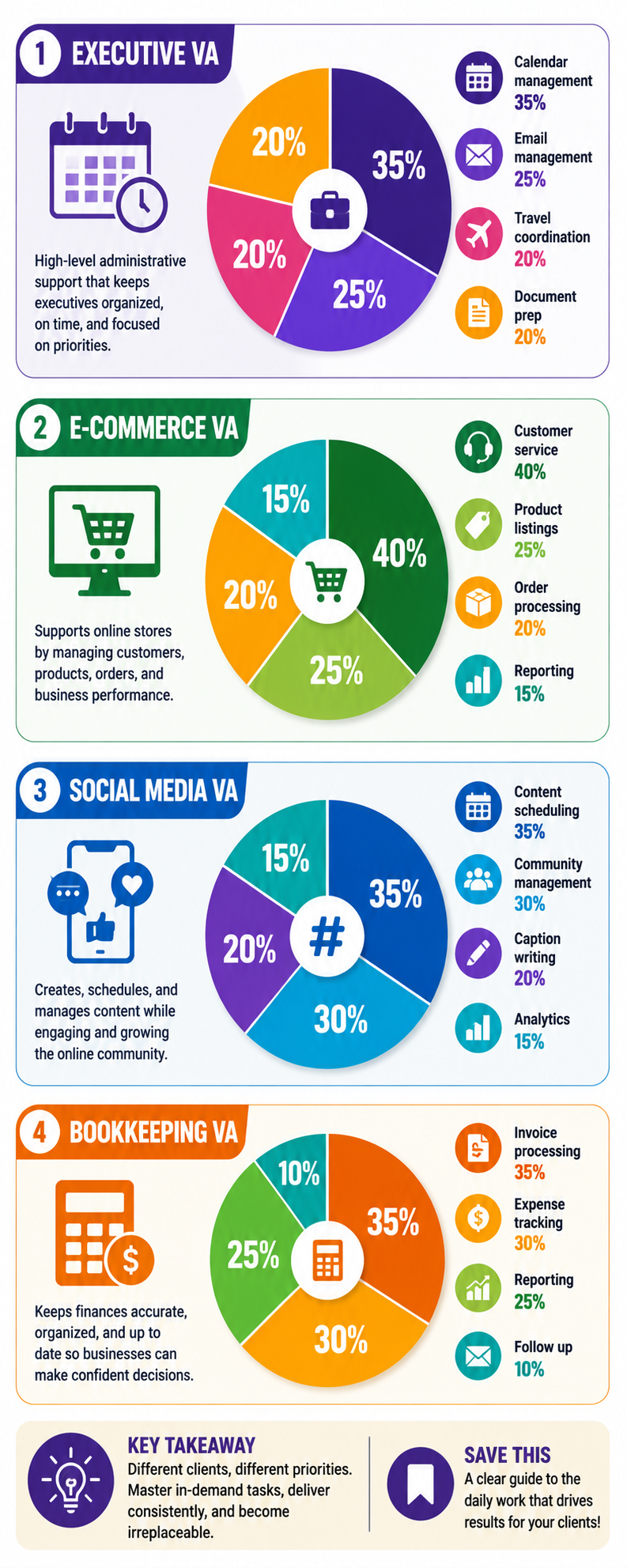
Managing a complex calendar — scheduling meetings, coordinating across time zones, protecting focus time, preventing back-to-back scheduling that leaves no breathing room, and handling rescheduling when conflicts arise. A skilled executive VA does not just put meetings on a calendar. They manage the calendar as a strategic resource that reflects the client's priorities rather than whoever asked for time most recently.
Managing email — triaging an inbox that receives hundreds of messages per day, flagging what requires the client's direct attention, drafting responses on the client's behalf, and ensuring that nothing important goes unacknowledged. A VA who manages email effectively saves an executive two to three hours per day — which is the clearest and most immediate ROI of any VA function.
Travel coordination — flights, hotels, ground transportation, restaurant reservations, and the backup plans that professional travelers need when something changes. An experienced executive VA who has coordinated travel for senior leaders understands that the details matter at a level most clients cannot articulate until something goes wrong.
Document preparation — presentations, reports, briefing materials, meeting agendas, and correspondence. An executive VA who understands the client's communication style produces documents that require minimal revision — which multiplies the value of every hour spent on preparation.
What it pays: $45 to $85 per hour for experienced executive VAs. Retainer packages of $1,500 to $4,000 per month for ongoing executive support arrangements.
Social Media and Content Management
Social media VAs handle the consistent content presence that business owners know they need but rarely have time to maintain.
What this work involves:
Content scheduling — taking content created by the client or by a content creator and scheduling it across platforms at optimal times using tools like Buffer, Hootsuite, or Later. A social media VA who understands platform-specific formatting, hashtag strategy, and posting frequency saves clients from the daily manual posting requirement that most solo operators eventually abandon.
Community management — responding to comments, engaging with followers, flagging mentions that require the client's direct response, and maintaining the interactive presence that algorithms reward with expanded reach.
Caption writing and content repurposing — taking long-form content and extracting platform-appropriate versions, writing captions that match the client's voice, and creating post variations from a single content piece.
Performance reporting — pulling analytics from each platform and presenting the data in a format the client can act on rather than a raw export they do not have time to interpret.
What it pays: $35 to $65 per hour. Monthly retainers of $800 to $2,500 depending on the number of platforms and the volume of content managed.
E-Commerce Operations
E-commerce VAs support online store owners with the operational tasks that keep the business functioning — the work that accumulates invisibly until it falls behind and becomes a crisis.
What this work involves:
Product listing management — creating, updating, and optimizing product listings on Shopify, Amazon, Etsy, or similar platforms. Writing descriptions, uploading images, setting prices, managing variants, and ensuring listings are accurate and discoverable.
Customer service — handling inquiries, processing returns, managing reviews, and resolving complaints. An e-commerce VA who handles customer service professionally reduces negative reviews, increases repeat purchases, and frees the store owner from the constant interruption of customer communication.
Order processing and inventory tracking — monitoring inventory levels, flagging low stock, coordinating with suppliers, and ensuring that order fulfillment runs smoothly.
What it pays: $30 to $55 per hour. Monthly retainers of $700 to $2,000 depending on store volume.
Bookkeeping and Financial Administration
Financial VAs handle the administrative side of a business's financial operations — the work that keeps the books accurate and the cash flow visible without requiring the client to process every transaction manually.
What this work involves:
Invoice generation and accounts receivable — creating and sending invoices, tracking which are outstanding, and sending payment reminders at defined intervals. A financial VA who maintains consistent invoicing and follow-up typically reduces a client's average payment collection time significantly.
Expense tracking and categorization — reviewing transactions, categorizing expenses for tax purposes, and maintaining the records that make end-of-year accounting straightforward rather than chaotic.
Financial reporting — generating monthly profit and loss summaries, cash flow reports, and budget-versus-actual comparisons in formats the client can understand and act on.
What it pays: $40 to $75 per hour. Monthly retainers of $900 to $2,500 depending on business volume and complexity.
Project Coordination and Operations
Operations VAs support growing businesses with the project management and process infrastructure that keeps multiple workstreams moving without requiring the founder to hold everything in their head simultaneously.
What this work involves:
Project timeline management — building and maintaining project plans in tools like Asana, Trello, Monday.com, or ClickUp. Tracking deadlines, flagging at-risk tasks, and keeping stakeholders updated on progress.
Process documentation — capturing how recurring tasks are done, turning tribal knowledge into written procedures that a team can follow consistently, and maintaining the process library as the business evolves.
Team coordination — facilitating communication between team members, scheduling cross-functional meetings, and ensuring that dependencies between workstreams are managed proactively.
What it pays: $45 to $80 per hour. Monthly retainers of $1,000 to $3,500 depending on scope and complexity.
The ratio of each task type shifts based on your niche — but the common thread across every VA role is that the work happens on your schedule from wherever you choose to work.
The Rate Structures That Work Best for VA Clients
Understanding how VA rates are structured helps both sides of the relationship — VAs know how to present their pricing, clients know what to expect.
Hourly billing
The most common starting structure for new VA relationships — you track your time and invoice for hours worked. Straightforward and easy to understand. The limitation is that your income is capped by your available hours — and hourly billing trains clients to think about time rather than outcomes.
Retainer packages
A defined monthly fee for a defined scope of work. A client pays $1,800 per month for 20 hours of executive support with specific deliverables. You know exactly what you are providing. The client knows exactly what they are paying. Retainers are the most sustainable VA income model — they create predictable monthly income that does not reset to zero at the end of each billing cycle.
Project-based pricing
A flat fee for a defined deliverable — setting up a social media content calendar, migrating a client's CRM to a new platform, building a process documentation library. Clients pay for the outcome rather than the time, which rewards efficiency and eliminates the time-tracking friction of hourly billing.
Most experienced VAs use a combination — retainer clients for stable monthly income and occasional project work for additional earnings when capacity allows.
What VA Rates Actually Look Like in 2026
The rate landscape for virtual assistants varies significantly by niche, experience, and client type. Here is the honest breakdown.
Entry-level general VA: $18 to $28 per hour General task support without specialized expertise. High competition. Lower ceiling.
Experienced general VA: $28 to $45 per hour Reliable professional with a track record and client reviews. Competitive but sustainable.
Specialized VA (executive, bookkeeping, e-commerce): $45 to $85 per hour Specific expertise in a high-value niche. Less competition. Higher client quality.
Premium placement VA (Belay, Boldly): $25 to $55 per hour through the platform Platform takes a portion but handles client acquisition. Above standard platform rates.
Fractional executive assistant: $65 to $120 per hour EA-level professional providing executive-grade support fractionally. Premium rates for premium expertise.
For the complete rate-setting framework that helps VAs arrive at the right number for their specific background and niche — how to set your virtual assistant rate without underselling yourself covers every factor that should influence your rate decision.
How Your Professional Background Determines Your VA Rate
The single most important factor in where your VA rate sits within these ranges is not how much freelance experience you have — it is how specifically your professional background maps to the client's need.
A VA with fifteen years of corporate executive assistant experience supporting C-suite leaders is not competing in the same market as a VA who completed an online VA course last month. The rate difference between those two profiles is $40 to $60 per hour — for the same job title.
The professional backgrounds that command the highest VA rates are the ones that required the most judgment — not the ones that involved the most tasks. An executive VA who managed a CEO's calendar across seventeen time zones developed judgment that a task-based VA cannot approximate regardless of how many tools they know.
For the complete picture of which professional backgrounds translate most directly into premium VA income — how admin professionals build premium virtual assistant businesses covers the positioning decisions that convert an administrative background into expert-level VA rates.
The Resources That Support Your VA Business Launch
The Virtual Assistant Side Hustle covers the complete VA business setup — from niche selection and rate setting through client acquisition and retainer building — in one structured resource built for people starting their VA practice from the beginning.
For the admin-to-VA transition specifically — the Admin to VA System covers how administrative professionals convert their existing background into premium VA positioning rather than competing at entry-level rates.
For the broader freelance context that VA work fits into — which professional skills have the highest freelance market value covers where VA skills sit relative to other professional backgrounds in the current market.
The Article That Takes This Further
If this gave you a clear picture of what VA work involves and what it pays — the virtual assistant niches that pay the most in 2026 is the natural next read. It goes deeper on which specific niches command the highest rates right now and what the client profile looks like for each — so you can decide where your background fits before you write your first outreach message.
From the Same Series
- How to Become a Virtual Assistant in 2026 — The Complete Beginner Guide
- Virtual Assistant Niches That Pay the Most in 2026
- How to Find Your First Virtual Assistant Client Without Experience
- How to Build a Virtual Assistant Business Without Burning Out
Frequently Asked Questions
What does a virtual assistant do on a daily basis?
A virtual assistant provides remote professional support across one or more functional areas — administrative and executive support, social media and content management, e-commerce operations, bookkeeping and financial administration, or project coordination. Daily tasks vary by niche and client but typically include inbox management, calendar coordination, content scheduling, customer communication, financial processing, or project tracking — all performed remotely on a schedule agreed with the client.
How much does a virtual assistant charge per hour in 2026?
Virtual assistant hourly rates in 2026 range from $18 to $28 per hour for entry-level general VA work, $28 to $45 per hour for experienced general VAs, $45 to $85 per hour for specialized VAs in high-value niches, and $65 to $120 per hour for fractional executive assistant-level professionals. The rate depends primarily on niche specialization and professional background — not on years of freelance experience.
What is the difference between a virtual assistant and an executive assistant?
An executive assistant traditionally works in-person or remotely as a dedicated employee supporting a specific executive or leadership team. A virtual assistant works as an independent contractor — often supporting multiple clients simultaneously — and provides similar support services on a freelance basis. Fractional executive assistant work — providing EA-level professional support to multiple clients — is one of the highest-paying positions in the VA market at $65 to $120 per hour.
How do virtual assistants charge clients — hourly or by retainer?
Most experienced virtual assistants transition from hourly billing to retainer packages as their client relationships develop. A retainer package — a defined monthly fee for a defined scope of work — creates predictable income for the VA and predictable support for the client. Entry-level and new VA relationships often start hourly until both parties understand the scope of the work. Project-based pricing is used for one-time deliverables with a defined scope and outcome.
What tools does a virtual assistant need to know in 2026?
The most valuable VA tools in 2026 are Google Workspace for document and communication management, a project management platform such as Asana Trello or Monday for task coordination, Zoom or Google Meet for client communication, a scheduling tool such as Calendly for appointment management, and niche-specific tools relevant to their specialization. Social media VAs need Buffer or Hootsuite. Bookkeeping VAs need QuickBooks or FreshBooks. E-commerce VAs need Shopify or similar platform familiarity. Most tools are learnable within a few days of focused practice.
Can a stay-at-home parent do virtual assistant work?
Yes — VA work is one of the most structurally compatible income options for stay-at-home parents because the work is fully remote, async-friendly, and schedule-flexible within agreed client availability windows. Parents with school-age children typically use school hours for client work. Parents with younger children use nap times and early morning windows. The async nature of most VA work means real-time availability during specific business hours is rarely required — which is the compatibility factor that makes it work around an active parenting schedule.
What is the Admin to VA System and who is it for?
The Admin to VA System is specifically for administrative professionals — office managers, executive assistants, administrative coordinators, and operations staff — who want to transition their existing professional background into a premium VA business rather than starting at entry-level VA rates. It covers the positioning decisions, rate-setting framework, and client acquisition approach that converts an administrative background into expert-level VA income.

Comments ()