
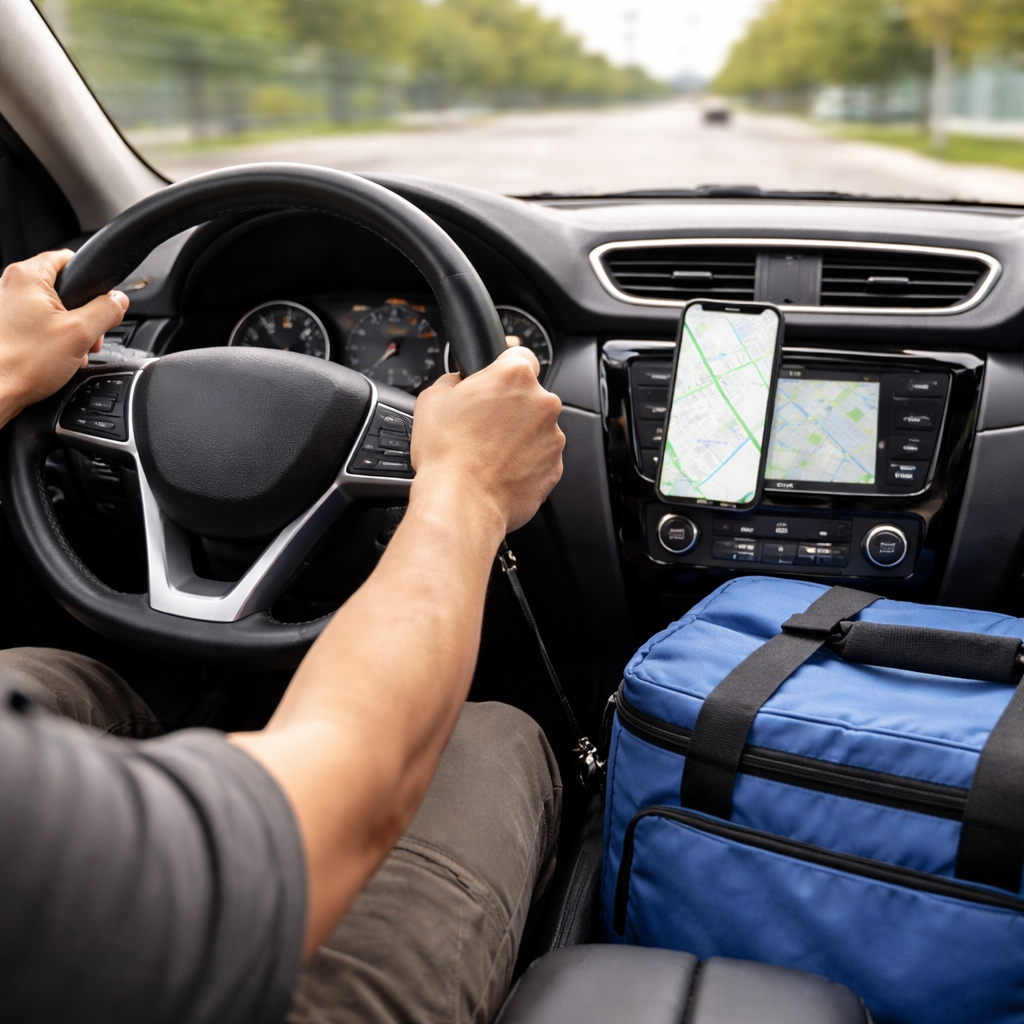
Your first medical courier route is the moment everything you prepared for becomes real. The compliance package is done. The contract is signed. The client is expecting you at 6am Tuesday — and now you need to show up and perform at the professional standard that healthcare facilities expect from day one.
Most new couriers feel some version of nerves before their first run — not because the work is technically difficult but because the stakes feel high in a way that food delivery or rideshare never did. You are showing up to a clinical environment, transporting items that matter to patient care, representing a business you built. That context is real and it is worth taking seriously.
The good news is that running your first medical courier route like a professional is entirely learnable — and the couriers who nail their first runs almost always do so because they prepared specifically, not because they had natural talent for it.
This is exactly what to do before, during, and after your first run.
Why Your First Run Sets the Tone for Everything That Follows
Healthcare facilities talk to each other. Lab directors know each other. Clinic office managers share vendor recommendations. The professional reputation you build on your first run with one facility travels faster than most new couriers expect — in both directions.
A courier who shows up on time, handles pickups correctly, communicates professionally, and delivers within the contracted window is the courier that facility calls first for stat runs, recommends to their partner facilities, and builds a long-term contract with.
A courier who shows up late, seems uncertain about protocols, or handles documentation carelessly gets replaced — quietly and quickly — and rarely gets the courtesy of an explanation.
Your first run is not just about completing a route. It is about establishing a professional standard that either opens doors or closes them.
If you want to understand what the daily reality of medical courier work looks like before your first run — the article on what a medical courier does on a daily basis covers the full picture of what experienced couriers experience across different run types.
Before Your First Run — The Preparation That Separates Professionals From Beginners
Know Your Route Before You Drive It
The biggest mistake new couriers make on their first run is treating route navigation the way they treat a casual drive — pulling up GPS when they get in the car and figuring it out as they go.
Professional medical couriers pre-drive or virtually pre-drive every new route before their first live run. The night before your first route — open Google Maps and trace every stop in order. Note the parking situation at each facility. Identify where the specimen drop-off or pickup entrance is — most hospitals and labs have specific courier entrances that are different from the main patient entrance. Note any access code requirements or buzzer systems your client contact mentioned.
Knowing exactly where you are going and how you are getting in before 6am on day one is the difference between arriving calm and arriving frantic.
Related reading: How route optimization and AI tools help medical couriers earn more per hour — covers the specific tools experienced couriers use to maximize route efficiency.
Prepare Your Equipment the Night Before
Every item you need for your run should be in your vehicle and ready before you go to sleep the night before your first route. Not the morning of — the night before. Morning-of scrambling leads to forgotten items, and forgotten items on a medical courier run create problems that damage client relationships.
Pre-run equipment checklist:
- Medical grade insulated cooler with fresh ice packs
- Biohazard specimen transport bags — adequate supply for expected pickup volume
- Secondary containment bags
- Chain of custody forms or run log — provided by your client or dispatch platform
- Pen and clipboard for documentation
- Your phone fully charged with your route planned in the navigation app
- Your client contact's phone number saved and accessible without searching
- Gloves for handling specimen packages at pickup points
For the complete equipment breakdown organized by run type — the complete medical courier equipment list before your first run covers every item with specific product recommendations and what to prioritize in your first month.
Confirm the Run With Your Contact the Day Before
A professional courier confirms the run the day before — not the morning of, not an hour before. A brief message or call to your facility contact that confirms the pickup time, location, and any changes to the expected pickup volume signals that you are organized and that they made the right decision contracting with you.
"Hi [Name], just confirming our scheduled pickup tomorrow morning at 6am from [location]. Please let me know if there are any changes to the expected volume or anything specific I should know before I arrive. Looking forward to it."
This takes two minutes and immediately sets you apart from couriers who show up without confirming — because the facilities that have been burned by no-shows or late arrivals notice and appreciate the confirmation every single time.
During Your First Run — What Professionalism Looks Like in Practice
Arrive Five Minutes Early — Not On Time
On time for a healthcare client means arriving at the moment the pickup is scheduled. Professional means arriving five minutes before that moment — giving yourself time to get situated, find parking, and walk in composed rather than rushed.
Healthcare facilities operate on tight specimen processing windows. A courier who arrives at exactly 6am every morning is reliable. A courier who arrives at 5:55am every morning is exceptional — and exceptional couriers get first call when stat runs come up and new contracts become available.
The Pickup Protocol — Exactly What to Do
When you arrive at a pickup location for the first time — introduce yourself clearly and professionally. You are not just picking up a package. You are beginning a professional relationship with the staff at this facility.
"Good morning, I am [Name] from [Business Name]. I am here for the scheduled specimen pickup."
Wait for the staff to prepare the pickup. Do not rush them. Do not hover over the counter impatiently. Stand professionally and be ready to sign or receive documentation the moment they indicate.
At every pickup, confirm:
- The number of specimens or items matches what was expected
- All packages are properly sealed and labeled
- Any temperature requirements for the items (ambient, refrigerated, frozen)
- The delivery location and any specific drop-off instructions for each package
- The expected delivery time window
If anything does not match what you expected — a package that seems damaged, a quantity that does not match your run log, an item that requires handling you were not briefed on — stop and clarify before you leave. Asking a clarifying question before you leave is professional. Discovering a problem at the drop-off location is a crisis.
Chain of Custody Documentation — Do Not Skip This
Chain of custody documentation is your professional protection and your client's compliance record. Every pickup and every delivery should be documented with:
- Time of pickup
- Location of pickup
- Specimen or item description as labeled
- Time of delivery
- Location of delivery
- Recipient name or confirmation method
Some clients provide their own run logs or digital confirmation systems. Others expect you to maintain your own documentation. Know which system your client uses before your first run — and use it consistently from day one.
A medical courier who maintains meticulous chain of custody documentation is a medical courier that healthcare facilities trust with higher-value and higher-sensitivity runs over time.
Communication During the Run — When and How to Update Your Client
Most medical courier runs proceed without incident. But when something comes up — unexpected traffic, a facility that is not yet open at pickup time, a specimen package that needs clarification — your client contact should hear from you immediately and professionally.
A short message is all it takes:
"Running approximately 10 minutes behind schedule due to traffic on [route]. Will arrive at [drop-off location] by [adjusted time]. Please let me know if this creates any issues with your processing window."
That message takes 30 seconds to send. It demonstrates professionalism, gives the facility time to adjust if needed, and prevents the anxiety of a silent late courier — which is the scenario that causes facilities to start looking for a replacement.
After Your First Run — What Separates Good Couriers From Great Ones
Send a Run Completion Confirmation
Within 30 minutes of completing your last drop-off — send your client contact a brief completion message.
"Good morning [Name] — all [number] pickups from this morning's route have been delivered to [drop-off location]. Delivery completed at [time]. Please reach out if you need anything else today."
Most couriers never send this message. The ones who do are the ones facility contacts remember — and recommend.
Document Your Run While It Is Fresh
Complete your run log or documentation immediately after your last drop-off — while times, quantities, and details are accurate. Documentation completed an hour or two after a run relies on memory and introduces errors that create compliance problems.
Five minutes of documentation immediately after the run is complete protects you legally, satisfies your client's compliance requirements, and demonstrates the professional standard that makes healthcare facilities want to give you more business.
Review What Worked and What Did Not
After your first run — before the adrenaline of completing it fades — take ten minutes to note what went smoothly and what created friction. Which stop took longer than expected and why. Where parking was harder than you anticipated. Which part of your preparation saved you time.
That ten-minute review after run one makes run two significantly more efficient — and the cumulative improvement of honest post-run review is one of the most underused income multipliers in the courier business.
For the route optimization tools that experienced couriers use to turn those reviews into measurable efficiency gains — how route optimization and AI tools help medical couriers earn more per hour covers the specific tools and strategies in detail.
The Resource That Prepares You for Your First Run
The Medical Courier Launch Kit includes a first-run preparation checklist, a chain of custody documentation template, client communication scripts for before, during, and after your run, and a professional courier protocol guide that covers every scenario you are likely to encounter in your first 30 days of active routes.
For the complete business foundation — from compliance through scaling — the Medical Courier Business System covers the full picture beyond your first run.
You Might Also Like
- How to Make Your First 1000 Dollars as a Medical Courier in 30 Days
- Medical Courier Startup Costs — What You Actually Need to Get Started
- What Does a Medical Courier Do — And Is It a Good Side Hustle for 2026
- The Mistakes Most New Medical Couriers Make in Their First 90 Days
Ready to take the next step? Read how to write a medical courier contract that protects you — so your client relationships are protected professionally from the moment your first run is complete.
Frequently Asked Questions
What should I do before my first medical courier run?
Pre-drive or virtually map your full route the night before. Prepare all equipment — cooler, ice packs, specimen bags, chain of custody forms, clipboard, and pen. Confirm the run with your client contact the day before. Charge your phone fully and have your client's contact number saved and accessible. Arrive five minutes before the scheduled pickup time — not at the scheduled time.
What do medical couriers do when picking up specimens?
At every pickup location, introduce yourself professionally by name and business name. Wait for staff to prepare the pickup. Confirm the specimen count matches your expected run volume. Verify all packages are properly sealed, labeled, and at the correct temperature. Complete your chain of custody documentation at the point of pickup. Ask clarifying questions before you leave — not after you have driven away.
How do medical couriers handle delays during a run?
Contact your client immediately when a delay occurs — do not wait until you arrive late without warning. A brief professional message explaining the cause of the delay and your adjusted arrival time gives the facility time to adjust their processing schedule and demonstrates the professional communication standard that healthcare clients value. Most clients are understanding about delays that are communicated proactively — they are far less understanding about silent late arrivals.
What is chain of custody documentation for medical couriers?
Chain of custody documentation is the written record of every pickup and delivery on a courier run — including pickup time, pickup location, item description, delivery time, delivery location, and delivery confirmation. It is your professional protection if a client questions a delivery, your compliance record for HIPAA purposes, and the documentation that healthcare facilities increasingly require from professional courier contractors.
How long does a typical medical courier route take?
Route duration varies significantly by the number of stops, distance between stops, and traffic conditions. A three to five stop early morning specimen route typically takes 90 minutes to two and a half hours. A longer pharmaceutical delivery circuit covering multiple facilities may take three to four hours. Route optimization tools like Circuit Route Planner can reduce multi-stop route time by 20 to 45 minutes by optimizing stop sequencing around traffic patterns and time windows.
What should a medical courier do after completing their first run?
Send a run completion confirmation to your client contact within 30 minutes of your final delivery. Complete your chain of custody documentation immediately while details are accurate. Review what went smoothly and what created friction so your second run is more efficient than your first. Invoice your client if your contract terms include per-run billing rather than monthly billing.
What is the biggest mistake new medical couriers make on their first run?
According to experienced medical courier operators, the most common first-run mistake is underestimating the importance of arrival time. Showing up at exactly the scheduled time feels punctual — but healthcare facilities that have been let down by unreliable couriers in the past treat exact-time arrival as borderline acceptable. Arriving five minutes early consistently signals the professional reliability that builds long-term contract relationships and generates referrals to other facilities.
Comments ()