
One of the first questions people ask when they discover medical courier work is how much it costs to start. It is a smart question — and one that most resources answer vaguely or incompletely.
The honest answer is that medical courier startup costs are lower than almost any other professional business you could launch in 2026. Most people can complete their full setup for under $500. Some get it done for less than $300 depending on their state and existing coverage. What matters is knowing exactly what you need so you budget accurately and do not waste money on things that do not move your business forward.
This breaks down every startup cost clearly — what is required, what is optional, what it actually costs, and what you can skip entirely until income justifies it.
Why the Startup Cost Barrier Is Lower Than You Think
Most legitimate businesses require significant upfront investment. A franchise costs tens of thousands of dollars. A retail business requires inventory. A service business often requires expensive certifications or equipment before the first dollar comes in.
Medical courier work is different because your primary business asset — your vehicle — is something most people already own. You are not buying a product to resell. You are not building a platform. You are monetizing a professional service using infrastructure you already have, with a compliance layer that costs a few hundred dollars to establish.
The couriers who overthink the startup costs and spend weeks researching before acting consistently start later and earn later than the ones who calculated the basics, committed to the investment, and started outreach in week two.
For the story of exactly how this plays out in a real first month — including what the income timeline looks like against the startup costs — the article on how one person lost their job and built a medical courier business from scratch covers the real numbers from day one.
The Required Startup Costs — What You Cannot Skip
These are the non-negotiable expenses every medical courier needs in place before approaching a single client.
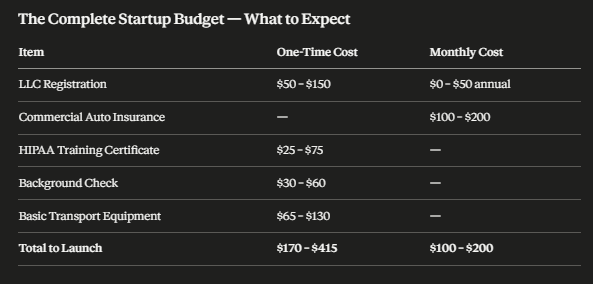
LLC Registration — $50 to $150 One Time
Registering your business as a single-member LLC is the foundation of your professional operation. Healthcare facilities contract with businesses — not individuals. An LLC signals professional operation, provides personal liability protection, and is required by most dispatch platforms and direct facility clients before they process contractor paperwork.
How to do it: Go to your state's Secretary of State website. File your LLC formation documents online. The process takes 20 to 45 minutes. Processing time ranges from same-day in some states to one to two weeks in others.
Cost range:
- Lowest cost states (Kentucky, Colorado, Mississippi): $40 – $50
- Average cost states: $75 – $100
- Higher cost states (Massachusetts, Tennessee): $105 – $150
This is a one-time cost. Your LLC stays active as long as you file annual reports — typically $0 to $50 per year depending on your state.
Commercial Auto Insurance — $100 to $200 Per Month
This is your most significant ongoing cost — and the one with the highest financial consequence if you skip it.
Your personal auto insurance policy almost certainly excludes coverage when your vehicle is used for commercial purposes. An accident during a courier run with only personal coverage means your claim can be denied entirely — leaving you personally liable for damages.
Commercial auto insurance or a business-use rider on your existing policy covers you during every run. Healthcare clients verify your insurance before contracting — a Certificate of Insurance (COI) is required documentation for every contract relationship.
Cost variables:
- Your vehicle type and age
- Your driving record
- Your state
- Your coverage limits
How to get it: Call your existing insurance provider first. Many will add a business-use rider or commercial coverage to your existing policy for less than a standalone commercial policy. Get at least two quotes before committing.
This cost does not go away — budget for it as a permanent monthly overhead from the day you start. The good news is that one morning specimen route pays for a full month of insurance in a single run.
HIPAA Awareness Training — $0 to $75
Medical couriers transport items protected under HIPAA. Healthcare clients need documentation that you understand basic HIPAA compliance requirements — proper handling of patient information, confidentiality obligations, and what to do if something is compromised in transport.
You do not need a clinical-level certification. Basic HIPAA awareness training with a certificate of completion is sufficient for virtually every medical courier contract.
Free option: HHS.gov provides free HIPAA training materials. No certificate of completion with the free option — but the knowledge is complete.
Paid options with certificates: Coursera, MedBridge, and several online compliance training platforms offer HIPAA awareness courses with downloadable certificates for $25 to $75. The certificate is worth the investment because you can attach it to your compliance package immediately.
Time required: Two to four hours for basic awareness training.
Background Check — $30 to $60
Healthcare facilities and dispatch platforms run background checks on every contractor. Running your own check first lets you see exactly what they will see — so nothing surprises you in a client conversation.
Where to run it: Checkr, Sterling, and Accurate all produce comprehensive background check reports that most healthcare clients accept. Checkr is the most widely recognized in the courier and gig economy space.
Cost: $30 to $60 for a comprehensive national check.
This is a one-time cost. Most background check results are valid for 12 months for contractor purposes — though some clients may require updated checks annually.
Basic Specimen Transport Equipment — $50 to $200
You do not need a refrigerated vehicle to start. You do need the right containers for the specimens and items you will be transporting.
Required from day one:
- Medical-grade insulated cooler with ice packs: $40 to $80
- Biohazard specimen transport bags: $15 to $30 for a starter supply
- Secondary containment bags: $10 to $20
Optional upgrades as income grows:
- Validated temperature monitoring device: $80 to $150
- Larger insulated transport bags for pharmaceutical runs: $40 to $80
- Vehicle organizer for efficient run management: $25 to $60
Start with the basics. Equipment upgrades are investments your first month of income can easily cover without affecting your launch budget.
The Optional Costs — Worth Having Eventually, Not Required to Start
These items improve your professional presentation and operational efficiency but are not required before your first run.
Branded magnetic vehicle signs: $30 to $60. Not required by most clients but adds professionalism when arriving at clinical environments.
Dedicated business phone line: $15 to $25 per month through Google Voice or a similar service. Separates business calls from personal calls and looks more professional on your compliance package contact information.
Accounting software: Wave is free and handles everything a new courier needs. FreshBooks at $17 per month adds more sophisticated invoicing and expense tracking when your contract volume justifies it.
Business cards: $20 to $40 for a professional batch. Useful when meeting facility contacts in person during outreach visits.
None of these costs are necessary in your first two weeks. The compliance package, the insurance, and the equipment are what get you to your first run. Everything else can be added as income makes it comfortable.
For the complete list of equipment organized by run type and experience level — the article on the complete medical courier equipment list before your first run covers every item with specific product recommendations and cost ranges.
When Your First Run Covers Your Startup Costs
Here is the math that puts the startup investment in perspective.
A single early morning specimen route at a direct contract rate of $32 per hour covering a two-hour circuit earns $64 gross in a single morning. A weekend routed run at the same rate covering three hours earns $96.
Your total non-insurance startup costs — $170 to $265 for LLC, HIPAA training, background check, and basic equipment — are covered by two to four runs at direct contract rates.
Your ongoing monthly overhead — $100 to $200 for commercial insurance — is covered by three to six hours of routed run income per month.
Everything beyond that is net income building toward your first thousand dollars and beyond.
For the specific plan to reach that first thousand dollars as fast as possible — how to make your first 1000 dollars as a medical courier in 30 days maps out the week-by-week approach that most couriers who hit that milestone follow.
The Resource That Removes the Guesswork
Knowing what things cost is one piece of the puzzle. Knowing exactly which items to get first, where to get them, how to organize your compliance documentation, and how to present yourself professionally to your first client from day one — that is the full picture.
The Medical Courier Launch Kit includes a complete startup checklist organized by priority, links to the most cost-effective sources for every required item, a compliance documentation template, and the step-by-step launch sequence that gets you from zero to first contract as efficiently as possible.
For the complete requirements breakdown including certifications — what certifications and requirements medical couriers need before starting covers every credential with sources and exact costs.
And once your compliance package is ready — how to write a medical courier contract that protects you covers the contract side of your first direct client relationship so you are protected from day one.
Frequently Asked Questions
How much does it cost to start a medical courier business in 2026?
Most people can complete their full medical courier startup for $300 to $500 in first-month costs — including LLC registration ($50 to $150), HIPAA training ($25 to $75), a background check ($30 to $60), basic transport equipment ($65 to $130), and the first month of commercial auto insurance ($100 to $200). Ongoing monthly costs after the first month are primarily the commercial insurance premium.
Do I need to buy a special vehicle to start a medical courier business?
No. Most medical courier runs can be completed in a standard sedan, SUV, or minivan that you already own. You do not need a refrigerated vehicle to start — temperature-controlled runs require medical-grade coolers and ice packs, not a specialized vehicle. Specialty vehicles become relevant as your operation grows and you pursue specific contract types that require them.
Is commercial auto insurance required for medical courier work?
Yes — it is non-negotiable. Your personal auto policy almost certainly excludes commercial use, which means any accident during a courier run could result in a denied claim and personal liability. Commercial auto insurance or a business-use rider is required before your first run and is verified by virtually every healthcare client and dispatch platform during contractor onboarding.
Can I start a medical courier business with less than 500 dollars?
Yes. The minimum viable startup — LLC registration in a low-cost state, free HIPAA training from HHS.gov, a self-background check, and basic transport equipment — can be completed for $175 to $250 before the first month of insurance. If your state has lower LLC fees and you use free HIPAA training, total non-insurance startup costs can fall below $200.
How quickly do startup costs get recovered from medical courier income?
At direct contract rates of $28 to $40 per hour, your non-insurance startup costs of $170 to $265 are recovered in two to four courier runs. Your ongoing monthly insurance cost of $100 to $200 is recovered in three to six hours of routed run income per month. Most couriers recover their complete first-month investment within the first two to three weeks of active runs.
What is the most important startup cost to prioritize first?
Commercial auto insurance is the highest-priority item because it carries the highest financial risk if skipped. LLC registration is second because no healthcare client or dispatch platform will process your contractor paperwork without it. HIPAA training and the background check follow — both are required documentation for your compliance package. Equipment comes last because you can order it during the week your LLC and insurance are processing.
Comments ()