
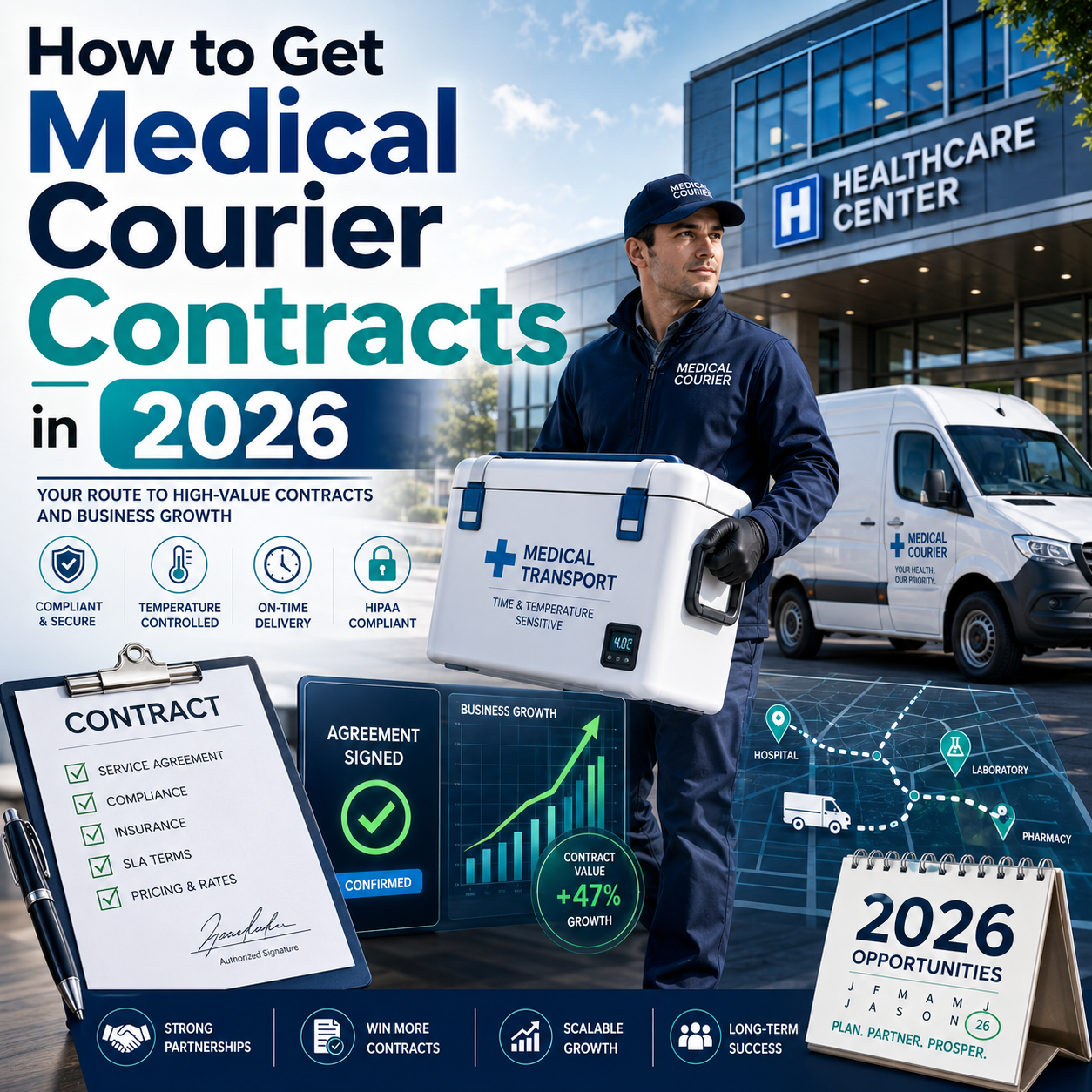
Getting your medical courier business set up is one thing. Getting someone to actually pay you to transport medical items is another.
That is where many new medical couriers get stuck.
You can have a reliable vehicle, insurance, business paperwork, training, and equipment ready to go, but none of those things automatically create customers.
If you want medical courier contracts, you need to know who may need your services, how to find the right contact, what questions to ask, how to price the opportunity, and when to walk away from a route that does not make financial sense.
There is no guaranteed formula for landing your first contract in 7, 14, or 30 days. What you can build is a professional prospecting system that gives you a much better chance of finding legitimate opportunities.
Quick Answer
To find medical courier contracts, start by identifying businesses in your service area that may use outside transportation services.
Potential prospects can include laboratories, physician groups, pharmacies, medical suppliers, veterinary laboratories, outpatient facilities, and other healthcare-related businesses.
Then determine whether the organization outsources transportation, identify the person or department responsible for courier vendors, and make a professional introduction.
Some organizations will already have established vendors. Others may handle transportation internally. Your first job is finding out whether a genuine opportunity exists.
Key Takeaways
- Medical courier contracts can come from direct clients, established courier companies, subcontracting opportunities, and government procurement.
- Not every medical facility needs an independent courier.
- Research the organization before making contact.
- Find the person or department responsible for transportation or outside vendors.
- Do not quote a route until you understand the mileage, time, stops, waiting, and handling requirements.
- Gross contract revenue is not the same as profit.
- A free trial is not automatically necessary.
- Get service terms in writing before beginning ongoing work.
- There is no reliable universal timeline for landing your first medical courier contract.
- Consistent, targeted outreach is more useful than randomly contacting hundreds of facilities.
First, Decide What Kind of Contract You Want
People use the phrase "medical courier contract" to describe several different opportunities.
You might be looking for:
- Independent contractor routes through an established courier company
- Subcontracting work from a smaller courier operator
- Direct service agreements with healthcare-related businesses
- Government courier contracts
These are different business models.
If your main goal is to start earning as a courier, working through an established company may be easier than finding your own healthcare clients.
If your goal is to build your own medical courier business, direct client acquisition becomes much more important.
Know which path you are pursuing before you start contacting businesses.
Where to Find Medical Courier Contracts
There is no single place where every medical courier opportunity is listed.
You need to use several methods.
Courier and Logistics Companies
Start with companies already providing courier, healthcare logistics, specimen transportation, or specialized delivery services.
Search for terms such as:
- Medical courier contractor
- Independent courier contractor
- Specimen courier contractor
- Laboratory courier
- Healthcare logistics driver
- Route driver
- Independent delivery contractor
Visit company websites and check their careers or contractor pages.
Some companies hire employees. Others use independent contractors. Some use both depending on the market.
If you are new to the industry, working with an established company can also help you understand how professional courier operations work before you pursue direct clients.
Find Potential Direct Clients
If you want your own clients, you are no longer simply searching for a job.
You are looking for organizations that may have a transportation problem your business can solve.
Potential businesses to research include:
- Independent laboratories
- Physician groups
- Pharmacies
- Medical supply companies
- Veterinary laboratories
- Outpatient healthcare facilities
- Healthcare businesses with multiple locations
A business appearing on Google does not automatically make it a good prospect.
A laboratory may already have its own drivers. A physician group may have transportation handled by its laboratory partner. A pharmacy may already have a delivery company.
Research first.
Step 1: Define Your Service Area
Before building your prospect list, determine how far you can realistically travel.
Consider:
- Traffic
- Tolls
- Fuel
- Vehicle expenses
- Driving time
- Unpaid return mileage
- Location of potential pickup and delivery points
Do not automatically choose a large service area because you think more territory means more money.
A compact route with several nearby stops can potentially be more profitable than a higher-paying route that sends you across a large metropolitan area.
Your service area needs to be both manageable and financially sensible.
Step 2: Build a Prospect List
Now start researching businesses.
Google and Google Maps can help you identify organizations in your area.
Try searches such as:
- Diagnostic laboratory near me
- Clinical laboratory near me
- Medical supply company near me
- Physician group near me
- Independent pharmacy near me
- Veterinary laboratory near me
Visit each organization's website before contacting it.
Look for clues such as:
- Multiple locations
- Laboratory services
- Specimen collection
- Delivery services
- Vendor information
- Procurement information
- Corporate offices
Create a simple spreadsheet or prospect tracker with:
- Business name
- Website
- Phone number
- Location
- Contact person
- Current transportation arrangement
- Date contacted
- Follow-up date
- Notes
This turns random cold calling into an organized business-development process.
Step 3: Find Out How Transportation Is Handled
Do not immediately call and ask:
"Do you need a medical courier?"
That question makes it easy for someone to simply say no.
Start by gathering information.
You can ask:
"Could you tell me who handles outside courier or transportation services for your organization?"
The answer may tell you that transportation is handled internally, managed by a laboratory partner, assigned to an existing courier company, or controlled by a purchasing or procurement department.
You may also discover that the organization uses outside vendors and is willing to consider another provider.
That is the information you need.
Step 4: Find the Right Decision-Maker
The person responsible for courier services will vary by organization.
It could be an:
- Office manager
- Practice administrator
- Laboratory manager
- Operations manager
- Logistics manager
- Purchasing representative
- Procurement department
- Facilities manager
- Corporate administrator
Do not assume the front desk can make vendor decisions.
At the same time, do not assume every laboratory manager controls courier contracts.
Simply ask who handles outside transportation vendors and work your way to the correct person.
Larger healthcare organizations may have formal vendor-registration or procurement systems. In those cases, following the official process will usually be more productive than repeatedly calling individual departments.
Step 5: Make a Professional Introduction
You do not need a complicated sales script.
Keep the first conversation simple.
You can say:
"Hi, my name is [Name]. I operate a courier service in [Area], and I'm researching organizations that use outside transportation providers. Could you tell me who handles courier or transportation vendors for your organization?"
Once you reach the appropriate person, explain:
- The area you serve
- The type of delivery services you provide
- Your availability
- Whether you are seeking regular routes, backup work, or overflow coverage
Do not exaggerate your experience.
Do not claim to be licensed or certified unless you actually hold the credential you are describing.
Professionalism matters more than trying to sound bigger than you are.
Step 6: Ask About Backup and Overflow Coverage
Do not automatically give up when a business tells you it already has a courier.
You can politely ask:
"Do you ever maintain backup courier options for overflow, vacations, or unexpected coverage?"
Some organizations may already have backup arrangements. Others may not need them.
If they are not interested, thank them and move on.
You are building a prospect pipeline, not trying to pressure every business into becoming a customer.
Step 7: Ask What Vendors Are Required to Provide
Before promising that you can service an organization, find out what it requires from outside vendors.
Depending on the organization and the services involved, requirements may include:
- Proof of insurance
- W-9
- Business information
- Background screening
- Training documentation
- References
- Vehicle information
- Vendor application
- Service agreement
- Privacy or security documentation
- Operating procedures
Requirements vary.
A small independent practice may have a relatively simple process. A major hospital system may have a formal procurement and vendor-credentialing process.
Ask the organization what it requires rather than assuming every healthcare facility follows the same checklist.
If you are operating in Florida, read Medical Courier Requirements in Florida before approaching potential clients.
Step 8: Understand the Route Before Discussing Price
Never hear "We need one pickup every weekday" and immediately throw out a price.
You need details.
Find out:
- Pickup location
- Delivery location
- Number of stops
- Frequency
- Pickup window
- Delivery deadline
- Approximate mileage
- Waiting time
- After-hours requirements
- Weekend requirements
- Tolls
- Parking
- Materials transported
- Special handling requirements
- Documentation requirements
Then calculate what it will cost you to provide the service.
A route paying $150 per day could be attractive if it is compact and predictable.
The same $150 could be terrible if it requires extensive mileage, tolls, waiting, and several hours of unpaid return driving.
The payment alone does not tell you whether the contract is profitable.
Step 9: Price the Actual Service
There is no universal medical courier rate that works in every city or for every route.
Your pricing should consider:
- Mileage
- Time
- Number of stops
- Urgency
- Waiting time
- Tolls
- Parking
- Special handling
- Vehicle expenses
- Insurance
- Administrative costs
- Desired profit
Start with a simple calculation:
Expected Revenue − Estimated Business Expenses = Estimated Profit
Then look at how much time the route requires.
Estimated Profit ÷ Total Time = Estimated Effective Hourly Profit
You should also examine the amount of driving involved.
A contract generating impressive monthly revenue can still be a bad contract if most of that money disappears into operating costs.
For a deeper breakdown, read What Medical Courier Contractors Earn.
Step 10: Be Careful With Free Trial Runs
Offering a free week of courier service is not automatically necessary.
Your fuel, vehicle, insurance, and time still cost money while you are completing a trial.
If a prospective client wants to test your service, clearly establish:
- Whether the trial is paid
- Services included
- Trial length
- Mileage involved
- Handling requirements
- Insurance responsibilities
- Payment terms
- What happens when the trial ends
A limited paid introductory period may make more financial sense than providing substantial work for free.
Step 11: Put the Agreement in Writing
Once a customer wants to move forward, document the arrangement.
Depending on the service, a written agreement may address:
- Parties to the agreement
- Services provided
- Pickup and delivery responsibilities
- Schedule
- Pricing
- Invoicing
- Payment terms
- Insurance
- Confidentiality and privacy responsibilities
- Handling requirements
- Liability
- Termination
- Other customer-specific requirements
Do not assume that a one-page agreement is automatically enough for every medical courier relationship.
Simple work may require a simple agreement. More complicated arrangements can require more protection.
For significant contracts, consider having an attorney review the agreement.
Step 12: Follow Up Professionally
Most businesses will not say yes during your first conversation.
Keep track of your outreach.
Record:
- Who you contacted
- When you contacted them
- What they told you
- Whether they use an outside courier
- Who makes vendor decisions
- What documentation they require
- When you should follow up
If someone says, "Call me next month," put it on your calendar.
If someone clearly says they are not interested, respect the answer.
Good follow-up is organized and professional. Calling the same business repeatedly after being told no is not.
Step 13: Ask Good Clients for Referrals
Once you have a strong working relationship with a client, referrals can help you find additional prospects.
There is no magic number of days you need to wait.
Ask when you have demonstrated that your service is reliable.
You can keep the request simple:
"If you know another organization that could use reliable courier coverage, I'd appreciate an introduction."
A referral from a satisfied business customer can open a conversation that would have been much harder to start cold.
Don't Ignore Subcontracting Opportunities
Your first medical courier contract does not necessarily need to come directly from a healthcare facility.
Established courier companies may already have clients and occasionally need:
- Additional drivers
- Route coverage
- Vacation coverage
- Weekend coverage
- Overflow help
- Backup drivers
Contact local courier businesses and ask whether they currently use independent contractors or subcontractors.
If they do, find out:
- How compensation works
- Total route mileage
- Schedule
- Vehicle requirements
- Insurance requirements
- Contractor requirements
- Whether return mileage is paid
- Who pays tolls and parking
Then evaluate the opportunity just as carefully as you would a direct contract.
If you are in Florida, see Medical Courier Companies in Florida.
What About Government Medical Courier Contracts?
Government contracting is another potential channel.
Federal contract opportunities can be published through SAM.gov, the federal government's official contracting system.
State, county, and municipal agencies may have their own procurement systems.
Government contracting is generally more formal than contacting a local private business. You may encounter:
- Vendor registration
- Solicitation documents
- Insurance requirements
- Bid deadlines
- Specific qualifications
- Pricing requirements
- Contract terms
Do not assume government medical courier contracts will always be available in your area.
Treat government procurement as another channel to research rather than your only strategy.
How Many Businesses Should You Contact?
There is no proven magic number.
Contacting 100 random medical offices is not automatically better than researching 20 businesses that have a realistic reason to use transportation services.
Start with quality.
For example, you could set a weekly activity goal such as:
- Research 5 new qualified prospects
- Make 5 appropriate business contacts
- Complete scheduled follow-ups
- Update your prospect tracker
- Prepare quotes or vendor applications when legitimate opportunities appear
As you learn more about your market, adjust your outreach.
The goal is not to brag about how many cold calls you made.
The goal is to find businesses that could realistically become customers.
How Long Does It Take to Get a Medical Courier Contract?
There is no reliable universal timeline.
One person might find an opportunity quickly because a company happens to need coverage at exactly the right time.
Another person could spend months building relationships before securing a direct client.
Your results can depend on:
- Location
- Demand
- Existing vendor relationships
- Competition
- Experience
- Insurance
- Pricing
- Availability
- Customer requirements
- Procurement procedures
- Follow-up
- Timing
Do not build your financial plan around the assumption that you will have a paying contract within 7, 14, or 30 days.
Instead, measure the things you can control:
- Qualified prospects researched
- Decision-makers identified
- Conversations completed
- Vendor applications submitted
- Quotes requested
- Follow-ups completed
- Real opportunities identified
Those numbers will tell you whether your pipeline is improving.
Common Medical Courier Contract Mistakes
Calling Every Medical Facility a Prospect
A business is not a qualified prospect simply because it operates in healthcare.
Find out whether outside transportation services are actually relevant.
Quoting Too Quickly
You cannot intelligently price a route without knowing the mileage, time, stops, and service requirements.
Giving Away Too Much Free Work
Being new does not mean your time, fuel, and vehicle have no value.
Assuming an LLC Will Win Contracts
An LLC is a business structure.
It does not create customers.
Exaggerating Credentials
Do not call yourself licensed, certified, bonded, or specially qualified unless you can support the claim.
Ignoring Unpaid Mileage
A route does not end financially just because the last package has been delivered.
If you have to drive 45 miles home without compensation, those miles still matter.
Focusing Only on Revenue
A $3,000 monthly contract sounds good until you calculate what it costs to service it.
Profit matters more than impressive gross revenue.
A Simple 30-Day Medical Courier Outreach Plan
This is not a promise that you will get a contract in 30 days.
It is a structured way to spend your first month building a pipeline.
Week 1: Research
Define your service area.
Identify local courier companies.
Build a qualified prospect list.
Research potential decision-makers.
Understand your operating costs.
Week 2: Begin Outreach
Make professional introductions.
Ask how transportation is currently handled.
Identify organizations that use outside vendors.
Track every response.
Week 3: Follow Up and Qualify
Follow up with interested prospects.
Learn their vendor requirements.
Gather route information.
Complete appropriate vendor applications.
Evaluate subcontracting opportunities.
Week 4: Quote and Refine
Prepare quotes for legitimate opportunities.
Review what you learned during the month.
Remove poor prospects.
Add new qualified prospects.
Improve your outreach based on the responses you received.
At the end of 30 days, you may have a contract.
You may have promising conversations that are still developing.
Or you may discover that your market requires a different approach.
All three outcomes give you information you can use.
Frequently Asked Questions
How do beginners get medical courier contracts?
Start by deciding whether you want direct clients, subcontracted routes, or independent contractor work through an established courier company.
For direct clients, identify businesses that may use outside transportation, determine how transportation is currently handled, find the appropriate decision-maker, and make a professional introduction.
Where can I find medical courier contracts?
Potential sources include healthcare and logistics companies, local courier companies, direct business relationships, subcontracting opportunities, referrals, job boards, contractor listings, and government procurement systems.
Use several channels instead of relying on one.
Are medical courier contracts posted online?
Some opportunities are.
Employee and contractor openings can appear on company websites and job boards. Government opportunities may appear through procurement systems such as SAM.gov.
Direct private-business contracts may require prospecting and relationship building.
How much should I charge for a medical courier contract?
There is no universal national medical courier contract rate.
Calculate pricing using the actual mileage, time, stops, urgency, waiting, operating costs, special handling, and desired profit for the route.
Should I offer a free trial?
Not automatically.
If a potential customer wants to test your service, define exactly what the trial includes and whether it will be paid.
Do not commit to substantial unpaid work simply because you are new.
Do I need an LLC before approaching medical courier clients?
Not automatically.
The appropriate business structure depends on your circumstances and the requirements of prospective customers.
An LLC is a business structure, not a medical courier certification.
Do I need a written contract?
Putting service terms in writing is a smart business practice.
The agreement should reflect the actual service, pricing, responsibilities, and risks involved.
More complicated or higher-value arrangements may justify professional legal review.
How quickly can I get my first medical courier contract?
There is no reliable standard timeline.
Your results depend on your market, preparation, pricing, customer demand, existing competition, and outreach.
Be skeptical of anyone guaranteeing a contract within a specific number of days.
Can I get medical courier contracts without experience?
Potentially.
Requirements vary by customer and opportunity.
Relevant delivery, logistics, driving, healthcare, or customer-service experience may help, but do not claim experience you do not have.
Focus on reliability, professionalism, and meeting the customer's actual requirements.
Your Next Move
Do not start by calling 50 random medical offices.
Start with 10 businesses that you have actually researched.
For each one, find out:
- What does this organization do?
- Could it realistically need transportation services?
- How is transportation currently handled?
- Who handles outside vendors?
- Does it accept new vendors?
- What would you need to provide to work with it?
Once you know those answers, you are no longer randomly cold-calling.
You are building a real sales pipeline.
If you're still setting up your business, Medical Courier Launch Kit — $27 includes startup checklists, outreach resources, pricing references, and company research tools.
If you're operating in Florida, read Medical Courier Requirements in Florida.
Before accepting or pricing contractor work, read What Medical Courier Contractors Earn.
You Might Also Like
- How to Become a Medical Courier in 2026
- Medical Courier Salary: What Drivers Really Earn in 2026
- Medical Courier Companies in Florida
- Medical Courier Requirements in Florida
- Medical Courier Insurance Guide
Sources
- U.S. Small Business Administration — Federal Contracting Guidance
- SAM.gov — Federal Contract Opportunities
- Internal Revenue Service — Independent Contractor and Business Structure Guidance
- U.S. Department of Health and Human Services — HIPAA Guidance
Contract opportunities, vendor requirements, insurance requirements, and applicable regulations vary by customer and location. Verify requirements with prospective clients and appropriate professional or government sources before entering an agreement.
Comments ()