
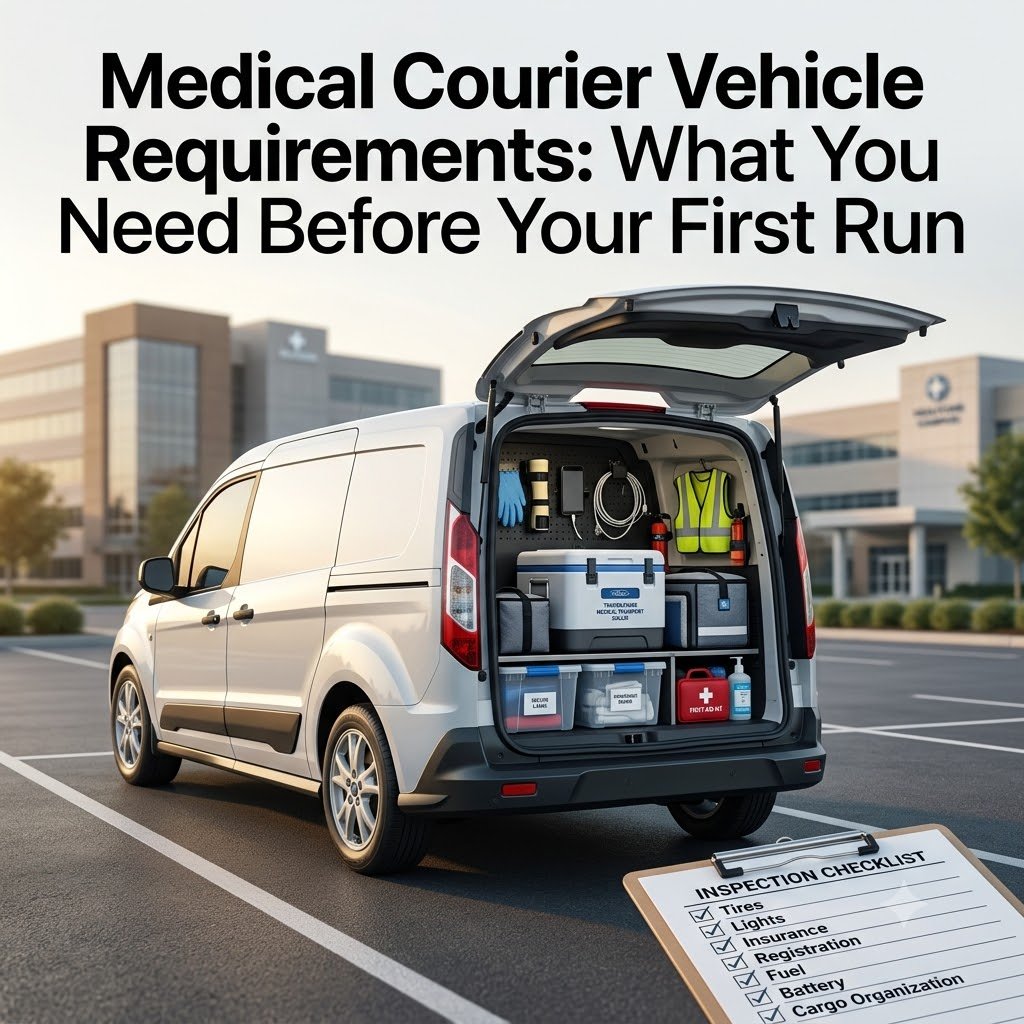
Ray showed up to his first facility meeting in a 2019 Honda Civic. Clean interior. No visible damage. Full tank of gas.
The lab coordinator looked at the car through the window, nodded, and said — "That works fine for us."
Ray had spent three weeks convinced he needed a cargo van before he could approach any facility. He did not. He needed a clean, reliable vehicle with the right insurance — and he already had one.
The vehicle conversation stops more new couriers than almost any other requirement. Most of the hesitation is based on assumptions that do not match what facilities actually ask for.
Quick Answer Medical courier vehicle requirements in 2026 are straightforward — a clean, reliable vehicle no older than ten years for most facilities, insured under a commercial auto policy, with appropriate transport equipment inside. A standard car or SUV is sufficient to start. A cargo van is not required and most couriers never need one. The vehicle requirements that matter most to facilities are condition, cleanliness, and commercial insurance.
Key Takeaways
- A standard car or SUV is sufficient for most medical courier work including specimen and medication transport
- Most facilities require vehicles no older than seven to ten years — not newer
- Commercial auto insurance on the vehicle is non-negotiable — personal policies do not apply
- Vehicle cleanliness and professional appearance matter as much as vehicle type at most facilities
- A cargo van becomes relevant only when contracted route volume exceeds what a standard vehicle handles
- No special vehicle modifications are required for standard specimen or medication transport
The medical courier vehicle question has one answer that applies to the majority of new couriers — the vehicle you already own is probably sufficient to start.
The requirements that facilities actually enforce are not about vehicle size or brand. They are about vehicle condition, vehicle age, commercial insurance coverage, and the professional appearance your vehicle presents when it pulls up to a loading dock or clinic entrance.
According to the American Medical Courier Association, the majority of independent medical couriers operating standard specimen and medication routes use personal cars or SUVs — not purpose-built transport vehicles — throughout their entire careers. The cargo van assumption is one of the most persistent and expensive misconceptions in this field.
What Facilities Actually Check
When a facility coordinator evaluates a new courier's vehicle — either in person during a first visit or through your application documentation — they are checking four specific things.
Most new couriers prepare for the wrong ones.
Vehicle Factor What Facilities Check Why It Matters Age No older than 7 to 10 years for most systems Reliability and professional appearance Condition No visible damage, clean exterior Represents the facility at pickup locations Interior cleanliness No food, debris, odors, or clutter Specimen integrity and professional standard Insurance Commercial auto certificate Legal compliance for transport operations Equipment Appropriate cooler and containment Safe specimen handling requirement Size Rarely specified — route dependent Only relevant for high-volume routes
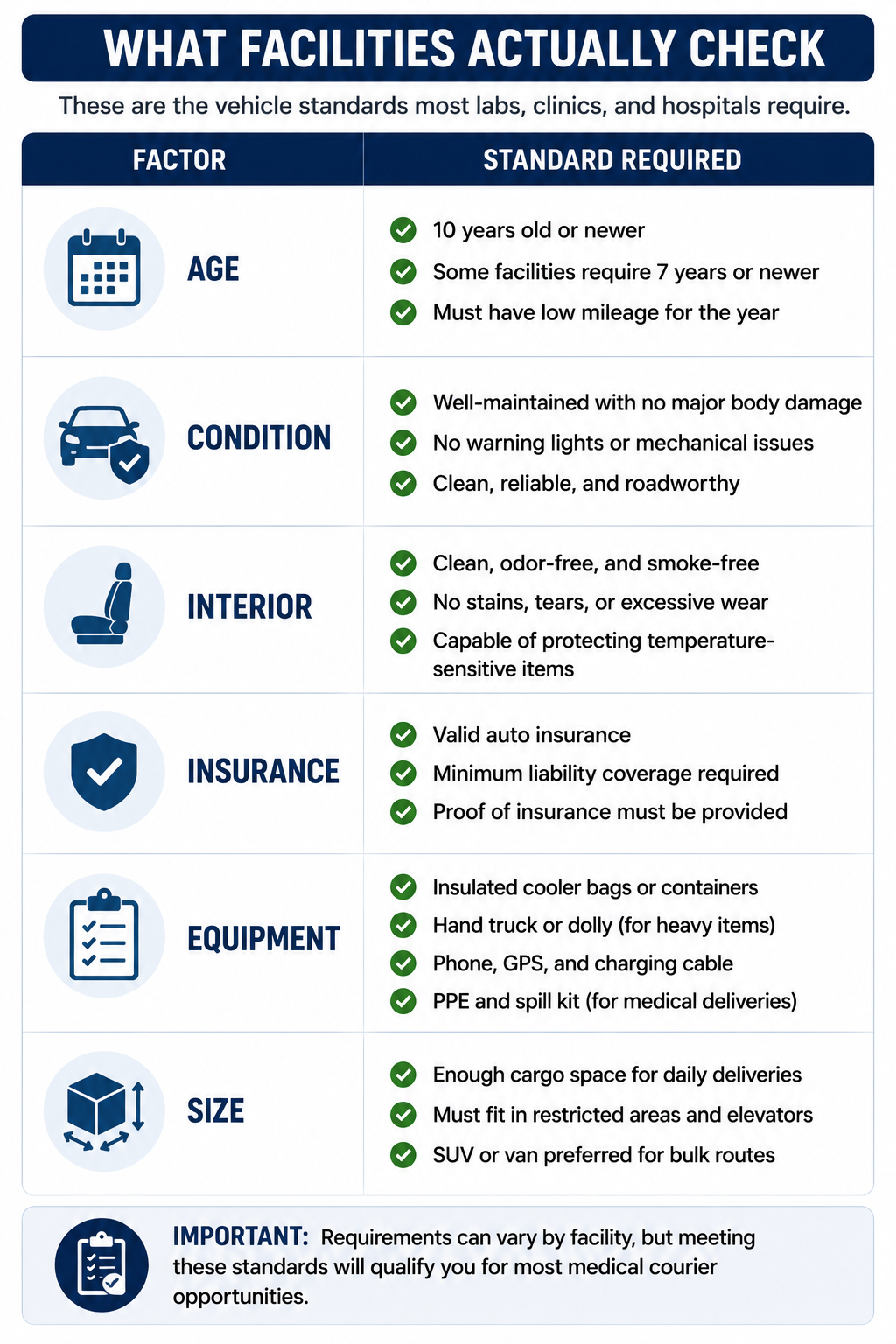
Vehicle size is the last item on that list for a reason. It is the factor new couriers worry about most and the one facilities specify least.
Cleanliness and professional appearance — items most couriers do not think about at all — are the factors that create the strongest first impression when a facility coordinator sees your vehicle for the first time.
The Medical Courier Business Starter Kit at SteadyIncomeTools.com includes a vehicle preparation checklist, equipment sourcing guide, and the complete facility first-visit protocol that makes every courier introduction professional from the first moment.
Vehicle Age Requirements
Most healthcare facilities and lab networks specify a maximum vehicle age in their courier contractor requirements. The most common standard is no older than ten years. Some larger hospital systems require no older than seven years.
A 2015 or newer vehicle meets the ten-year standard through 2025. A 2018 or newer vehicle meets the seven-year standard through 2025.
If your vehicle is older than ten years — confirm the specific requirement with each facility before assuming disqualification. Smaller independent clinics and physician offices rarely enforce a strict age requirement. Larger hospital systems and national lab networks are more likely to specify and verify.
Vehicle age requirements exist for one practical reason — reliability. Facilities that depend on daily specimen pickup cannot absorb route failures caused by vehicle breakdowns. A newer vehicle signals lower breakdown risk to the facility coordinator making the hiring decision.
Vehicle Type — What Actually Works
The most common question new medical couriers ask is whether they need a specific type of vehicle. The honest answer is that vehicle type matters far less than vehicle condition and insurance status.
Standard Car — Sedan or Hatchback
A standard four-door sedan or hatchback is sufficient for most specimen pickup and medication delivery routes. Trunk space accommodates a standard medical-grade insulated cooler with room for daily route volume at most independent clinic and physician office accounts.
Sedans are the most fuel-efficient option for urban and suburban routes where stops are frequent and distances between facilities are short. Ray's 2019 Honda Civic is representative of what most new medical couriers start with — and what many experienced couriers continue using indefinitely.
SUV or Crossover
An SUV or crossover offers more interior volume than a sedan without the operating cost of a cargo van. The rear cargo area accommodates multiple coolers for couriers running routes with higher pickup volume per run.
SUVs present a more substantial professional appearance at facility entrances — which matters in markets where larger hospital systems have higher visual expectations for contracted couriers. Most experienced couriers who upgrade from a sedan move to an SUV rather than a cargo van.
Cargo Van
A cargo van is the right vehicle for couriers running high-volume routes with multiple simultaneous pickups across large geographic areas. It is not the right starting vehicle for most new couriers and should not be purchased before route volume justifies the operating cost.
A cargo van costs significantly more to insure, fuel, and maintain than a sedan or SUV. For a new courier running one or two morning routes, those additional costs reduce net income without providing a corresponding benefit.
The upgrade to a cargo van makes financial sense when — and only when — contracted route volume consistently exceeds what a standard vehicle can efficiently handle.
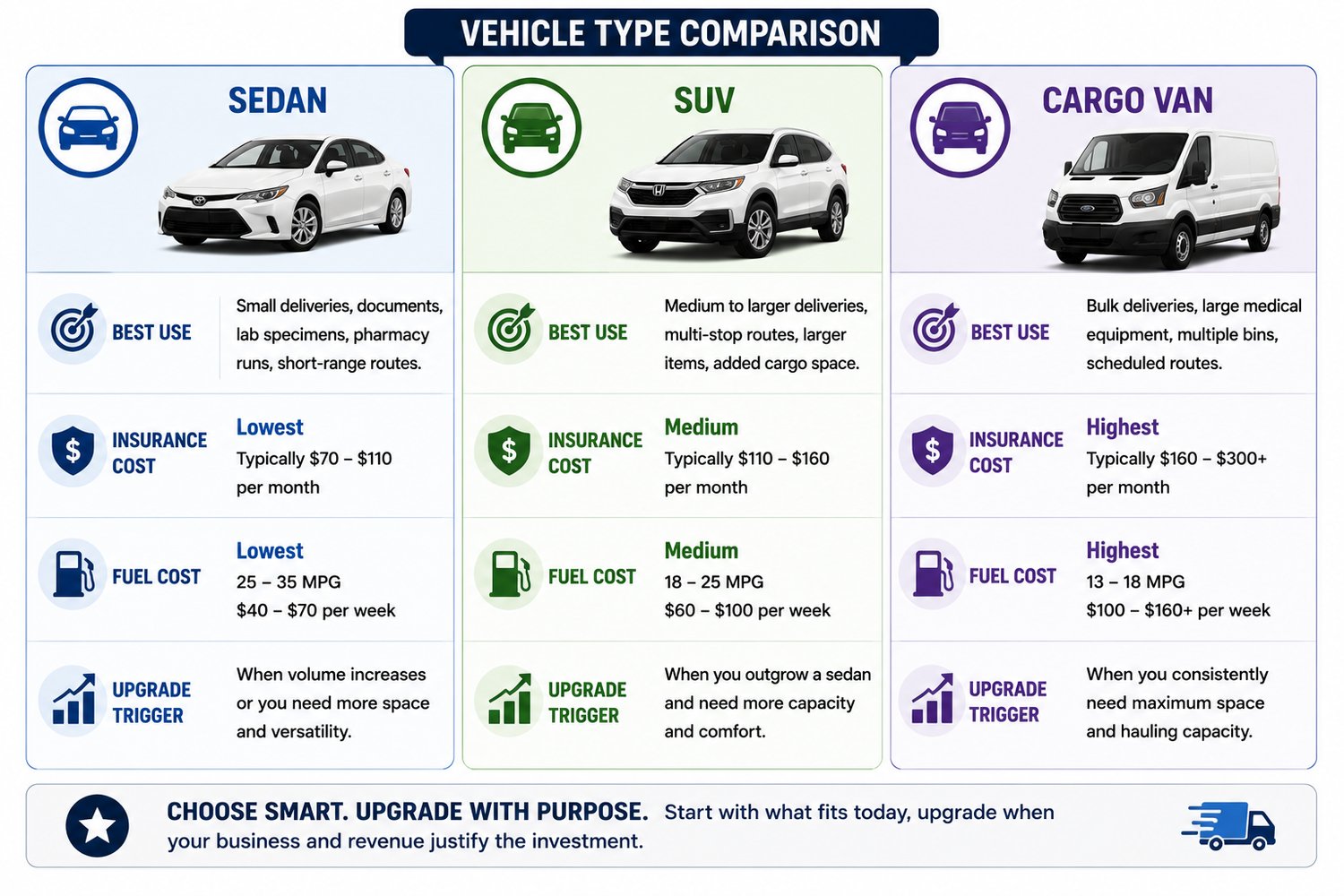
Vehicle Type Best For Insurance Cost Fuel Cost When to Upgrade Sedan 1 to 2 routes, urban routes Lowest Lowest When volume grows SUV / Crossover 2 to 4 routes, mixed terrain Moderate Moderate Already upgraded Cargo Van 4+ routes, high volume Highest Highest Only when volume justifies
Vehicle Condition Standards
Facility coordinators and lab managers evaluate your vehicle the moment it arrives at their location. A vehicle that presents professionally communicates reliability before you say a single word.
The condition standards that matter most are not complicated. They are the same standards you would apply to any professional service vehicle.
Exterior: No visible body damage, rust, or peeling paint. Clean windows. Functioning lights. Tires with adequate tread. A vehicle that looks like it belongs at a healthcare facility — not one that looks like it was borrowed from a neighbor.
Interior: No food containers, personal clutter, strong odors, or visible debris. The transport area — trunk or rear cargo — must be clear of personal items when specimens or medications are being transported. A dedicated transport zone that is clean and organized signals professionalism immediately.
Mechanical: Reliable starting and operation is the baseline. Facilities that experience route failures due to vehicle breakdowns rarely give a second chance. Scheduled maintenance current — oil changes, tire pressure, brake condition — before any route work begins.
Commercial Insurance — The Vehicle Requirement Most Couriers Miss
Your vehicle can be the right age, the right condition, and the right size — and still disqualify you from every facility contract if it is insured under a personal auto policy.
Commercial auto insurance is a vehicle requirement — not just a business requirement. It determines whether your vehicle is legally authorized for commercial transport operations. Facilities that request your Certificate of Insurance before contracting are verifying that your vehicle is covered for the specific work you are being hired to do.
For the complete coverage breakdown by type, cost, and provider — medical courier insurance guide covers every policy decision specific to this work.
Vehicle Equipment — What Goes Inside the Vehicle
The vehicle itself is only half the requirement. What is inside the vehicle when you arrive at a facility is equally important to facilities that handle specimen integrity seriously.
The minimum equipment every medical courier vehicle needs before the first run:
- Medical-grade hard-sided insulated cooler — maintains temperature control for specimens
- Two sets of gel ice packs — one in use, one in rotation for consistent temperature
- Biohazard specimen bags — leak-proof, properly labeled for specimen containment
- Secondary containment bags — required for specimen transport under HIPAA chain of custody
- Nitrile gloves — multiple pairs per run for safe specimen handling
- Cleaning spray and disposable cloths — cooler decontamination between runs
- Pen and clipboard — route documentation and chain of custody sign-off
For the complete equipment sourcing guide with specific product recommendations and cost breakdown — medical courier equipment checklist covers every item with current pricing.
Before Your First Facility Visit — The Vehicle Preparation Standard
Walk around your vehicle the morning before any facility visit or first contract conversation. Run through this check before you leave the driveway.
Outside: Clean exterior. No visible damage. Tires inflated. Lights functioning. Inside: No personal clutter. No food containers. No strong odors. Transport area clear. Equipment: Cooler clean and odor-free. Ice packs frozen. Specimen bags stocked. Gloves available. Documents: Certificate of Insurance in the vehicle. HIPAA certificate accessible if requested.
That four-point check takes five minutes. It is the difference between arriving at a facility as a professional contractor and arriving as someone who is trying to become one.
For everything that needs to be in order before you make that first facility call — medical courier requirements explained covers every credential and document alongside the vehicle and equipment standards.
The Medical Courier Business Starter Kit at SteadyIncomeTools.com includes the complete vehicle preparation checklist, equipment sourcing guide with current pricing, and the facility first-visit protocol that turns a first impression into a signed contract.
Directional Close
Ray drove a Honda Civic to his first facility meeting. He had clean seats, a stocked cooler, and a Certificate of Insurance in the glove compartment.
He got the contract.
The vehicle conversation is simpler than most new couriers make it. The car you already own is almost certainly sufficient to start. The insurance that covers it commercially — and the equipment inside it — are what actually determine whether a facility says yes.
Get the vehicle ready. Get the equipment stocked. Get the insurance in place.
Then make the calls that turn preparation into income. Read how to get medical courier contracts for the exact outreach approach that converts facility conversations into signed agreements.
You Might Also Like
- How to Become a Medical Courier in 2026 — the complete step by step starting point
- Medical Courier Requirements Explained — every credential and document in one place
- Medical Courier Insurance Guide — the commercial coverage every vehicle needs
- Medical Courier Equipment Checklist — every item you need inside the vehicle before your first run
Frequently Asked Questions
What kind of vehicle do you need for medical courier work? A standard car, SUV, or crossover is sufficient for the majority of medical courier work in 2026 including specimen pickup, medication delivery, and medical document transport. Most facilities do not specify vehicle type — they specify vehicle age, condition, cleanliness, and insurance status. A cargo van is not required to start and most experienced medical couriers operate with a sedan or SUV throughout their career. The upgrade to a cargo van only makes financial sense when contracted route volume consistently exceeds what a standard vehicle can efficiently handle.
How old can your vehicle be for medical courier work? Most healthcare facilities and lab networks require courier vehicles to be no older than ten years. Some larger hospital systems and national lab networks specify no older than seven years. Smaller independent clinics and physician offices rarely enforce a strict age requirement. A 2015 or newer vehicle meets the ten-year standard and a 2018 or newer vehicle meets the seven-year standard. Confirm the specific age requirement with each facility during your initial outreach conversation rather than assuming the strictest standard applies universally.
Do you need a cargo van to be a medical courier? No — a cargo van is not required for most medical courier work and should not be purchased before contracted route volume justifies the additional operating cost. Most new couriers start with a personal car or SUV and find it sufficient for one to three morning routes. A cargo van becomes relevant when route volume grows to the point where multiple simultaneous pickups across large geographic areas exceed the capacity of a standard vehicle. The additional insurance, fuel, and maintenance costs of a cargo van reduce net income until volume is high enough to offset them.
Does your vehicle need special modifications for medical courier work? No special vehicle modifications are required for standard medical courier work including specimen transport and medication delivery. The transport requirements are met through equipment — a medical grade insulated cooler, biohazard specimen bags, secondary containment bags, and gel ice packs — rather than permanent vehicle modifications. Temperature-controlled pharmaceutical transport for specialized routes may require a permanently installed refrigeration unit but this applies to a narrow category of specialty contracts not relevant to most new couriers starting with standard specimen and clinic routes.
What do facilities check when evaluating a medical courier vehicle? Healthcare facilities evaluating a medical courier vehicle check vehicle age against their maximum age requirement, exterior condition for visible damage or deterioration, interior cleanliness particularly in the transport area, commercial auto insurance through a Certificate of Insurance, and appropriate transport equipment including a medical grade cooler and biohazard containment supplies. Vehicle size is rarely specified except for high-volume routes. Cleanliness and professional presentation are evaluated from the moment the vehicle arrives at the facility entrance and create a first impression that is difficult to recover from if negative.
Can you use your personal car as a medical courier? Yes — a personal car is the most common starting vehicle for medical couriers in 2026 provided it meets the facility age and condition requirements and is insured under a commercial auto policy rather than a personal one. The vehicle type itself is not the limiting factor for most routes. The insurance is the critical distinction — a personal auto policy excludes commercial transport and claims will be denied if an accident occurs during a courier run. Switching the coverage on your existing personal car from personal to commercial auto is the only vehicle-related change most new couriers need to make before their first run.
What equipment needs to be inside a medical courier vehicle? Every medical courier vehicle needs a medical grade hard sided insulated cooler, two sets of gel ice packs in rotation, biohazard specimen bags, secondary containment bags, nitrile gloves in multiple pairs, cleaning spray and disposable cloths for cooler decontamination, and a pen and clipboard for chain of custody documentation. This minimum equipment setup costs $65 to $130 depending on suppliers and quality level. All equipment should be stocked and ready before any facility visit or first route run — not ordered after the first contract is signed.
Does vehicle cleanliness matter for medical courier work? Yes — vehicle cleanliness matters significantly for medical courier work and is evaluated by facility coordinators from the moment a courier arrives at their location. An exterior that presents professionally and an interior free of personal clutter, food containers, and odors communicates reliability and attention to detail before any conversation begins. The transport area specifically — trunk or rear cargo — must be clean, organized, and dedicated to transport equipment during any run. Facilities that handle specimen integrity seriously evaluate vehicle presentation as a direct indicator of how carefully the courier will handle their specimens and medications.
Comments ()