
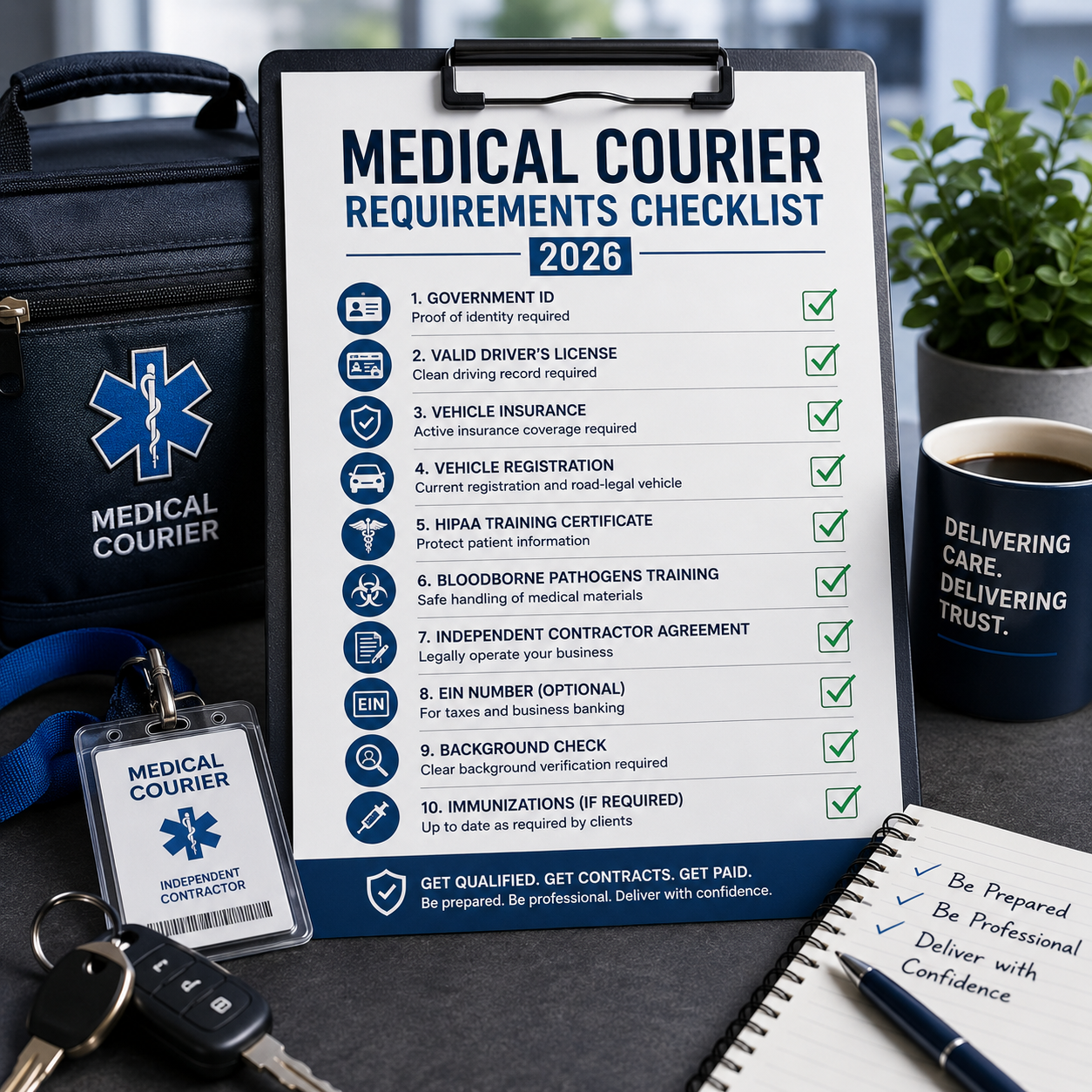
Teresa had everything she needed to start medical courier work — except she did not know what everything was.
She spent three weeks researching online, getting conflicting answers about licenses, certifications, and insurance. She almost paid $400 for a courier certification course that no healthcare facility in her area actually required.
One phone call to a local lab manager clarified the entire list in four minutes. She had her first contract running six days later.
The requirements for medical courier work in 2026 are not complicated. They are just not clearly documented in one place — until now.
Quick Answer Medical courier requirements in 2026 include a valid driver's license, reliable vehicle, commercial auto insurance, a clean background check, and a HIPAA compliance certificate. Most couriers also register an LLC before approaching facilities. Total cost to meet all requirements is $300 to $600. No medical degree, no CDL, and no special courier certification is required for standard routes.
Key Takeaways
- Five non-negotiable requirements must be in hand before contacting any facility
- Commercial auto insurance is the most commonly missed requirement — and the most important
- HIPAA training is available online for $25 to $75 and takes two to four hours
- Background check results return in three to seven business days and cost $30 to $60
- An LLC is not legally required but most facilities prefer contracting with a business entity
- No special courier certification is required — courses that claim otherwise are not industry-standard
Medical courier requirements exist for one reason — healthcare facilities are legally responsible for the safe handling of patient specimens, medications, and protected health information. Every requirement they ask for is a compliance checkpoint that protects both the facility and the patient.
Understanding why each requirement exists makes it easier to present yourself professionally when you call a facility for the first time. You are not checking boxes. You are demonstrating that you operate at a professional standard.
According to the Bureau of Labor Statistics, healthcare support roles — including specialized medical transport — are among the fastest-growing service categories through 2030, driven by an aging population and expanding outpatient care networks. The couriers who enter this space fully credentialed are the ones facilities call first.
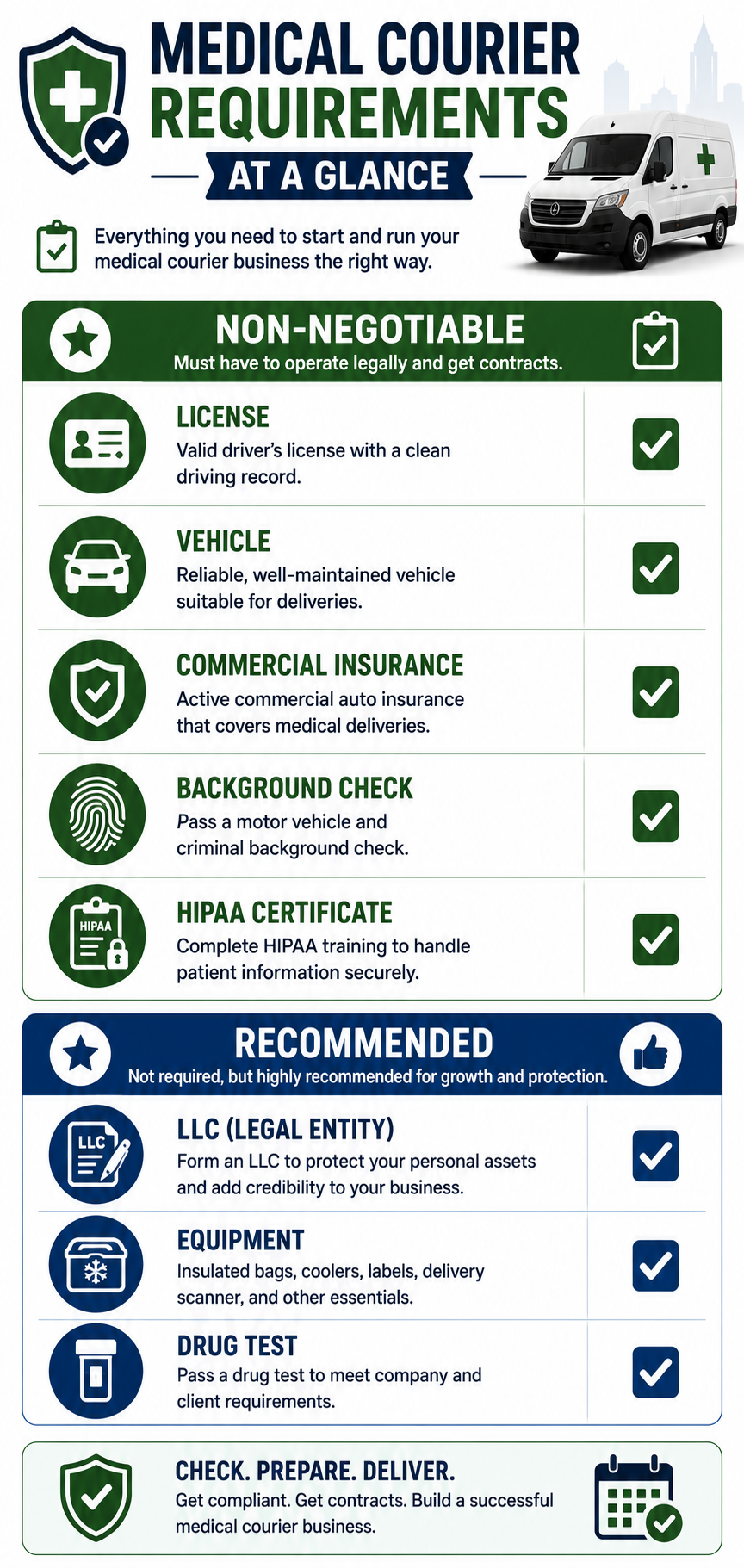
The Five Non-Negotiable Medical Courier Requirements
These five items must be complete before you contact a single facility. Every one of them has a specific purpose — and every one of them will be asked for before a facility signs a contract with you.
Requirement 1 — Valid Driver's License
A standard state-issued driver's license is sufficient for the overwhelming majority of medical courier work. No commercial driver's license is required for transporting specimens, medications, or medical documents.
A CDL only becomes relevant if you are transporting regulated medical waste in quantities that trigger federal Department of Transportation thresholds. That applies to a narrow category of specialty biohazard routes — not standard lab or pharmacy courier work.
Your license must be current, valid in your state, and free of major violations. Some facilities pull your driving record as part of their vetting process. A clean record accelerates that process significantly.
Requirement 2 — Reliable Vehicle
Your vehicle does not need to be new. It needs to be clean, mechanically reliable, and appropriate for professional client-facing transport.
Most medical couriers start with a personal car or SUV. Some hospital systems and larger lab networks require vehicles no older than seven to ten years. A cargo van is not required to start — it becomes relevant as contracted route volume increases beyond what a standard vehicle can handle efficiently.
Your vehicle will be seen by facility staff at pickup and drop-off locations. First impressions at loading docks and clinic entrances matter more than most new couriers expect.
Requirement 3 — Commercial Auto Insurance
This is the requirement most new couriers miss — and the one that stops facility conversations cold when it is absent.
Your personal auto insurance policy does not cover you when you are transporting goods, specimens, or medications for commercial purposes. If you are in an accident while on a commercial route under a personal policy, your claim can be denied entirely.
Commercial auto insurance for a medical courier typically costs $100 to $200 per month depending on your state, vehicle type, and coverage level. It is issued in your business name — which is another reason the LLC comes first.
For a full breakdown of coverage types, providers, and cost ranges — medical courier insurance guide covers every option specific to this work.
Requirement 4 — Clean Background Check
Healthcare facilities require background checks before granting any courier access to their premises, specimens, or patient-adjacent spaces. Most use third-party screening services — Sterling, Checkr, and First Advantage are common in the healthcare sector.
The background check costs $30 to $60 and is typically your expense as the applicant. Results return in three to seven business days depending on the provider and your state.
Felonies are the most common automatic disqualifier. Recent DUIs typically disqualify as well. Minor violations from more than five to seven years ago vary by facility policy. When in doubt — run your own background check first so there are no surprises during a facility's vetting process.
Requirement 5 — HIPAA Compliance Training
Medical couriers handle protected health information every single run. Patient names appear on specimen labels. Delivery addresses connect to medical records. Documents contain diagnosis codes and treatment information.
The Health Insurance Portability and Accountability Act — HIPAA — governs how that information must be handled, stored, and protected. Facilities are legally required to ensure that every person who has access to PHI is trained on their obligations under the law.
HIPAA compliance certificates for couriers and healthcare support staff are available online through HIPAA Exams, Compliancy Group, and MedBridge. Courses take two to four hours and cost $25 to $75. The certificate carries your name and completion date — which is what facilities ask to see before granting access.
This is not optional. It is non-negotiable at every professional healthcare facility.
If you want the complete startup system — compliance checklist, outreach scripts, contract templates, and 90-day action plan — the Medical Courier Business Starter Kit at SteadyIncomeTools.com walks you through every requirement in order from day one.
Two Strongly Recommended Requirements
These two items are not legally mandated for all couriers — but they are practically required for professional operation and direct contract eligibility.
LLC Registration
Most healthcare facilities prefer or require contracting with a registered business entity rather than an individual. An LLC — limited liability company — accomplishes two things simultaneously.
It signals professional legitimacy to the facilities you approach. And it separates your personal financial liability from your business operations — which matters when you are transporting medical specimens under a signed contract.
Forming a single-member LLC costs $50 to $150 depending on your state and takes five to ten business days. For the full decision framework — should you form an LLC for medical courier work covers when it is essential and when it can wait.
Basic Transport Equipment
You need appropriate equipment before your first run — not after. Facilities expect you to arrive with the right tools for safe specimen handling.
The minimum equipment list for standard specimen transport:
- Medical-grade hard-sided insulated cooler
- Two sets of gel ice packs — one in use, one in rotation
- Biohazard specimen bags — leak-proof, labeled
- Secondary containment bags
- Nitrile gloves — multiple pairs per run
- Cleaning spray for cooler decontamination between runs
Total cost for the minimum setup: $65 to $130 depending on suppliers. This is not optional equipment — it is what separates a professional medical courier from a gig driver with a cooler bag.
Requirements That Are NOT Standard — Know the Difference
Several requirements get cited online that are either industry-specific, state-specific, or not standard at all.
Requirement Standard? Notes CDL license No Only for regulated medical waste transport Medical courier certification course No Not required by healthcare facilities Drug test Sometimes Required by some hospital systems — not universal DOT physical No Only for CDL-level transport Biohazard handling certification Sometimes Required by specific lab networks Vehicle GPS tracking Sometimes Required by some larger contracts Drug testing is the most common facility-specific requirement. Larger hospital systems and national lab networks are more likely to require it. Independent clinics and smaller physician offices rarely do. Ask during your initial facility conversation — do not assume either way.
What Facilities Actually Look For When You Call
When you introduce yourself to a lab manager or office coordinator, they are mentally running through a checklist. They want to know four things before they consider moving forward.
Are you insured for commercial transport? Are you HIPAA trained? Have you passed a background check? Are you operating as a legitimate business entity?
Walking into that conversation with all four answers being yes moves you from cold caller to credible candidate in under two minutes.
For the complete outreach script and call approach — how to become a medical courier in 2026 covers the exact first contact process that converts facility calls into trial runs.
The Medical Courier Business Starter Kit at SteadyIncomeTools.com includes a printed requirements checklist, the LLC setup guide, HIPAA training provider comparison, and the insurance briefing document that makes every facility conversation professional from the first call.
Directional Close
Teresa's three weeks of confused research came down to one thing — she did not have the complete list in one place. Now you do.
The requirements are not the barrier. The time it takes to complete them is the only variable. Most couriers who start all five simultaneously on the same day are ready for outreach within ten to twelve business days.
Once your requirements are complete — the next question is what this work actually pays before you quote your first facility. Read medical courier salary: what drivers really earn in 2026 before you name a number.
You Might Also Like
- How to Become a Medical Courier in 2026 — the complete step by step launch guide
- Medical Courier Insurance Guide — every coverage type explained with cost ranges
- Should You Form an LLC for Medical Courier Work — the full decision framework
- Medical Courier Taxes Explained — what independent contractors owe and how to prepare
Frequently Asked Questions
What are the requirements to become a medical courier in 2026? The five non-negotiable medical courier requirements in 2026 are a valid driver's license, a reliable vehicle, commercial auto insurance, a clean background check, and a HIPAA compliance certificate. Most couriers also register an LLC before approaching facilities and purchase basic transport equipment including an insulated cooler, biohazard bags, and nitrile gloves. Total cost to meet all requirements ranges from $300 to $600 including the first month of commercial insurance.
Do you need a CDL to be a medical courier? No — a standard state-issued driver's license is sufficient for the vast majority of medical courier work including specimen transport, medication delivery, and medical document runs. A CDL is only required for transporting regulated medical waste in quantities that trigger federal Department of Transportation thresholds. That applies to a narrow category of specialty biohazard routes. Standard lab, pharmacy, and clinic courier work does not require a CDL at any point.
Do medical couriers need HIPAA training? Yes — HIPAA training is a non-negotiable requirement for professional medical courier work. Medical couriers handle protected health information on every run including patient names on specimen labels, delivery addresses tied to medical records, and documents containing diagnosis codes. Healthcare facilities are legally required to verify that anyone with access to PHI has completed HIPAA training. Certificates are available online through providers including HIPAA Exams and Compliancy Group for $25 to $75 and take two to four hours to complete.
What background check do medical couriers need? Healthcare facilities typically require a standard criminal background check before granting courier access to their premises and specimens. Most use third-party screening services including Sterling, Checkr, and First Advantage. The check costs $30 to $60 and is typically the courier's expense. Results return in three to seven business days. Felonies and recent DUIs are the most common disqualifiers. Running your own background check before facility outreach eliminates surprises during the vetting process.
Do medical couriers need commercial auto insurance? Yes — commercial auto insurance is a non-negotiable requirement for professional medical courier work. A personal auto policy does not cover a driver who is transporting goods or specimens for commercial purposes. If an accident occurs on a commercial route under a personal policy the claim can be denied entirely. Commercial auto insurance for a medical courier typically costs $100 to $200 per month depending on state, vehicle type, and coverage level. It must be issued in the business name — which is why LLC registration comes before insurance application.
Do medical couriers need to pass a drug test? Drug testing requirements for medical couriers vary by facility. Larger hospital systems and national lab networks are more likely to require pre-contract drug testing. Independent clinics, smaller physician offices, and regional labs rarely require it. There is no universal regulatory requirement for medical courier drug testing outside of DOT-regulated routes. Ask about drug testing requirements during your initial facility conversation — do not assume either way. Having a clean record and being prepared to test on request strengthens your professional credibility regardless.
Is a medical courier certification course required? No — there is no industry-standard medical courier certification course that healthcare facilities require before contracting with a courier. Courses marketed as required certifications are typically third-party products not recognized as mandatory by hospitals, labs, or clinics. The actual requirements are the five items covered in this article — license, vehicle, commercial insurance, background check, and HIPAA training. HIPAA training is the closest thing to a certification requirement and it costs $25 to $75 online from reputable providers.
Do medical couriers need an LLC? An LLC is not legally required to operate as a medical courier but it is strongly recommended before approaching facilities for direct contracts. Most healthcare facilities prefer or require contracting with a registered business entity rather than an individual. An LLC signals professional legitimacy, separates personal financial liability from business operations, and is required before commercial auto insurance can be issued in the business name. Forming a single-member LLC costs $50 to $150 depending on the state and takes five to ten business days.
Comments ()