
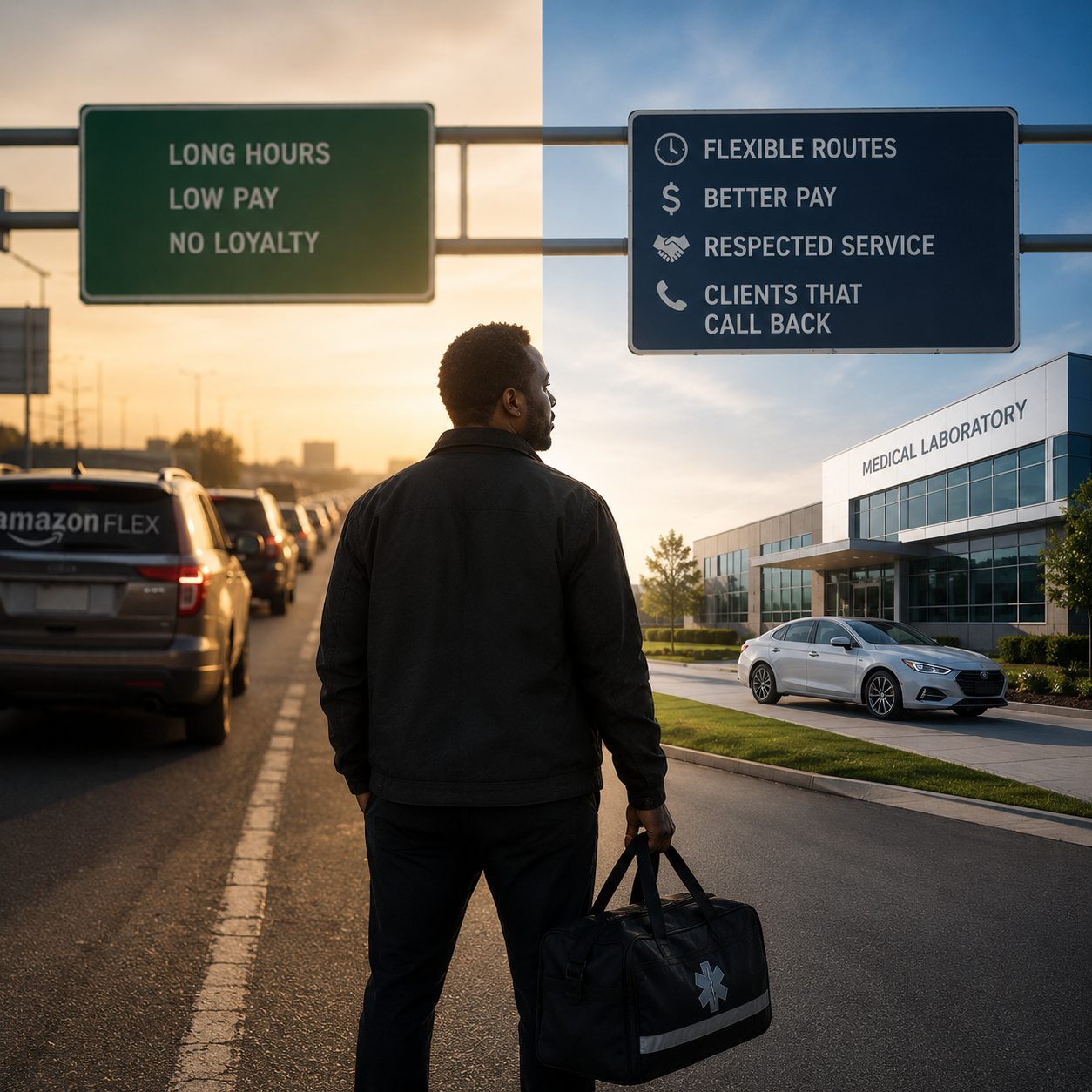
Marcus had been driving for Amazon Flex for eight months when a friend mentioned medical courier work. Same vehicle. Same hours. Double the pay per route — and clients who actually called back.
He spent one weekend getting his paperwork in order. He sent three emails to local labs. He had his first contract signed within ten days.
He has not driven for Amazon Flex since.
Quick Answer To become a medical courier in 2026, you need a valid driver's license, reliable vehicle, commercial auto insurance, a clean background check, and HIPAA compliance training. Most couriers complete setup in two to four weeks for a total startup cost of $300 to $600. No degree, no CDL, and no prior medical experience required.
Key Takeaways
- The five non-negotiable requirements are license, vehicle, commercial insurance, background check, and HIPAA training
- Total startup cost for most new couriers is $300 to $600 including first month of insurance
- Direct contract couriers earn $28 to $65+ per hour — two to three times more than standard gig delivery
- Most new couriers land their first contract within two to four weeks of completing setup
- Direct client outreach — not job boards — is the fastest path to a first contract
- This is professional contracted work, not gig work — clients sign agreements and pay on invoice
Medical courier work is one of the most accessible professional income opportunities available to drivers in 2026. The barrier to entry is low. The pay ceiling is not.
According to the Bureau of Labor Statistics, specialized medical transport commands significantly higher rates than general delivery work — a gap that has widened as healthcare facilities have raised their standards for courier vetting and credentialing.
The difference between a $17 per hour gig driver and a $42 per hour medical courier is not skill or experience. It is a $400 compliance setup and the knowledge of exactly what to do with it.
What a Medical Courier Actually Does
Medical couriers transport time-sensitive biological and medical materials between healthcare facilities. That includes blood and urine specimens from clinics to labs, prescription medications from pharmacies to patients, and medical records between offices.
This is not food delivery with a different name. Medical courier work is professional transportation performed under HIPAA compliance obligations and healthcare facility access requirements.
Clients are hospitals, diagnostic labs, urgent care centers, and physician offices — not consumers rating you on an app. They sign contracts. They pay on invoice. They refer you to other facilities when you perform reliably.
Medical Courier Requirements in 2026
Here is exactly what you need before your first outreach call.
Do not contact facilities until all five non-negotiable items are in hand. Facilities that call back when you are still waiting on paperwork rarely call a second time.
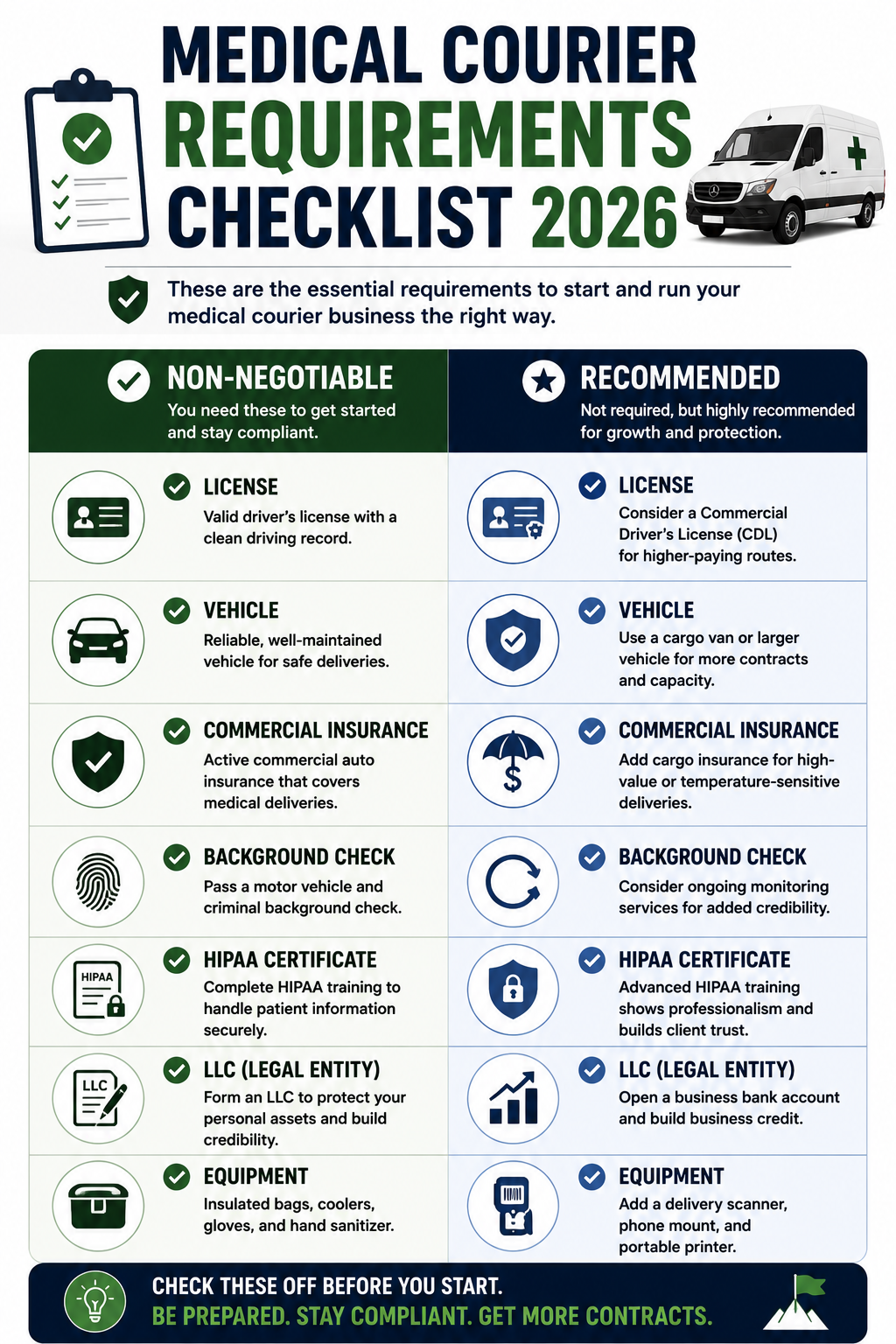
The Five Non-Negotiable Requirements
Valid Driver's License A standard state-issued driver's license is sufficient for most medical courier work. A CDL is not required unless you are transporting regulated medical waste in quantities that trigger federal DOT thresholds. That applies to a narrow category of specialty routes — not standard specimen or medication delivery.
Reliable Vehicle Your vehicle must be clean, mechanically reliable, and appropriate for professional work. Most couriers start with a personal car or SUV. Some hospital systems require vehicles no older than ten years.
Commercial Auto Insurance Your personal auto policy does not cover you when transporting goods or specimens for commercial purposes. Commercial coverage typically costs $100 to $200 per month. This is the requirement most new couriers miss — and the one that stops facility conversations cold when it is absent.
Clean Background Check Healthcare facilities require background checks before granting courier access to their buildings and specimens. The check costs $30 to $60. Results return in three to seven business days. Felonies and recent DUIs are the most common disqualifiers.
HIPAA Compliance Training Medical couriers handle protected health information — patient names on specimen labels, delivery addresses tied to medical records. HIPAA certificates are available online through providers including HIPAA Exams and Compliancy Group. Courses take two to four hours and cost $25 to $75.
Two Strongly Recommended Items
LLC Registration Most facilities prefer contracting with a registered business entity rather than an individual. Forming a single-member LLC costs $50 to $150 depending on your state and takes five to ten business days.
Basic Transport Equipment A medical-grade insulated cooler, gel ice packs, biohazard specimen bags, and nitrile gloves cover most standard runs. Total cost: $65 to $130.
For the full credential and compliance breakdown — medical courier requirements explained covers every document, cost, and timeline in one place.
If you want the complete startup system — outreach scripts, contract templates, pricing guide, and 90-day action plan — the Medical Courier Business Starter Kit at SteadyIncomeTools.com walks you through every step from paperwork to first paid run.
How to Become a Medical Courier: Step by Step
Step 1 — Start All Four Compliance Documents on the Same Day
Do not work through them sequentially. Initiate LLC registration, commercial insurance application, HIPAA training enrollment, and background check submission simultaneously.
All four started on the same day means all four complete within the same ten-day window. That is the fastest legal path from decision to ready.
Step 2 — Purchase Your Equipment Before You Start Calling
When a lab coordinator asks whether you are set up for specimen transport, your answer needs to be yes without hesitation. The minimum setup — insulated cooler, gel packs, biohazard bags, nitrile gloves, cleaning spray — runs under $150.
Order before outreach begins. Arrive prepared.
Step 3 — Build a Target Client List of 20 to 30 Facilities
Your best first clients are within 20 miles of where you live. Closer routes mean lower fuel costs and faster relationship building.
Search Google Maps for diagnostic lab, clinical laboratory, urgent care, and physician group in your area. Record the name, address, and direct phone number for each location before you make a single call.
Step 4 — Call Directly — Do Not Email and Wait
Ask to speak with the lab manager, office manager, or logistics coordinator at each facility. Use this opening:
"Hi, I'm [name] with [business name]. We provide licensed, HIPAA-compliant specimen and medical courier services in the [area] region. I wanted to reach out to see if your facility uses independent couriers or has any upcoming courier needs I could help with."
Some facilities have long-term courier relationships. Others have been burned by unreliable gig drivers and are actively looking. You will not know which is which until you call.
Step 5 — Offer a Trial Week Before Asking for a Full Contract
When a facility expresses interest, remove their risk. Offer one week of morning pickup routes at a flat agreed-upon rate before asking for a full contract commitment.
Trial runs that go smoothly convert to ongoing contracts at a high rate. One smooth week earns more trust than any proposal document.
Step 6 — Expand Through Referrals After Your First Contract
After 60 days with any client, ask directly: "Do you know any other facilities in the area that might benefit from what we provide?"
That question costs nothing and takes thirty seconds. Most couriers never ask it. The ones who do build full schedules faster than anyone relying only on cold outreach.
What Your Income Looks Like at Each Stage
Contract Stage Routes Estimated Monthly Income First contract — single facility 1 morning route $600 – $800 Early growth — two facilities 2 morning routes $1,400 – $2,000 Established — three facilities 3 routes, mixed timing $3,000 – $5,500 Full operation — multiple contracts 4+ routes, multiple types $5,000 – $9,000+
A single morning specimen route earns $600 to $800 per month. Three direct contracts covering different facilities and time windows earn $3,000 to $5,500 per month from the same vehicle.
The vehicle does not change. The insurance does not change. The contracts do.
For the full income breakdown by work structure, state, and route type — medical courier salary: what drivers really earn in 2026 covers every tier with specific numbers.
Common Mistakes New Medical Couriers Make
Starting outreach before documents are ready. Facilities that call back when you are still waiting on your insurance certificate rarely call a second time. Have everything in hand before you dial.
Underpricing the first contract. Fear of losing a contract causes most new couriers to quote $15 to $18 per hour when the direct contract market supports $30 to $45. Quote market rates — not what you think they want to hear.
Working only one time window. Specimen pickup is morning-heavy but medication delivery, document transport, and evening stat runs fill the rest of the schedule. Couriers covering multiple windows earn significantly more from the same vehicle.
Never asking for referrals. The fastest route expansion strategy costs nothing and takes thirty seconds. Most couriers never use it.
The Medical Courier Business Starter Kit at SteadyIncomeTools.com includes the exact outreach scripts, contract templates, equipment checklist, and pricing guide that take new couriers from paperwork complete to first paid run — without the six-week learning curve most people build on their own.
Directional Close
The compliance documents are the only real barrier between you and your first medical courier contract. Everything else — the equipment, the outreach, the trial run — follows naturally once those four items are in hand.
Most couriers who treat setup as a ten-day sprint rather than a six-month project have their first contract before the end of their first month.
Before you price that first contract, understand exactly what this work pays across every work structure. Read medical courier salary: what drivers really earn in 2026 before you quote anything to your first facility.
You Might Also Like
- Medical Courier Requirements Explained — every credential, document, and compliance item in one place
- Medical Courier Companies Hiring in 2026 — if you want employee income while building toward direct contracts
- Medical Courier Insurance Guide — the commercial coverage that unlocks professional rates
- How to Get Medical Courier Contracts — the outreach strategy that fills your schedule with direct clients
Frequently Asked Questions
Do you need a special license to become a medical courier? No special license is required for standard medical courier work in 2026. A valid state-issued driver's license is sufficient for transporting specimens, medications, and medical documents. A CDL is only required for hauling regulated medical waste in quantities that trigger federal DOT thresholds — which applies to a narrow category of specialty routes. The vast majority of working medical couriers operate with a standard driver's license throughout their entire career.
How long does it take to become a medical courier? Most new medical couriers complete setup and land their first contract within two to four weeks. LLC registration takes five to ten business days. Commercial auto insurance can be secured in one to two days. HIPAA training takes two to four hours online. A background check returns in three to seven business days. All four can be initiated on the same day — meaning the full compliance package is typically complete within ten to twelve business days of starting.
Can you become a medical courier with no experience? Yes — no prior medical or courier experience is required. The requirements are compliance-based, not experience-based. What facilities evaluate is whether you are insured, HIPAA-trained, background-checked, and professional. The learning curve is the route itself — which most new couriers master within the first two to three runs.
How much does it cost to become a medical courier? Total startup costs range from $300 to $600, including the first month of commercial auto insurance. The breakdown is approximately $50 to $150 for LLC registration, $100 to $200 for first month insurance, $25 to $75 for HIPAA training, $30 to $60 for the background check, and $65 to $130 for basic transport equipment. Most couriers recover these costs within their first two to four runs under a direct facility contract.
Can you use your own car to become a medical courier? Yes — a standard personal car or SUV is sufficient for most medical courier work including specimen transport, medication delivery, and document runs. The vehicle must be clean, mechanically reliable, and insured under a commercial auto policy rather than a personal one. A cargo van is not required to start and becomes relevant only as contracted route volume grows beyond what a standard vehicle can handle efficiently.
How do you find your first medical courier clients? The most direct path is local phone outreach to diagnostic labs, urgent care centers, and physician offices within 20 miles of your location. Build a target list of 20 to 30 facilities using Google Maps, call each one, and ask to speak with the lab manager or office manager. Offer a trial week at a flat rate before asking for a full contract commitment. Most couriers who work through a full call list land their first trial run within one to two weeks of starting outreach.
Is medical courier work stable compared to gig delivery? Medical courier work under direct contracts is significantly more stable than app-based gig delivery. Facilities on direct contracts provide scheduled routes — typically daily morning pickups — and pay on invoice rather than per order. Income is predictable, the professional relationship is ongoing, and you are not competing with other drivers through an algorithm for individual orders.
What is the first thing to do to become a medical courier? Initiate all four compliance documents simultaneously on the same day — LLC registration, commercial insurance application, HIPAA training enrollment, and background check submission. Starting all four at once means they complete within approximately the same ten-day window rather than sequentially over four to six weeks. While those documents are processing, build your target client list of 20 to 30 local facilities so outreach begins the day your paperwork is complete.
Comments ()