

Carol had managed the executive suite of a regional healthcare company for nineteen years. She knew every stakeholder, every vendor relationship, every calendar quirk of the four senior leaders she supported. In March of 2024 the company brought in a consultant, restructured the administrative function, and eliminated her role. She was 56.
The severance was eight weeks. The job search produced six interviews in four months — all of which went quiet after the second round. By October she was doing the math on her retirement account and trying not to think about what the numbers meant.
A colleague mentioned virtual assistant work at a dinner in November. Carol dismissed it initially — she assumed it meant answering emails for $15 an hour. What she discovered was a market that valued exactly what she had spent two decades building — at rates her last employer had never come close to paying her.
By her sixth month as a VA she was billing $7,400 per month. Working from home. Setting her own schedule. Answering to three clients who competed for her availability rather than one employer who had decided she was expendable.
Her story is not the exception. It is the predictable outcome of an experienced professional who stopped asking the wrong market to value her and found the one that would.
The Question Everyone Is Really Asking
When someone searches "how much do virtual assistants make" — they are almost never asking an abstract question about the VA industry.
They are asking a specific, urgent, personal question that sounds something like this: Is this real enough to replace what I lost? Can this actually cover my bills? Is this worth the risk of trying something I have never done before?
Those questions deserve honest answers — not optimistic ranges designed to make the opportunity look as large as possible, and not conservative hedging designed to avoid setting false expectations.
The honest answer is that virtual assistant income varies significantly — by niche, by experience level, by how quickly you build your client base, and by whether you enter the market with the positioning your background actually justifies or the positioning that anxiety produces.
This breaks down the real numbers across every major VA category so you can evaluate this opportunity against your specific situation rather than against a generic income claim.
What Is Actually Driving the Demand for VA Work Right Now
Before the numbers — understanding why the VA market is growing right now matters for anyone evaluating whether this is a real long-term opportunity or a temporary gap.
The answer is structural — and it is directly connected to the same economic forces that are eliminating the jobs that experienced professionals built their careers around.
Small business formation in the United States hit record levels in 2023 and 2024 and has continued growing. Every new business owner who launches without a support team eventually reaches the point where administrative and operational overhead consumes the time they should be spending on revenue generation. That moment is when they look for a VA — and the number of business owners reaching that moment is growing faster than the supply of qualified VAs to serve them.
At the same time — AI tools are changing what clients expect from VAs. The routine, repetitive administrative tasks that AI can handle are being automated. The judgment-based, relationship-intensive, strategically complex work that experienced professionals deliver is growing in demand because it is exactly what AI cannot replicate.
The experienced professional who was replaced by cheaper labor or automation in one market is frequently the most qualified person available in the VA market for the work that still requires genuine human expertise. The irony is real — and so is the opportunity it creates.
For the people who are living through this displacement right now — the 52-year-old whose department was outsourced, the 58-year-old whose role was eliminated in a restructuring that was really just a cost reduction with a strategic name — the VA market is not a consolation prize. It is a structural opportunity created in part by the same forces that created their displacement.
The Honest Income Breakdown — What VAs Actually Make in 2026
Entry Level General VA — $18 to $28 Per Hour
This is the starting point for VAs with no specialized niche and no prior professional background in the work they are offering. General task support — basic email management, simple scheduling, data entry, social media posting — at rates that reflect the commodity nature of the offering.
Monthly income at this level: Working 20 hours per week: $1,440 to $2,240 per month Working 30 hours per week: $2,160 to $3,360 per month
Who earns at this level: People who are genuinely starting from scratch with no relevant professional background. People who positioned themselves as generalists rather than specialists. People who set their rate based on platform averages rather than their professional experience.
If you are an experienced professional with a relevant corporate background — you should not be here. This is the rate that anxiety produces when it overrides the judgment of what your background actually justifies.
Experienced General VA — $28 to $45 Per Hour
VAs with a professional background in administrative or operational work who have not yet specialized their positioning. The experience is visible in the quality of the work — but the positioning does not communicate it clearly enough to command specialized rates.
Monthly income at this level: Working 20 hours per week: $2,240 to $3,600 per month Working 30 hours per week: $3,360 to $5,400 per month
Who earns at this level: Former office managers and administrative coordinators who positioned as general VAs rather than niche specialists. Corporate professionals who are two positioning decisions away from the specialized rate range — and who often move there within three to six months of active client development once they see what the market actually supports.
Specialized VA — $40 to $75 Per Hour
The first rate tier where professional experience is fully reflected in the market price. Bookkeeping VAs, social media VAs, e-commerce operations VAs, and project coordination VAs with relevant professional backgrounds compete in a significantly smaller talent pool — which supports significantly higher rates.
Monthly income at this level: Working 20 hours per week: $3,200 to $6,000 per month Working 30 hours per week: $4,800 to $9,000 per month
Who earns at this level: Former bookkeepers and financial administrators. Marketing coordinators and social media managers. Operations coordinators with e-commerce or project management backgrounds. These are people whose professional background maps directly onto a high-demand VA niche — and who positioned themselves specifically enough to reach the clients who pay for that specificity.
This is the income tier where VA work begins to look like genuine salary replacement for most displaced professionals — particularly those who were earning $50,000 to $75,000 in their last role.
Executive and Administrative Support VA — $45 to $85 Per Hour
The premium tier for experienced administrative professionals who position for executive-level client relationships. Former executive assistants, senior administrative managers, and C-suite support professionals who bring corporate-grade judgment to small business and entrepreneurial clients.
Monthly income at this level: Working 20 hours per week: $3,600 to $6,800 per month Working 30 hours per week: $5,400 to $10,200 per month
Who earns at this level: The Carol at the beginning of this article — the experienced administrative professional who spent years managing complex executive environments and now offers that capability fractionally to multiple clients. The former EA who supported three senior partners at a law firm. The administrative director who kept a forty-person office running during a three-year expansion.
This is where a $52,000 salary becomes a $84,000 annual income — and where the bitterness of the job loss begins to feel, if not entirely resolved, at least financially answered.
The income is not theoretical. It is what happens when someone with real professional experience stops letting an employer set the ceiling on what that experience is worth.
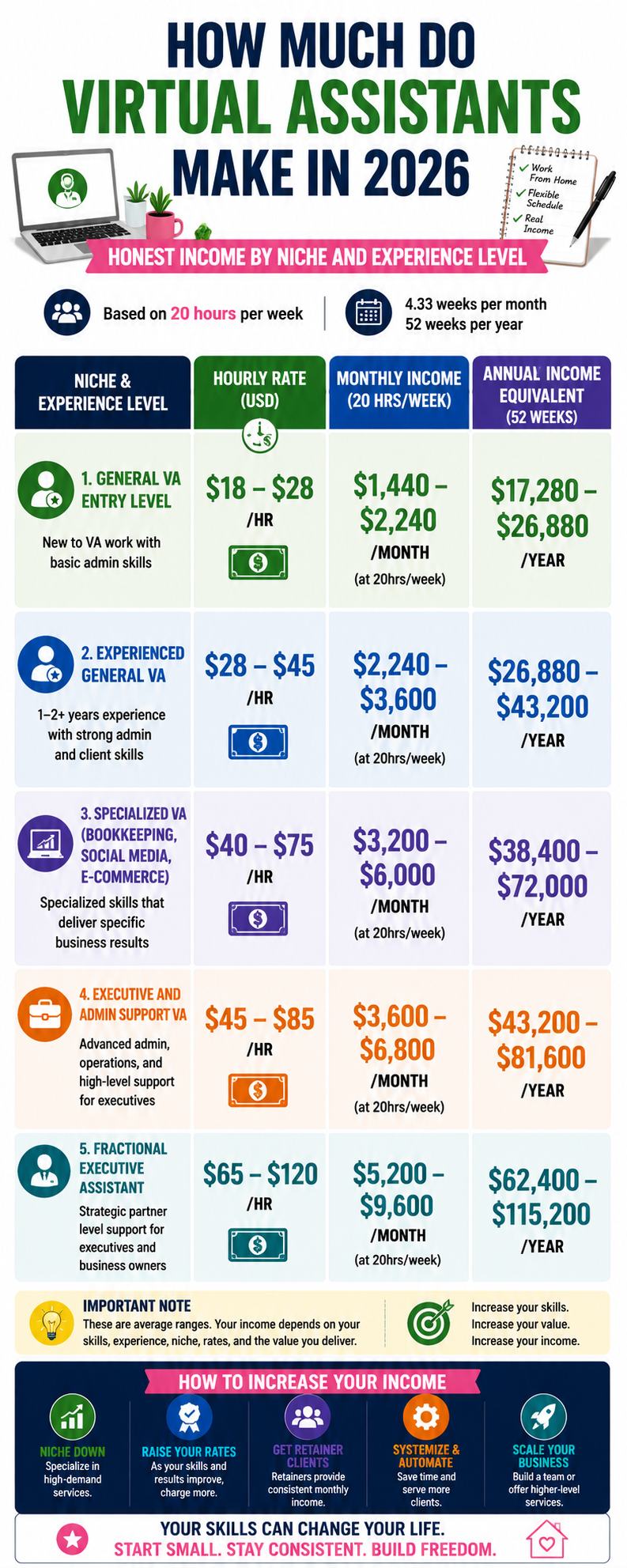
Fractional Executive Assistant — $65 to $120 Per Hour
The highest-paying position in the VA market — and the one most directly accessible to professionals with senior corporate administrative backgrounds. Multiple clients. Defined retainer hours per client. EA-level professional support delivered fractionally across a small number of high-quality relationships.
Monthly income at this level: Working 20 hours per week: $5,200 to $9,600 per month Working 30 hours per week: $7,800 to $14,400 per month
Annual income at this level: $62,400 to $172,800 depending on hours and rate
Who earns at this level: Professionals with ten or more years of senior corporate administrative experience who position for C-suite and founder-level clients and who build their practice around retainer relationships rather than hourly project work. These are not people who stumbled into a high rate — they are people who researched the market, understood their positioning, and asked for what their background justified.
For the complete picture of what this level looks like in practice — how admin professionals are building six figure virtual assistant businesses covers the transition from administrative employment to premium VA income with honest timelines and specific milestones.
The Age Advantage Nobody Is Talking About
Here is the specific truth that the job market for older workers will never tell you — because the job market benefits from you not knowing it.
The professional qualities that make experienced workers targets for layoffs in traditional employment — the seniority that costs more, the institutional knowledge that is harder to replace than a younger hire, the professional standards that require experienced peers to maintain — are exactly the qualities that make them exceptional VAs for clients who have been burned by cheaper, less experienced alternatives.
A business owner who hired a general VA from an online platform for $18 per hour and experienced the consequence — missed deadlines, inconsistent communication, work that required more oversight than it saved — is the most motivated buyer for what an experienced professional offers.
They are not looking for the cheapest option. They tried that. They are looking for someone who shows up at the professional standard that twenty years of corporate experience produces — and they will pay meaningfully more for it because they understand from direct experience what the alternative costs.
The 56-year-old who was replaced because she was too expensive for her employer is often the most sought-after option for the small business owner who finally understands that cheap has a cost.
For the older workers who are rebuilding income after displacement — how older workers are out-earning their previous salaries as freelancers covers what that transition looks like with real income numbers at every stage.
The Income Timeline — What to Expect and When
The income numbers above are not first-week results. They are the outcome of a building process that follows a consistent pattern for most experienced professionals.
Month one — $500 to $1,500: First client signed. First retainer generating income. The positioning is working. The model is proven in your specific market. The income is modest — but the proof of concept is everything.
Month two and three — $1,500 to $3,500: First retainer running consistently. Second client in conversation. First referral appearing. Income growing as the client acquisition process becomes more efficient and the positioning sharpens through real client conversations.
Month four through six — $3,500 to $6,500: Two to three retainer clients generating consistent monthly income. Rate increase discussions beginning as track record justifies them. Referrals supplementing outreach. The income looks different from month one in a way that feels genuinely significant.
Month six through twelve — $5,000 to $10,000+: Established practice. Stable retainer base. Selective about new clients because the pipeline is generating enough opportunities to choose rather than accept. Income that is either at or approaching salary replacement for most displaced professionals — sometimes significantly beyond it.
For the complete month-by-month breakdown of what drives income growth at each stage — how to build freelance income in 30 days after a layoff covers the full trajectory from first outreach through consistent monthly income.
The Specific Situation of Professionals Over 50
There is a conversation worth having directly — because a significant number of people searching this question are not 28-year-olds evaluating side income options. They are people in their late forties, fifties, and early sixties who lost careers they spent decades building and who need to know whether virtual assistant work is a real answer to a real financial problem.
The honest answer is yes — with a specific caveat.
VA work is a real answer for professionals whose background includes relevant administrative, operational, or executive support experience. For that group the transition is not a pivot — it is a repackaging. The skills exist. The market for them exists. The gap is almost entirely positioning and the confidence to ask for what those skills are actually worth.
VA work is a harder answer for professionals whose background is in fields that do not map directly onto VA services — manufacturing, skilled trades, clinical practice, or highly technical specializations that do not translate into the kind of remote professional support VA clients are buying.
For that second group — the article covering how older workers are out-earning their previous salaries as freelancers covers the broader range of income options available to experienced professionals rebuilding after displacement, including which paths fit which professional backgrounds most naturally.
What Carol Did With the Information
Carol signed her first VA retainer in January — six weeks after that dinner conversation. A founder of a healthcare technology startup who needed executive-level administrative support but could not justify a full-time EA hire. The retainer was $2,200 per month for 20 hours of support.
By April she had three clients. By July she was billing $7,400 per month — $88,800 annualized — from a home office in the same house where she had spent October doing the math on her retirement account.
She did not get lucky. She had a relevant background, positioned it correctly, asked for rates the market supported, and stayed consistent through the month when nothing had converted yet but the outreach was building toward something.
That is the formula. It is not glamorous. It is repeatable.
The Resources That Make This Real
The Admin to VA System is built for exactly the transition Carol made — covering the positioning decisions, rate-setting framework, client acquisition approach, and retainer building strategy that move an experienced administrative professional from displacement to premium VA income. It is not a general course repurposed for admins. It is built around the specific context of someone with real professional experience who needs a clear, honest path to monetizing it at the rates it actually commands.
The Virtual Assistant Side Hustle covers the complete VA business setup for professionals entering the market from any professional background — niche selection, tool setup, client acquisition, and income building in one structured resource.
For the complete guide to starting your VA practice from the very beginning — the complete guide to becoming a virtual assistant in 2026 covers every step from niche selection through first client in one place.
And for the specific rate-setting framework that ensures you enter the market at the level your background justifies rather than the level your anxiety suggests — how to set your virtual assistant rate without underselling yourself is worth reading before your first client conversation.
Worth Reading Next
- The Virtual Assistant Niches That Pay the Most in 2026
- How to Find Your First Virtual Assistant Client Without Experience
- How to Go From Admin Assistant to Six Figure Virtual Assistant Business
- How Older Workers Are Out-Earning Their Previous Salaries as Freelancers
The article that builds most directly on what we covered here is how to find your first virtual assistant client without experience — because the income numbers in this article are only meaningful when you have the client acquisition approach that converts them from projections into invoices. That article covers exactly how to do that — starting this week, without a portfolio, without a website, and without prior VA history.
Frequently Asked Questions
How much do virtual assistants make per hour in 2026?
Virtual assistant hourly rates in 2026 range from $18 to $28 per hour for entry-level general VA work, $28 to $45 per hour for experienced general VAs, $40 to $75 per hour for specialized VAs in niches like bookkeeping, social media, and e-commerce, $45 to $85 per hour for executive and administrative support VAs, and $65 to $120 per hour for fractional executive assistant professionals. The single most impactful factor in where your rate sits is niche specialization — not years of freelance experience.
Can a virtual assistant make a full-time income in 2026?
Yes — a VA working 20 to 30 hours per week in a specialized niche can generate $3,200 to $9,600 per month — which represents full-time income for most displaced professionals at the mid to upper range of their previous salaries. The timeline to full-time income is typically four to seven months for professionals who position correctly, start at market-rate pricing, and maintain consistent client development through the first 90 days.
How much do virtual assistants make per month?
VA monthly income depends on hourly rate and hours worked. At the general VA level working 20 hours per week — $1,440 to $3,600 per month. At the specialized VA level working 20 hours per week — $3,200 to $6,000 per month. At the executive support and fractional EA level working 20 hours per week — $3,600 to $9,600 per month. Most experienced professionals who position correctly reach $3,000 to $5,000 per month within three to four months of active client development.
Can older workers make good money as virtual assistants?
Yes — and in many cases older workers with relevant professional backgrounds earn at the upper end of VA income ranges specifically because their experience level qualifies them for the specialized and executive support niches that command premium rates. The professional qualities that make experienced workers targets for layoffs in traditional employment — institutional knowledge, professional judgment, communication skills developed over decades — are exactly the qualities that premium VA clients are looking for and consistently paying premium rates to access.
How long does it take to replace a salary as a virtual assistant?
Most experienced professionals who enter the VA market with relevant professional backgrounds, specialize in a high-value niche, price at market rates from the beginning, and maintain consistent client development reach salary replacement within five to eight months. The timeline is faster for professionals with large active professional networks who can activate warm relationships for first clients, and slower for those who rely primarily on cold platform applications without network outreach.
What professional backgrounds make the best virtual assistants?
The professional backgrounds that translate most directly into premium VA income are executive and administrative support, bookkeeping and financial administration, marketing and social media management, operations and project coordination, and customer service and client relationship management. All of these involve skills that small business owners and entrepreneurs need consistently, cannot easily replicate through AI or cheaper alternatives at the quality level that experienced professionals deliver, and are willing to pay premium rates to access fractionally.
What is the difference between the Virtual Assistant Side Hustle and the Admin to VA System?
The Virtual Assistant Side Hustle covers the complete VA business launch for professionals entering the market from any background — including niche selection, tool setup, client acquisition, and income building. The Admin to VA System is specifically for administrative and executive support professionals who want to position their existing corporate background for premium VA rates — covering the specific positioning decisions, rate-setting frameworks, and client acquisition approaches that convert an administrative background into expert-level VA income rather than entry-level task support rates.
Comments ()