
Marcus had been driving for DoorDash for eight months when a friend mentioned medical courier work over dinner. He looked it up that night, filed an LLC the following Monday, and six weeks later was running a morning specimen route for a regional lab network at $34 per hour — finishing before 9am every day.
His DoorDash earnings for the same three hours would have been approximately $38 total.
He has not opened the DoorDash app since.
Medical courier work sits in one of those rare gaps in the labor market — genuinely needed, consistently available, professionally compensated, and almost entirely invisible to the people who would benefit most from knowing about it. Most people who spend years driving for gig economy apps have never heard of it. Many of the ones who do hear about it assume it is complicated, credentialed, or inaccessible.
It is none of those things. Here is exactly what it is, what it pays, and how to become a medical courier in 2026 — starting this week.
What Medical Courier Work Actually Is
A medical courier transports time-sensitive healthcare materials between facilities — specimen samples from clinics to labs, medications from pharmacies to care facilities, medical records between offices, and blood products between hospitals and blood banks.
The work is not clinical. You do not handle patients. You do not need medical training. You need a reliable vehicle, a professional compliance package, and the organizational discipline to show up on time, handle materials carefully, and document every pickup and delivery.
Healthcare facilities need this service every single day — including weekends, early mornings, and after hours. The specimen collected at 6am needs to reach the processing lab before the 8am cutoff. The medication needs to arrive before the afternoon shift change. The time sensitivity is real — and it is exactly what makes the work valuable enough to pay professional rates rather than app-based delivery rates.
The direct comparison to food delivery and rideshare is worth making clearly — because most people who discover medical courier work are already driving for one of those platforms and evaluating whether to switch.
Why Medical Courier Pays What Other Delivery Work Does Not
The income gap between medical courier work and app-based delivery is not a small difference. It is the difference between building a real professional income and trading your vehicle depreciation for poverty-adjacent hourly rates dressed up by surge pricing notifications.
Here is the honest comparison:
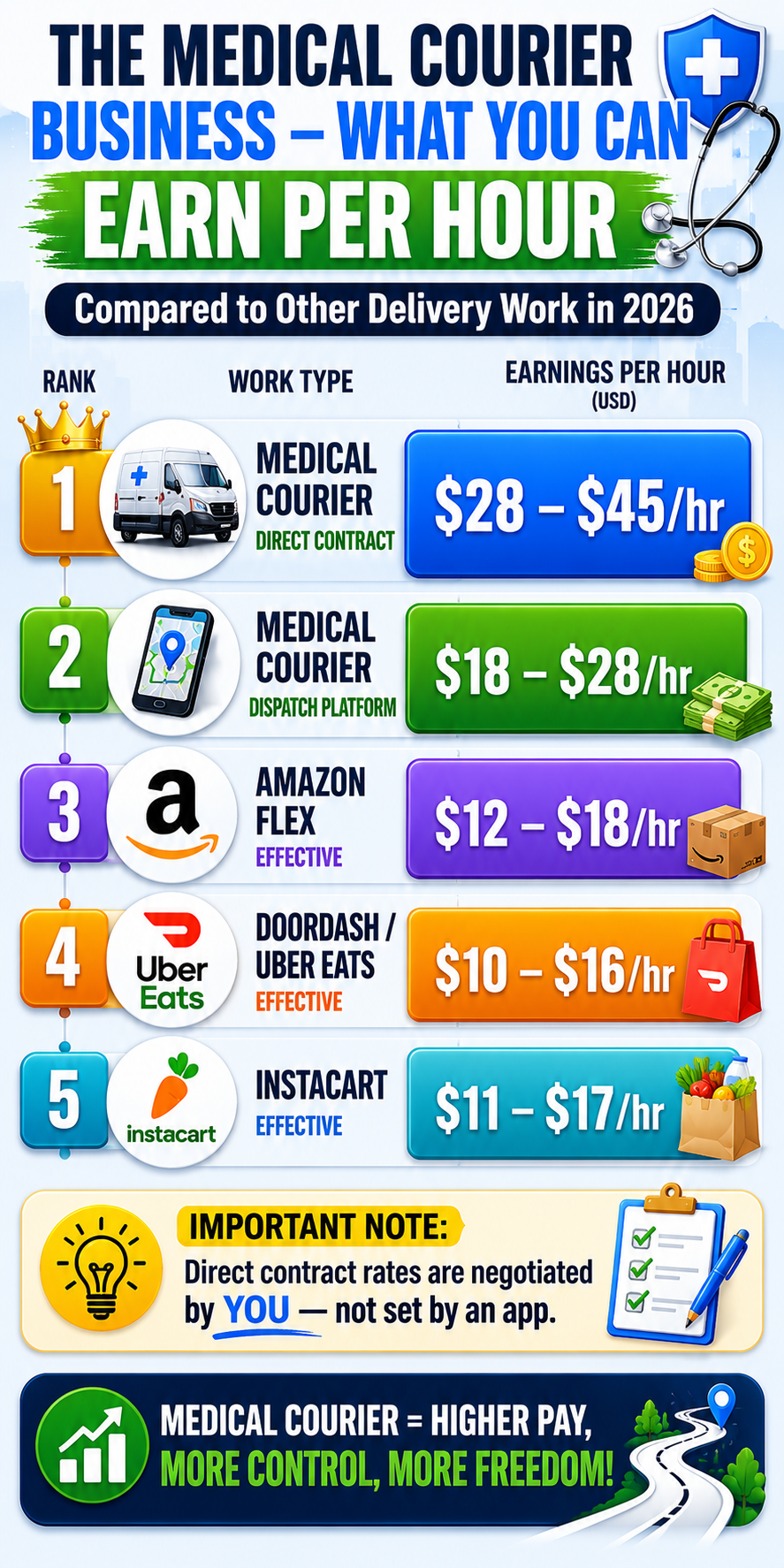
App-based delivery platforms — DoorDash, Uber Eats, Instacart — advertise earnings that sound reasonable and produce effective hourly rates, after accounting for fuel, vehicle wear, and the time spent waiting for orders, that most drivers report at $10 to $16 per hour in typical markets. The rate is set by the algorithm. You negotiate nothing. It changes without notice.
Medical courier dispatch platforms — the entry point for new medical couriers — pay $18 to $28 per hour equivalent for routed medical delivery work. More consistent per hour than food delivery because medical runs are routed rather than scattered across residential neighborhoods.
Medical courier direct contracts — the goal that most couriers reach within their first 60 to 90 days — pay $28 to $45 per hour at rates you negotiate directly with healthcare facilities. The rate is set by you. It reflects your professional compliance investment. It does not change because an algorithm updated overnight.
That gap does not close over time in the app-based delivery world. In medical courier work it widens — because your rates grow with your client relationships while app rates stay wherever the algorithm sets them.
For the direct head-to-head comparison between medical courier and Amazon Flex specifically — how medical courier income compares to Amazon Flex covers the full income comparison with honest numbers from both sides
 .
.
What You Need to Become a Medical Courier in 2026
The requirements to become a medical courier are specific, achievable, and completable within one to two weeks for most people. Here is exactly what you need — and nothing more.
A Reliable Vehicle
You do not need a specialized vehicle. A sedan, SUV, or minivan in good working condition is sufficient for most medical courier routes. The vehicle needs to be reliable — not new, not fancy, not refrigerated. Healthcare clients care that you arrive on time and that their materials are handled correctly. The vehicle is a tool, not a credential.
As your business grows and you pursue specific contract types — blood bank transport, frozen specimen delivery — specialized equipment may become relevant. For starting, what you already drive is almost certainly sufficient.
A Single-Member LLC
Healthcare facilities contract with businesses — not individuals. An LLC registration signals professional operation, provides personal liability protection, and is required by virtually every dispatch platform and direct facility client before they process contractor paperwork.
File online through your state's Secretary of State website. The process takes 30 to 45 minutes. Fees range from $50 to $150 depending on your state. Your LLC is active within one to ten business days depending on state processing times.
This is the first thing to do — before anything else.
Commercial Auto Insurance
Your personal auto insurance policy almost certainly excludes commercial use. An accident during a courier run without commercial coverage means a denied claim and personal liability for the full cost of damages.
Commercial auto coverage or a business-use rider on your existing policy costs $100 to $200 per month for most couriers. Call your existing insurance provider first — adding a rider to your current policy is often less expensive than a standalone commercial policy.
Every healthcare client will request a Certificate of Insurance before they finalize a contractor agreement. Get this in place before you start outreach.
HIPAA Awareness Training
Medical couriers transport items protected under HIPAA. Healthcare clients need documentation that you understand basic compliance requirements — what patient information confidentiality means in a transport context and what to do if something is compromised.
Free training is available through HHS.gov. Paid courses with downloadable certificates run $25 to $75 through platforms like Coursera or MedBridge. The certificate is what you need — complete the training, download the certificate, and add it to your compliance package.
Time required: two to four hours.
A Background Check
Healthcare facilities run background checks on every contractor. Run your own first — through Checkr or Sterling — so you know exactly what any client will see before they see it.
Cost: $30 to $60 for a comprehensive national check.
A Compliance Package
Your LLC registration, commercial insurance certificate, HIPAA training certificate, background check results, and driver's license copy — compiled into a single professional PDF that you can email within 60 seconds of a client asking for it.
This document is your professional introduction. The courier who sends it the same day it is requested converts client conversations to contracts. The courier who says "I will get that to you in a few days" loses the momentum of the conversation.
For the complete breakdown of every startup cost including where to get each item — what it actually costs to start a medical courier business covers every expense with exact figures so you know exactly what to budget.
How to Find Your First Medical Courier Contract
Once your compliance package is ready — the outreach process is direct and more accessible than most new couriers expect.
Start with dispatch platforms for immediate income.
Dispatch platforms approve and activate new contractors faster than direct healthcare facility relationships develop. Apply to two platforms in week one — Dropoff and CourMed are strong starting points in most markets. Upload your compliance documentation during the application. Follow up within 48 hours if you do not hear back.
Dispatch platform income typically begins within two to three weeks of application approval — giving you real earnings while your direct contract pipeline builds.
Build your direct outreach target list in week two.
Twenty healthcare facilities within 30 miles — independent labs, urgent care centers, compounding pharmacies, specialty clinics. Names, phone numbers, the name of the person who handles vendor relationships. This list is built from Google Maps searches in your area and takes two to three hours of focused research.
Make five calls per day starting Monday of week two.
Your pitch is three sentences:
"Good morning, my name is [Name] and I own [Business Name], a licensed medical courier service based in [City]. I specialize in specimen transport and pharmaceutical delivery and I am reaching out to introduce my services to facilities in the area. Do you have five minutes this week to discuss any current or upcoming courier needs — particularly for early morning or weekend coverage?"
Follow every call with an email the same day. Attach your compliance package. Use a subject line that reads exactly: Medical Courier Services — [Your Business Name] — [City].
Five calls per day across two weeks of consistent outreach reaches 50 facilities — enough pipeline to generate three to five serious conversations in most markets.
For the story of how this outreach process plays out in a real first month — including honest income numbers at every stage — how one person lost their job and built a medical courier business in 30 days covers the complete timeline from day one to first contract.
What the First 90 Days Actually Look Like
The income trajectory of a new medical courier follows a pattern consistent enough to plan around.
Weeks one and two: Zero courier income. Full focus on compliance setup and dispatch platform applications. This is normal and expected.
Weeks three and four: First dispatch platform runs generating $150 to $400 in combined income. First direct outreach conversations beginning. First compliance package emails sent.
Month two: First direct contract signed — typically a three-morning-per-week early specimen route at $28 to $35 per hour. Combined dispatch and first direct contract income reaches $800 to $1,400 for the month.
Month three: Direct contract running consistently. Second outreach cycle producing one to two additional contract conversations. Monthly income reaches $1,500 to $2,500 as the direct contract base grows.
The income in month one is not impressive. The income in month three — from the same hours of work, with the same vehicle — is the income of a professional who built something that belongs entirely to them.
For the specific strategies that accelerate income from month one to month three — how to make your first 1000 dollars as a medical courier covers the week-by-week approach that most couriers who hit that milestone follow.
The Equipment You Need Before Your First Run
You do not need to spend hundreds of dollars on equipment before your first run. You need a specific short list of items that signals professional operation to every healthcare client you serve.
Before your first run:
- Medical grade hard-sided insulated cooler — $45 to $80
- Reusable gel ice packs — $15 to $25
- Biohazard specimen transport bags — $20 to $35
- Secondary containment bags — $15 to $30
- Chain of custody documentation forms — $5 to $15
- Clipboard, pens, and disposable nitrile gloves — $20 to $30
Total Tier 1 equipment investment: $120 to $215.
For the complete equipment breakdown organized by run type with specific product recommendations — the complete medical courier equipment list covers every item so you arrive at your first pickup prepared rather than improvising.
The Resource That Compresses the Learning Curve
The biggest cost of starting a medical courier business is not the LLC filing fee or the insurance premium. It is the time spent figuring out things that someone could have told you in an afternoon — which dispatch platforms to prioritize, what to say on the first client call, how to structure a contract rate proposal, what equipment to have before your first run.
The Medical Courier Launch Kit covers every one of those decisions — compliance checklist, outreach scripts, contract templates, equipment list, and 30-day launch sequence — in one organized resource that compresses the trial-and-error learning curve of the first 30 days into a structured system.
For the complete business foundation — from first contract through building a multi-driver operation — the Medical Courier Business System covers the full picture beyond the first 90 days.
And for the comprehensive guide to everything medical courier work involves — the complete guide to starting a medical courier business from scratch covers the full picture in one place.
Worth Reading Next
- How One Person Lost Their Job and Built a Medical Courier Business in 30 Days
- How to Make Your First 1000 Dollars as a Medical Courier in 30 Days
- Medical Courier vs Amazon Flex — Which One Actually Pays Better in 2026
- What It Actually Costs to Start a Medical Courier Business
Before you close this tab — the complete guide to starting a medical courier business from scratch is the most comprehensive single resource on this topic on the site. If this article answered your first questions and you want the full picture — that is where to go next.
Frequently Asked Questions
How do I become a medical courier in 2026?
To become a medical courier in 2026 you need four things — a single-member LLC registered in your state, commercial auto insurance or a business-use rider on your existing policy, HIPAA awareness training with a certificate of completion, and a background check. Compile these into a professional compliance package PDF and you are ready to apply to dispatch platforms and begin direct outreach to healthcare facilities. Total setup time is one to two weeks. Total startup cost is $300 to $500 for most people.
How much does a medical courier make per hour?
Medical couriers on dispatch platforms earn $18 to $28 per hour equivalent. Medical couriers on direct healthcare facility contracts earn $28 to $45 per hour — at rates they negotiate directly rather than rates set by an app. Early morning and weekend runs typically command 20 to 40 percent premium above standard rates because those windows are the hardest for healthcare facilities to staff. A medical courier running three to four direct contracts can generate $2,000 to $4,000 per month part-time.
Do you need special medical training to become a medical courier?
No medical training or certification is required to start a medical courier business. You need HIPAA awareness training — which covers basic patient information confidentiality requirements — and the operational discipline to handle specimens and medications carefully, document every pickup and delivery, and arrive consistently within contracted time windows. No clinical skills, nursing background, or medical knowledge is required.
What vehicle do you need to be a medical courier?
A reliable sedan, SUV, or minivan in good working condition is sufficient for most medical courier routes. You do not need a refrigerated vehicle or specialized transport equipment to start. Temperature-controlled transport is handled through medical-grade insulated coolers and gel ice packs — not a specialized vehicle. As your business grows and you pursue specific contract types involving frozen specimens or temperature-controlled pharmaceuticals, additional equipment investments become relevant — but they are not required to start.
How long does it take to make money as a medical courier?
Most medical couriers who follow a structured setup and outreach approach generate their first income within two to three weeks of starting — from dispatch platform runs that begin as soon as their application is approved. Direct contract income typically begins in weeks three to four for couriers who start outreach in week two. Most couriers running consistent outreach generate $800 to $1,400 in month one combined from dispatch and their first direct contract.
Is medical courier work a good side hustle or full-time business?
Both — depending on how many contracts you build and how many hours you want to work. As a side hustle running early morning routes before another job or around a family schedule, medical courier work generates $800 to $1,800 per month from 10 to 15 hours per week. As a full-time business with three to five direct healthcare facility contracts, it generates $3,500 to $7,000 per month. As a multi-driver operation, the income ceiling rises significantly as each additional driver adds contract capacity without proportionally adding your personal time.
What is the Medical Courier Launch Kit and how does it help new couriers?
The Medical Courier Launch Kit is a complete startup resource for new medical couriers covering the compliance checklist, outreach scripts, contract templates, equipment list, and 30-day launch sequence. It compresses the trial-and-error learning curve of the first 30 days into a structured system — so you spend your first month building client relationships rather than figuring out the logistics of starting from scratch.

Comments ()