

Reading Time: 8 minutes Last Updated: July 2026
Priya teaches seventh-grade English outside Sacramento, and spent a whole summer researching a side business before it occurred to her to check whether her contract even allowed it. She opened the handbook the week before school started and finished the outside-employment clause in eleven minutes.
Three sentences, one disclosure form, no prohibition on her plans.
She'd delayed by a full summer over a paragraph — the one answering "are teachers allowed to have another job" — that turned out to be three sentences long.
Quick Answer
Yes — teachers in nearly every U.S. district are allowed to have another job, provided the outside work doesn't interfere with contract duties, use district resources, or create a conflict of interest. Some districts require a moonlighting form once income crosses a threshold; prohibition is rare, disclosure is common.
Key Takeaways
- Outside employment is allowed in nearly all 2026 districts — restrictions concern how, not whether.
- Three boundaries appear in almost every contract: no conflict, no district resources, no interference.
- Moonlighting forms take minutes and rarely get denied.
- An LLC is optional in most side-income scenarios; a sole proprietorship is fully legal.
- The permission question answers in fifteen minutes.
Who This Is For
You've wondered whether your side income is even allowed, and heard vague warnings about "teachers getting in trouble" without specifics. This is the plain walkthrough.
Why This Matters
Permission uncertainty is where teacher income ideas go dormant — waiting has no immediate cost, reading feels like committing.
In practice, the reading is the cheapest step in the process. Districts that do restrict outside work say so in unmistakable language, so a fifteen-minute read is almost always a green light with terms. The extra income that won't risk your job guide covers yellow-light contracts; this article gets you to the reading.
Are Teachers Allowed to Have Another Job? The Actual Legal Landscape
States treat teacher employment slightly differently, but the 2026 pattern is consistent. Public-school contracts and collective bargaining agreements address outside work in a section titled "Outside Employment," "Secondary Employment," or "Moonlighting."
Almost none prohibit outside jobs outright — they set conditions: no contract-hour work, no school property, no confidential information, no conflict of interest (like tutoring your own students for pay). Private-school contracts vary more and non-compete language occasionally appears; the reading takes fifteen minutes either way.
Can't find your outside-employment clause? HR or your union rep can point you to it in one email.
The Three Boundaries Almost Every Policy Shares
Three lines appear in nearly every teacher contract, regardless of state or district size. Knowing them lets you preview whether an income idea fits before you even read your policy.
Boundary One: No Interference With Contract Duties
Your outside work can't degrade your teaching, keep you from staff meetings, or make you unavailable during contract hours. This is the "still show up sharp on Monday" clause — evening and weekend work clears it easily; a 2 p.m. shift does not.
Boundary Two: No District Resources
Nothing you use for outside income can be district property: not the classroom, school laptop, printer paper, contract-hour curriculum, student information, or your work email. The Etsy article and digital products guide walk this boundary in depth — it applies to every outside role.
Boundary Three: No Conflict of Interest
You can't leverage your position in ways that create real or perceived conflict — tutoring your own students for pay, selling to their families, or using your title in ways implying district endorsement. Different-district students, adult clients, and general audiences avoid the boundary entirely.
Moonlighting Forms — What They Actually Are
Some districts require written disclosure of outside employment once income crosses a threshold or hits a weekly hour count.
The form is usually a single page: what you're doing, roughly how many hours, whether it involves district students. It goes to HR, gets filed, and you rarely hear about it again — denial is typically limited to obvious conflict cases.
Filing it isn't a confession. It's paperwork.
A District Compliance Officer's Take on Teacher Side Work
A district compliance officer I know reviews outside-employment questions weekly. Her framing helped me stop hedging.
She says the district cares about three things: does this affect your teaching, does it involve district property, is it embarrassing enough to end up on the news? If the answer to all three is no, she almost always signs off — the rest is your business.
Her filter is what a paid legal review would tell you.
The Waiting Room Trap
The stall that keeps teachers from checking their policy has a shape: it feels safer not to know.
You imagine restrictions, treat them as real, don't act, never confirm. Meanwhile the actual policy is one browser tab away. This mirrors the pattern in the teacher business ideas pillar — every idea in an unread folder feels harder than it is.
Read the paragraph. Whatever it says, "are teachers allowed to have another job" stops being a rumor and starts being a fact.
Four Situations — Match Yours
A specific business idea, no policy check yet → Read your outside-employment clause tonight; fifteen minutes replaces a summer of delay.
Policy mentions a form → File it before your first client or listing; filing is the whole ritual.
Private-school or charter, unsure of the rules → Ask HR directly — non-compete language is rare but exists.
Still don't know which lane fits your life → A skills-and-schedule assessment beats another Reddit thread on policies.
Three Levels of Support
Free and diagnostic. The Teacher Income Assessment matches your skills and hours to sixteen income paths — so you check policy for one specific idea, not an imagined menu.
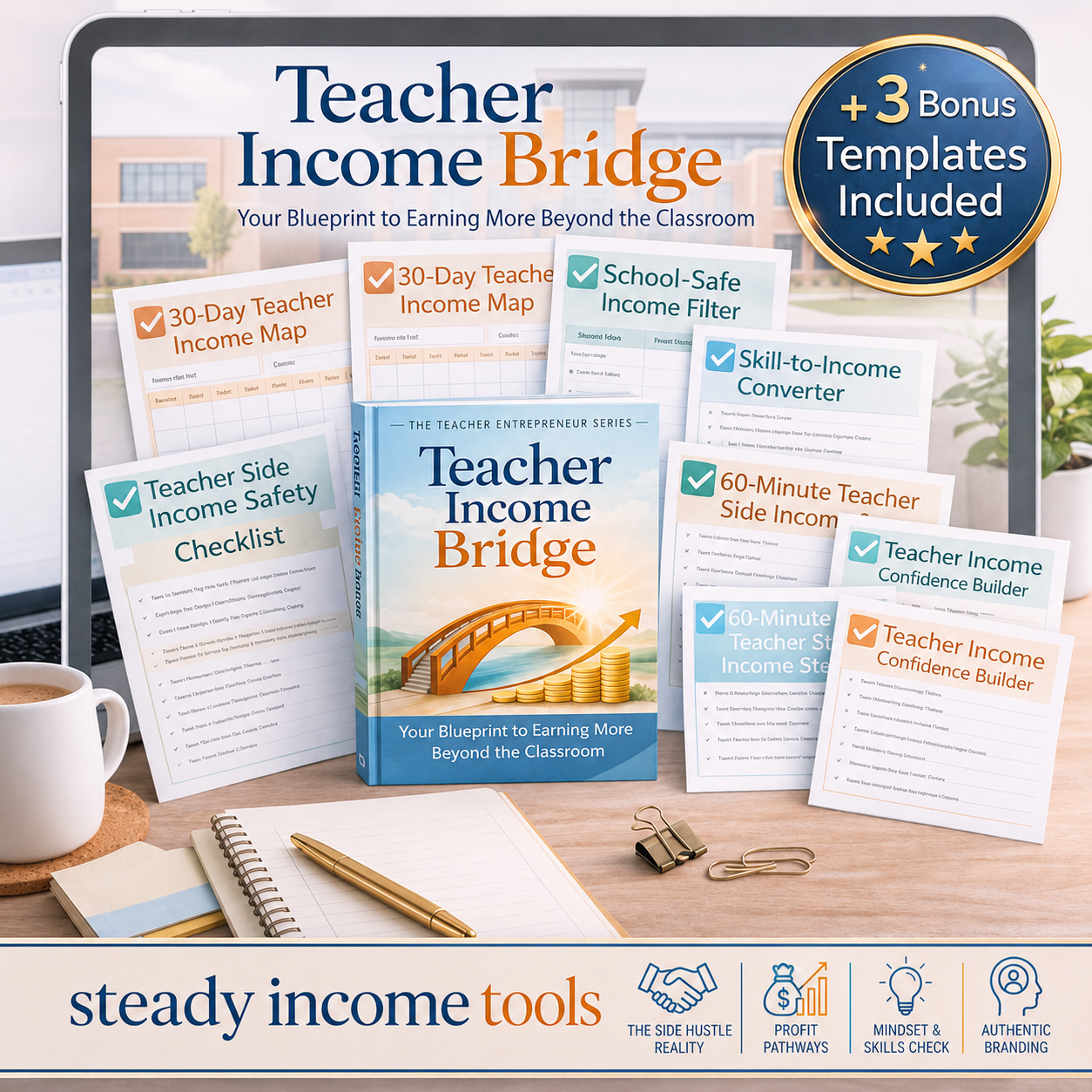
Guided. The Teacher Side Income Blueprint sequences a launch's first thirty days, with a policy check built into opening week.
Audio. The Teacher Side Income Audio Bundle delivers the same system as MP3 lessons plus printable planners.
The Summer This Article Just Saved
A cautious teacher can spend twenty hours researching side income before checking whether it's allowed. The reading step compresses that arc into an evening, and the Blueprint compresses execution on the other side.
What the Blueprint Handles on the Policy Side
The school-safe opportunity filter turns your idea into a same-day district-policy check. The safety checklist walks this article's three boundaries against your planned work, and the sequenced roadmap places any moonlighting-form filing before your first client, not after.
Where This Guidance Comes From
Steady Income Tools recommends only what shortens honest paths. If your policy read comes back with a form and a green light, this article and one evening may be all you need. Fit and consistency drive results; we systematize the order.
Still Not Ready to Read Your Contract?
The delay has a reason worth naming: reading the clause makes it real, and real means choosing. Give yourself permission to open the handbook without deciding anything — you're gathering facts, not signing up. The pillar on teacher business ideas will still be here after you close the tab.
Five Ways Teachers Trip on Policy Without Meaning To
Assuming the rumor is the rule. "I heard a teacher got in trouble" isn't policy — read your own contract, since rumors travel between districts that don't share language.
Using district Google accounts for shop email. The sign-in itself counts as using district resources — personal accounts from day one.
Selling to current students' families. Innocent transactions still cross conflict-of-interest lines — choose different-district or adult audiences.
Filing the moonlighting form after starting. Retroactive filing raises the eyebrow that on-time filing avoids.
Confusing state law with district policy. Public-employee ethics statutes exist, but most day-to-day rules live in your contract — which is usually stricter.
Your Fifteen-Minute Policy Check
- Monday: locate your employee handbook or contract PDF via HR portal or union site.
- Tuesday: search for "outside employment," "secondary employment," or "moonlighting" and read the paragraph.
- Wednesday: note any disclosure threshold or form referenced; screenshot the section.
- Thursday: if a form is required, download and set it aside for later filing.
- Friday: match one specific income idea against the three boundaries.
- Weekend: proceed, or ask HR one clarifying question in writing.
FAQ
Do I need permission from my principal to start side income?
Most districts operate on disclosure, not principal approval. You file the moonlighting form with HR if one applies to your role, and your principal typically isn't in that loop unless the work touches your school directly. Prohibition happens in narrow conflict-of-interest cases, usually through conversation rather than blanket denial.
What happens if my district doesn't have a written outside-employment policy?
Silence in the handbook doesn't mean prohibition — it usually means the topic falls under general professional-conduct language plus state-level public-employee ethics rules. The three universal boundaries still apply. Ask HR one direct question in writing to confirm before starting, and keep that reply on file.
Do teachers need to register a business to earn side income legally?
Registration depends on your state and structure, not your teaching status. Selling under your own legal name as a sole proprietor is legal in most states without registration, though many jurisdictions require a "doing business as" filing if you use a brand name. A one-hour session with a local tax pro clarifies your specific setup fast.
Will filing a moonlighting form affect my teaching evaluation?
For nearly all teachers, no. The form goes to HR, gets logged, and stays out of instructional evaluations — which are governed by different processes entirely. The only overlap risk is if outside work causes visible interference with duties, which the boundary rules already cover.
Can I use my teaching title in outside marketing?
Cautiously and honestly. "A licensed teacher" or "a classroom educator" is generally fine — true, and not tied to a specific district. Naming your employer implies endorsement your district hasn't given, and adult clients care about credentials anyway.
Related Articles
- Teacher Business Ideas: What Educators Can Actually Start in 2026
- Can Teachers Sell on Etsy? Rules, Privacy, and How to Start in 2026
- Extra Income for Teachers That Won't Risk Your Job
- Online Jobs for Teachers: The Best Remote Roles for 2026
One version of Priya already opened her handbook; another is still waiting until spring. Only one of them starts a business in October. Which version you become depends on the next fifteen minutes — the handbook is entirely indifferent either way.
Comments ()