

Reading Time: 8 minutes Last Updated: July 2026
Nadia teaches high school Spanish outside Charlotte, and last spring she counted the files in her resources folder: three hundred and forty-one. Vocabulary games, conjugation drills, sub plans, a full novel study built because nothing decent existed for her level.
Then a teacher two doors down mentioned buying a verb-drill packet online — nearly identical to one in Nadia's folder. Somebody was selling what she'd been giving away to herself for nine years.
That folder is the starting point for most digital products teachers can sell. You likely have one too.
Quick Answer
Teachers can sell printables, worksheets, lesson plans, unit studies, sub plans, classroom decor, digital planners, Google Slides templates, assessment banks, and parent-communication kits. The rule that matters most: only sell what you created on your own time with your own tools, since materials made for your district may legally belong to them. Start with one polished resource on one platform, not a fifty-item store on day one.
Key Takeaways
- Your existing classroom materials are a product inventory in waiting — but ownership rules decide what's sellable.
- Resources solving one sharp, specific problem outsell broad "mega bundles" from new sellers almost every time.
- Teachers Pay Teachers is the biggest marketplace, not the only one — alternatives trade traffic for margin and control.
- Building season is breaks and summer; selling season runs itself year-round.
Who This Is For
You've made resources colleagues borrow, or bought a download and thought you could've built it better. This guide is for educators ready to turn creation they already do into products.
Why This Matters
Teacher resource-buying has only deepened in 2026: planning time keeps shrinking while expectations don't, so teachers spend their own money solving tonight's problem — and they buy from people who understand it.
That demand makes this one of the few income paths where your day job is the qualification. It's the clearest example of the product lane from the pillar guide to teacher business ideas, and the anchor of most passive income plans for educators.
The Ownership Question Nobody Wants to Ask First
Work created within the scope of your employment — contract hours, district devices or subscriptions — is generally district property under work-for-hire principles, and selling it can violate policy. The clean path: build sellable versions from scratch, on your own time and laptop, without district logos, purchased-curriculum excerpts, or student work.
The Digital Products Teachers Can Sell Most Reliably
Buyers aren't shopping categories — they're shopping tonight's emergency, and the reliable sellers map straight onto it.
No-prep sub plans sell because emergencies don't schedule themselves. Targeted skill practice — one standard, one format, answer key included — sells because reteaching happens weekly. Seasonal teacher printables spike on predictable calendars, and editable templates sell to teachers who'd rather adapt than create.
Where to List: The Marketplace Trade-Off
Teachers Pay Teachers remains the default because the buyers are already there — you rent foot traffic in exchange for fees and rules. The teachers pay teachers alternatives flip that deal.
Marketplaces like Etsy reach parents and homeschoolers, not just classroom teachers. Self-hosted storefronts on platforms like Payhip or Shopify keep the whole margin and the customer email, but every visitor is one you brought yourself. Many 2026 sellers run a hybrid: marketplace for discovery, own store for repeat buyers.
Your first ten listings will teach you more than any platform comparison — including this one.
A Test-Kitchen Habit From a Six-Figure Storefront
A resource seller I interviewed — a former second-grade teacher, now full-time — swears by what she calls test-kitchen listings.
Before designing anything polished, she describes the resource in one sentence and asks: would a stranger search those exact words at 9 p.m. on a Sunday? If she can't imagine the search, she doesn't build it. Her flops were all resources she loved; her sellers were all problems buyers already had words for.
The Comparison Trap That Freezes New Sellers
The thing that stalls teacher-sellers isn't skill or ideas — it's browsing.
You look at established stores with a thousand reviews and cinematic preview images, then at your rough first draft, and the gap feels disqualifying. But those stores' first listings were rough too — marketplaces just don't show you anyone's year one. Every browsing session ends the same way, with "get better at design first," a conclusion that has kept talented teachers in the audience for years.
The escape is shipping something small enough that imperfection feels acceptable — one resource, one problem, listed this month. If evenings feel impossible, product building pairs naturally with side hustles that don't require nights or weekends, because it bends around any schedule.
Which Door Should You Walk Through First?
You have a folder full of classroom-tested materials → Rebuild your single most-borrowed resource from scratch and list it within thirty days.
You create constantly but nothing feels "sellable" → Run the test-kitchen filter on your last five creations; list whichever survives.
You want product income but hate design work → Start with text-forward products — sub plans, discussion guides, assessment banks — where clarity beats decoration.
You're unsure this lane fits you at all → Spend fifteen minutes on a skills-and-schedule assessment before committing an evening.
Pick Your Support Level
Map yourself first, free. The Teacher Income Assessment matches your skills, energy, and schedule against sixteen income paths — selling educational resources among them — so you confirm fit before building.
Run the thirty-day version. The Teacher Side Income Blueprint sequences a first product launch day by day, templates prebuilt.
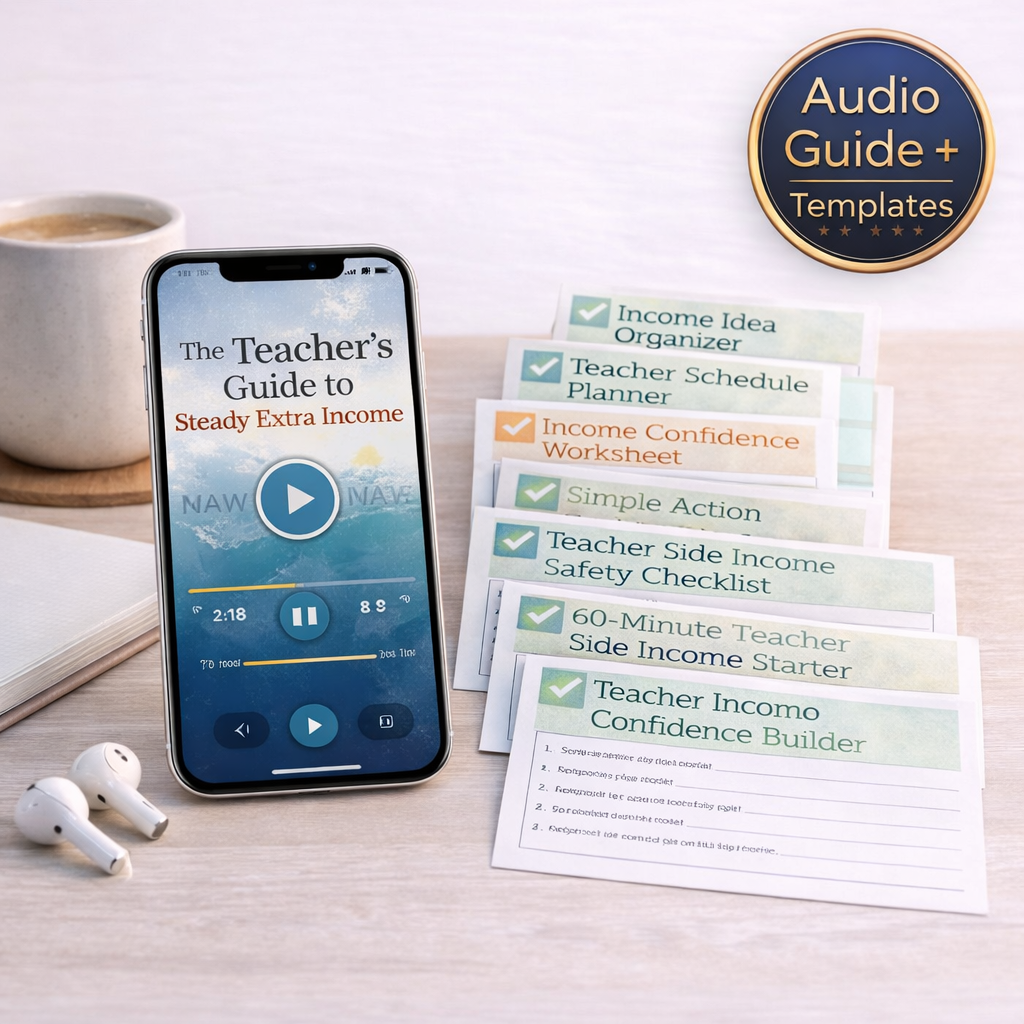
Absorb it during your drive. The Teacher Side Income Audio Bundle covers the same ground as MP3 training with printable planners — for teachers done with screens by dinnertime.
Evenings This Guide Just Handed Back
Ownership rules, marketplace comparisons, and reverse-engineering what sells normally eat eight to twelve scattered evening hours — consider that part done. What the Blueprint removes on top is sequencing: knowing day four from day fourteen, where self-directed launches drift into next semester.
How the Blueprint Handles the Product Path
In plain terms: the skill-to-income planner maps teaching strengths onto resource types buyers want, the time-to-money matrix slots creation into hours you truly have, and the school-safe filter walks this article's ownership questions step by step. The thirty-day roadmap strings it together so a first listing ships, and a one-hour quick start covers the pre-launch check most sellers skip.
Our Promise When We Recommend Anything
Steady Income Tools teaches the whole path before pointing at any product, and says outright when you can skip buying: know your niche and love your design tools already, and the free assessment may be all you need. No income figures get promised here. Organization is the only thing a system can guarantee.
Not Ready to Build Yet? Read This Part Only
Fair — then do one thing this week: star the three folder files colleagues have asked to borrow. That market signal will still be there when your semester exhales, and buyers never know or care when a store opened. Summer is a perfectly honorable start date.
Four Traps Between You and a First Sale
Uploading district-made materials as-is. The fastest route to a policy problem — rebuild on your own time and tools.
Launching a mega bundle first. Fifty unvalidated pages is a month of risk; a four-page resource is an experiment, and experiments win.
Copying top sellers' topics. Their reviews are the moat you can't cross. Serve a narrower classroom than they do.
Treating listings as finished. Previews and titles are ads; sellers who revisit them quarterly quietly outsell those who don't.
This Week's Build Plan
- Monday: list every resource a colleague ever borrowed or complimented.
- Tuesday: run each through the test-kitchen filter — write the exact search phrase a buyer would type.
- Wednesday: read your district's outside-work and intellectual-property policy, in writing.
- Thursday: choose one resource and outline its rebuild on your personal device.
- Friday: pick a first platform — marketplace for traffic, own store for margin — and open the account.
- Weekend: build page one. Just page one.
FAQ
Can teachers sell digital products?
Yes, in nearly all districts — the restrictions concern how, not whether. Materials must be created outside your employment scope, without district resources, purchased-curriculum content, or student work. Check your contract's outside-employment and intellectual-property clauses once, and build with a clear head.
What digital products sell best for new teacher stores?
Narrow, urgent, low-trust purchases: no-prep sub plans, single-standard practice sheets with answer keys, seasonal activities, and editable templates. These sell to strangers because a bad purchase costs them little. Big-ticket units sell better once your store carries reviews, so sequence them second.
Do teachers need permission to sell lesson plans?
Not for lesson plans you created independently, on personal time and equipment. You do need to avoid selling plans developed as part of your job — work-for-hire rules can make those district property. When in doubt, rebuild from a blank document at home — the concept is yours; the district file may not be.
Are Teachers Pay Teachers alternatives worth it?
Often, yes — as a complement more than a replacement. Etsy reaches homeschool families and parents, while a self-hosted store keeps your full margin plus the buyer relationship. What alternatives lack is TPT's built-in teacher traffic, so many 2026 sellers run both and let the numbers decide.
Do I need design skills to sell teacher printables?
Helpful, not required. Free tools with education templates have flattened the design curve, and formats like sub plans and assessment banks win on clarity rather than decoration. What you can't outsource is classroom judgment — knowing what a real teacher needs on a rough Tuesday.
Related Articles
- Teacher Business Ideas: What Educators Can Actually Start in 2026
- Best Passive Income Ideas for Teachers Build Income That Grows Over Time
- Side Hustles for Teachers That Don't Require Nights or Weekends
- Summer Income Ideas for Teachers That Don't Cause Burnout
Picture Nadia's folder a year from now: not three hundred and forty-one private files, but fifteen public listings, rebuilt clean, each answering a stranger's 9 p.m. Sunday search. The novel study she built because nothing decent existed — another Spanish teacher is searching for it right now. The only question is whether she finds Nadia's version or keeps finding nothing.
Comments ()