

Reading Time: 12 minutes Last Updated: July 2026
Corinne has taught fourth grade in Dayton for eleven years, and she keeps a note on her phone titled "Someday." It holds twenty-three entries: an Etsy shop, a tutoring service, curriculum writing, a reading blog, a summer camp. Every entry was added on a Sunday night, and not one has ever been started.
She isn't short on discipline — she plans five subjects a week for twenty-six kids. What she's short on is a way to sort teacher business ideas by what they actually cost in hours and energy. Twenty-three ideas presented as equals is a list nobody can act on.
This guide does the sorting for her, and for you.
Quick Answer
The strongest teacher business ideas fall into three lanes. Service businesses — tutoring, consulting, freelance work — pay the soonest. Product businesses — digital resources, printables, workbooks — build slowly but keep working after the effort ends.
Audience businesses — blogs, YouTube, email lists — take the longest and reward patience. Choose one lane based on your weekly hours and energy, not on whatever is loudest online, and start with a single offer.
Key Takeaways
- Every viable teacher business fits one of three lanes: service, product, or audience — and each lane trades time and payoff differently.
- Your school-year schedule should pick your lane, not the other way around.
- Teaching skills transfer directly: planning becomes project management, differentiation becomes client work, assessment becomes iteration.
- District outside-work policies come first — check yours before committing to anything client-facing.
- One idea, started small, beats a folder of twenty-three ideas waiting for summer.
Who This Is For
You're a current or former educator who wants income beyond your contract without abandoning the classroom or your evenings. Maybe you've collected ideas for years, like Corinne, and never picked one. Maybe you tried something once — a shop, a listing, a profile — and it fizzled by October.
This guide is for teachers who need a decision framework more than another list.
Why This Matters
Teacher pay in 2026 still trails inflation in most districts, and the usual fix — coaching stipends, summer school, after-care — trades the little recovery time you have for modest returns. A business built on your existing skills scales differently. It can start with two hours a week, survive report-card season by design, and grow during breaks instead of dying during them.
There's a second reason it matters: teachers who choose a lane deliberately tend to stick with it.
The ones who chase whatever a video promised usually join the graveyard described in why most side hustles fail teachers. The difference is rarely talent. It's fit.
The Three Lanes Every Idea Falls Into
Take any idea from your own someday folder and it lands in one of these lanes. Knowing which lane you're in tells you what to expect, which is half the battle.
Lane One: Service Businesses — Paid for Your Time and Judgment
Service businesses exchange your expertise for direct payment. For educators, the natural fits are online tutoring, test prep, academic editing, educational consulting for small schools or homeschool families, curriculum writing on contract, and instructional-design freelancing for training companies.
The upside is speed — a service business can land its first client within weeks because you're selling something that already exists: you. The trade-off is that income stops when you stop, and client work claims fixed hours on a calendar that already fights you from August to June.
Service work suits teachers with two to five predictable free hours a week and enough social energy left after dismissal to be present for one more human.
Lane Two: Product Businesses — Build Once, Sell Repeatedly
Product businesses package your knowledge into something that sells without you in the room: lesson resources, classroom printables, planning templates, digital workbooks, niche guides for parents or homeschoolers. Platforms in 2026 make the storefront part nearly trivial — the real work is making something genuinely useful.
The trade-off inverts here. Products earn nothing for weeks while you build, then keep earning while you sleep, grade, or sit in a staff meeting. If the compounding side of this lane appeals to you, the passive income ideas for teachers guide goes deeper on which resource types hold up.
Product work suits teachers whose free time arrives in bursts — a quiet Saturday, a fall break — rather than in reliable weekly slots.
Lane Three: Audience Businesses — Own the Attention First
Audience businesses build a following around a topic, then earn through their trust: a blog about classroom management, a YouTube channel on science demos, an email newsletter for new teachers. Monetization comes later through ads, sponsorships, or your own products.
This is the slowest lane and the most misrepresented one. The educators earning meaningfully from audiences in 2026 mostly spent two or more years publishing before the curve bent. It's a genuine path — but it's a marathon entered deliberately, not a quick fix.
Audience work suits teachers who would create the content anyway because they love the topic, and who can wait for results without quitting.
Teacher Business Ideas That Respect a School Calendar
Here's the sorting step that turns a lane into a plan: map the idea against the three seasons of a teaching year.
The school year gives you fragments — an hour on Tuesday, maybe two on Sunday. Fragments favor product-building in small pieces or one light service client, not launches.
Breaks give you blocks: winter and spring breaks are perfect for finishing a product or onboarding a client. Summer gives you runway — the season for building the thing that carries the next school year, which is why pairing this plan with summer income planning works so well.
When teachers tell me online businesses teachers can start "never worked" for them, the timeline was usually the culprit. They launched a marathon idea in September, the hardest month of the fragment season, and concluded the idea was broken.
The idea was fine. The season was wrong.
A Curriculum Writer's Way to Pick Your First Offer
A veteran curriculum writer I know uses a filter she calls the Tuesday Test, and it's the sharpest selection tool I've seen for educators.
Ask: could I make progress on this idea for thirty minutes on a random Tuesday in October, after a full teaching day, and feel fine about it? Not thrilled — fine. If the honest answer is no, the idea belongs in a break or summer slot, and you need a smaller school-year idea instead.
The Tuesday Test kills fantasy planning. It forces every candidate from your someday folder to prove it can survive your real life, not your imagined one.
The Someday Folder Problem
Teachers stall on business ideas in a specific, predictable way — and it isn't procrastination.
Collecting ideas feels like progress, so the folder grows while nothing launches. Every new idea also quietly devalues the last one, because choosing means closing doors, and educators are trained to keep options open for every learner. Add the fear of district trouble — usually vaguer than the actual policy — and the safest move always looks like waiting.
The fix is structural, not motivational: shrink the decision. You're not choosing your forever business. You're choosing one lane for one semester, with permission to switch in January.
On the district worry specifically, the guide on extra income that won't risk your job covers how to stay clearly inside the lines.
Find Your Starting Lane in Ten Seconds
Match yourself to one line below and you have your first move.
You have two to three reliable hours weekly and energy for people → Start a service: one tutoring or freelance client, capped at that time.
Your free time comes in bursts, not weekly slots → Start a product: one small digital resource, built across three burst sessions.
You'd create content about your subject even unpaid → Start an audience: one channel, one topic, weekly publishing, judged after six months — not six weeks.
You genuinely can't tell which describes you → Start with an assessment week: track your real free hours and energy for seven days before choosing anything.
Three Ways to Move From Here
Begin free with the Path Finder. The Teacher Income Assessment is a free fifteen-minute workbook that matches your skills, schedule, and energy — separately for school year and summer — to sixteen teacher-friendly income paths. It's the assessment week from the chooser above, already built.
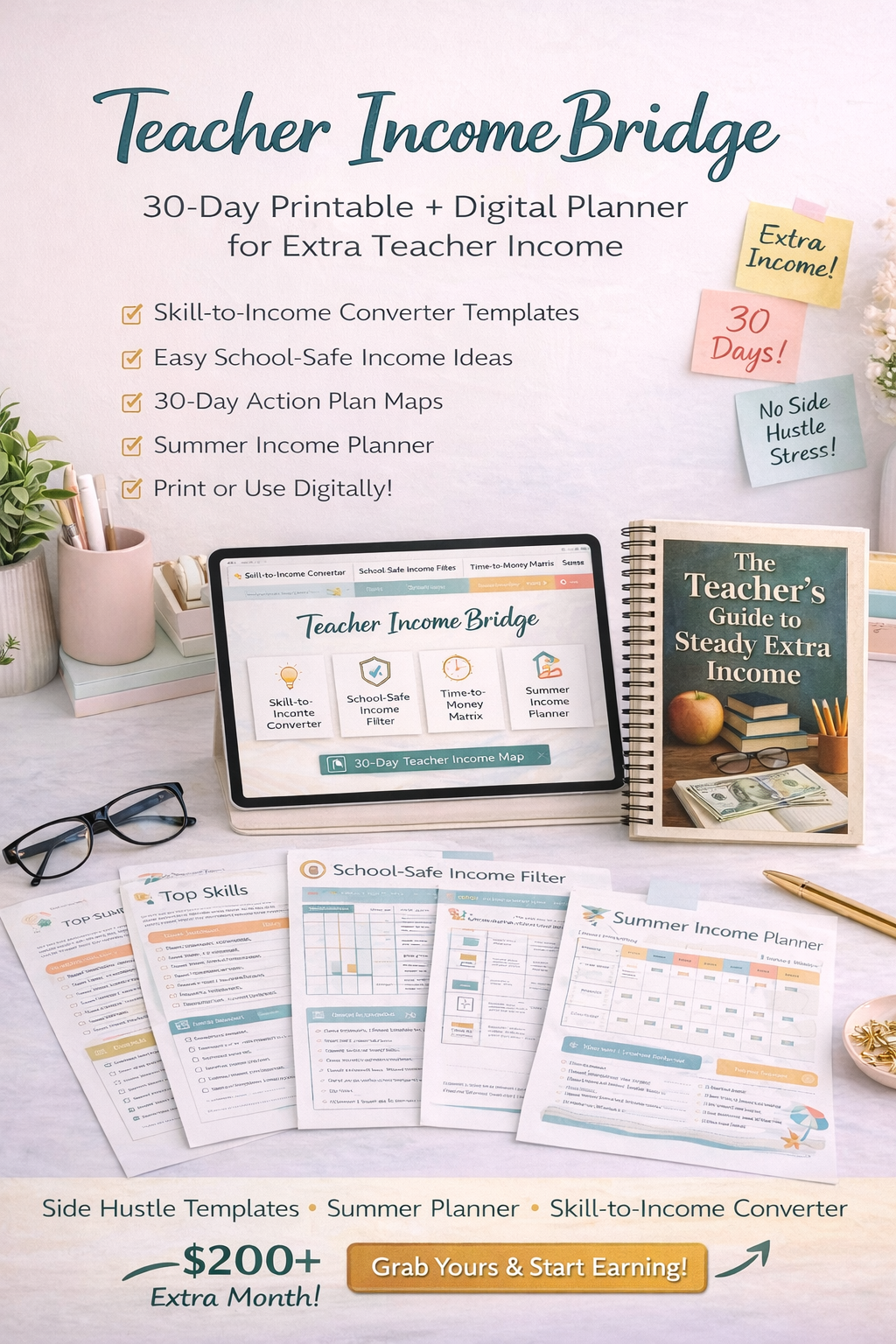
Follow the full system. The Teacher Side Income Blueprint turns your chosen lane into a thirty-day plan with the planning templates done for you — built for educators starting from zero.
Learn hands-free on your commute. The Teacher Side Income Audio Bundle delivers the full strategy as audio training plus printable planners, for teachers whose eyes are done with screens by 4 p.m.
The Research You Get to Skip
Sorting twenty-three ideas into lanes, checking each against a school calendar, and building planning templates from scratch is honestly fifteen to twenty hours of evenings — I've watched teachers spend a full quarter on it. The structure in this article compresses the sorting to one sitting. The Blueprint compresses the rest: the templates, the sequencing, and the thirty-day order of operations arrive finished, so your limited hours go into building the business instead of building the plan for the business.
What's Actually Inside the Blueprint
Rather than repeat a sales page, here's the plain version. The Blueprint centers on a thirty-day roadmap that assigns one small action per day, sized for after-school energy.
Around it sit a skill-to-income planner that maps your teaching strengths to specific opportunities, a school-safe opportunity filter for weighing anything against professional considerations and district policy, and a time-to-money matrix for matching activities to the hours you really have. A teacher side income guide covers the main paths in depth, and two bonuses — a safety checklist and a sixty-minute quick start — get your first plan drafted in about an hour.
Where This Advice Comes From
Steady Income Tools publishes educational-first guides: we teach the full picture, recommend tools only where they genuinely shorten the road, and tell you plainly when you don't need to buy anything. Nothing here promises income, because no honest resource can. What we promise is organization — the difference between a someday folder and a started thing.
If This Still Feels Like One More Thing
That reaction deserves respect, not a pep talk. If your energy inventory is running at survival level right now, the right business decision might be no business this semester.
The guide to steady extra income without burnout is written for exactly that place. A business idea keeps. Your recovery time this month might not.
Five Ways Good Ideas Quietly Stall
Starting two lanes at once. A tutoring client plus a product build splits fragment-season hours until both starve. One lane, one semester.
Judging a marathon by sprint rules. Audience businesses evaluated at week six always look like failures. Match the evaluation window to the lane.
Skipping the district policy check. Five minutes with your contract and board policy beats months of low-grade worry. Most policies are clearer than the fear suggests.
Building for imaginary time. Plans that require the summer version of you to show up in October collapse by Halloween. Plan for Tuesday-you.
Perfecting before launching. The fourth revision of a product that hasn't met a customer teaches you nothing. Version one, shipped small, teaches everything.
Your First Week, One Move a Day
- Monday: write down your three most recent someday ideas and label each one service, product, or audience.
- Tuesday: run each through the Tuesday Test and cross out any that fail for the school year.
- Wednesday: read your district's outside-employment policy — the actual text, not your memory of it.
- Thursday: track your genuinely free hours this week in a note, honestly.
- Friday: pick the one surviving idea whose lane matches those hours.
- Weekend: take its smallest possible first action — one outline, one profile, one template sketch — and stop there.
FAQ
What businesses can teachers start?
Teachers can start service businesses like tutoring, test prep, academic editing, curriculum writing, and educational consulting; product businesses selling digital resources, printables, and planning templates; and audience businesses like blogs, YouTube channels, and newsletters. The best fit depends on your weekly hours, energy level, and season of the school year — service pays soonest, products compound, audiences reward long patience.
Can teachers have a side business?
In most districts, yes — provided it doesn't conflict with your contract, use school resources or student information, or interfere with your duties. Policies vary by district and state, so read your specific outside-employment clause before starting anything client-facing. Businesses serving adults or general audiences typically raise fewer questions than ones involving your own current students.
Can teachers freelance?
Yes, and freelancing is one of the fastest lanes for educators because it sells skills you already use daily: writing, editing, instructional design, presentation building, and research. Most teacher freelancers start with one client capped at a few hours weekly during the school year, then expand during breaks. The same district-policy check applies as with any outside work.
Can teachers make passive income?
Teachers can build income that continues after the initial effort — digital resources, templates, and evergreen content are the common routes. Calling it passive oversells it slightly: products need occasional updates and marketing. The honest framing is front-loaded income, where a break or summer of building keeps paying through the school year when your time disappears.
How much can teachers earn online?
It varies too widely for a single honest number — the lane, the hours invested, and the niche all matter more than the label "online." Service work generally produces income fastest because you're paid per engagement. Products and audiences start near zero and grow with catalog and reach. Be skeptical of anyone quoting guaranteed figures; results depend on effort and fit.
What is the easiest side hustle for teachers?
Easiest usually means fastest-to-first-dollar with skills you already have, and for most educators that's tutoring or a small freelance service — no product to build, no audience to grow. But easiest to start isn't easiest to sustain: if your after-school energy is gone, a small digital product built during breaks may be easier over a full year.
Related Articles
- The Teacher's Guide to Steady Extra Income Without Burnout
- Why Most Side Hustles Fail Teachers And What Works Instead
- Best Passive Income Ideas for Teachers Build Income That Grows Over Time
- Summer Income Ideas for Teachers That Don't Cause Burnout
Corinne's someday folder still exists, by the way. It's just shorter now.
Twenty-two entries got labels and a polite goodbye; one — a small set of fourth-grade math printables — got a lane, a Tuesday Test pass, and thirty minutes last night at the kitchen table. That's the whole difference between a collection and a business: one idea that finally got picked.
Comments ()