

Priya had been running medical courier routes for six weeks as a sole proprietor when a facility coordinator asked for her Certificate of Insurance.
The certificate listed her personal name — not a business name. The coordinator paused. Then asked whether she was operating as a registered business entity.
She was not. The facility put the contract conversation on hold until she could provide documentation of a registered business. She had the LLC formed and the updated insurance certificate in hand eleven days later. The contract was signed the afternoon she delivered the documents.
The LLC did not change her routes. It did not change her vehicle. It changed how every facility she approached perceived her — permanently.
Quick Answer Most independent medical couriers should form an LLC before approaching facilities for direct contracts. An LLC costs $50 to $150 to register, takes five to ten business days, and signals professional legitimacy to every facility you contact. It also separates your personal financial liability from your business operations — which matters when you are transporting medical specimens under a signed contract. It is not legally required in most states but it is practically required for professional direct contract work.
Key Takeaways
- An LLC is not legally required but is practically required for direct facility contract work in 2026
- Most healthcare facilities prefer or require contracting with a registered business entity
- LLC formation costs $50 to $150 depending on state and takes five to ten business days
- Personal liability protection separates your personal assets from business-related claims
- A single-member LLC is the right structure for most independent medical couriers starting out
- An LLC does not automatically reduce your tax rate but opens the door to future tax planning options
The LLC question comes up early for most new medical couriers — and the answer is almost always the same. Form it before you approach your first facility. The cost is low. The timeline is short. And the professional credibility it creates in every facility conversation is disproportionate to the effort required to establish it.
According to the Small Business Administration, LLC formation is the most common business structure chosen by independent service contractors in the United States — specifically because it provides personal liability protection without the complexity of a corporation while maintaining pass-through taxation that keeps filing simple.
For medical couriers the decision is less about tax optimization and more about professional positioning and liability protection. Both matter from your very first contract.
What an LLC Actually Does for a Medical Courier
An LLC — limited liability company — does two things that matter specifically to independent medical couriers.
It separates your personal financial liability from your business operations. And it signals to every healthcare facility you approach that you are operating as a professional business entity — not an individual trying out a side gig.
Both outcomes have real consequences in this field.
Liability Protection
When you transport medical specimens or medications under a direct facility contract — you are handling materials that have legal and clinical significance. A specimen that is compromised during transport. A medication delivery that goes to the wrong address. A facility property damage incident during a pickup.
These situations are uncommon. When they occur without an LLC, any resulting claim can reach your personal assets — your savings, your personal vehicle, your home equity if you own property.
With an LLC, the claim reaches your business assets first. Your personal finances are separated from your business liability by the legal structure the LLC creates.
That protection is not hypothetical. It is the specific reason the LLC exists as a business structure — and it is worth $50 to $150 in state filing fees before your first route.
Professional Credibility
Healthcare facilities evaluate independent couriers carefully before granting access to their specimens, patients, and premises. A courier operating under a registered LLC name signals organizational maturity — that you have taken the steps a professional operator takes before presenting to clients.
The Certificate of Insurance issued in your LLC name. The business bank account in your LLC name. The service agreement signed under your LLC name. These details collectively communicate that you are building a business — not testing an idea.
That distinction influences how facility coordinators respond to your outreach — and how quickly they move through their vetting process.
The Medical Courier Business Starter Kit at SteadyIncomeTools.com includes a state-by-state LLC formation guide, operating agreement template, EIN registration walkthrough, and the business bank account setup checklist that gets your courier business legally structured in under two weeks.
Sole Proprietor vs LLC — The Practical Difference
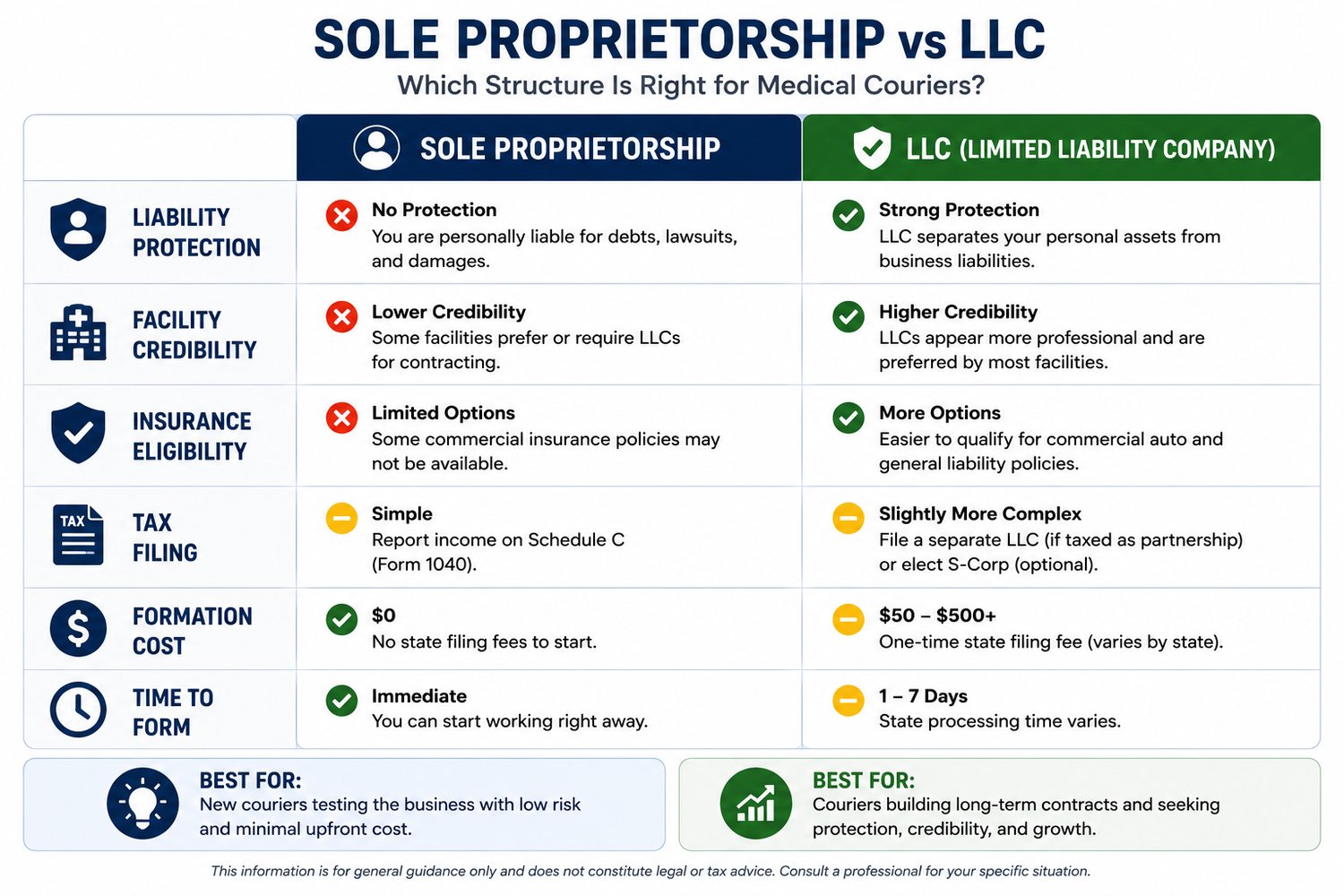
Operating as a sole proprietor means your business and your personal finances are legally the same entity. Income is reported on your personal tax return. Liability from business operations reaches your personal assets directly.
Operating as a single-member LLC means your business is a separate legal entity from you personally. Income still flows through to your personal tax return — the LLC does not create a separate tax entity by default. But liability from business operations reaches the LLC first before it can reach your personal assets.
Factor Sole Proprietor Single-Member LLC Personal liability exposure Full — no separation Limited — business assets first Facility contract eligibility Some facilities decline Accepted by all facility types Insurance issued in business name No — personal name only Yes — LLC name on certificate Business bank account Personal account used Dedicated business account Tax filing Schedule C — simple Schedule C — same simplicity Formation cost None $50 – $150 state filing fee Formation timeline Immediate 5 – 10 business days The tax filing simplicity is identical between the two structures for a single-member LLC. The liability protection and professional credibility are not identical — and those two differences are what the $50 to $150 filing fee is actually purchasing.
How to Form an LLC for Medical Courier Work
The formation process is straightforward in every state. It requires four steps and produces a registered business entity within five to ten business days in most states.
Step 1 — Choose Your Business Name
Your LLC name must be unique in your state and must include a designator — LLC, L.L.C., or Limited Liability Company — at the end. Search your state's Secretary of State business name database before filing to confirm availability.
Most medical courier LLCs use a simple geographic or service descriptor — [City] Medical Courier LLC, [Your Name] Courier Services LLC, or [Name] Medical Transport LLC. Keep it professional and straightforward. Facility coordinators will see this name on your Certificate of Insurance and service agreements.
Step 2 — File Articles of Organization
Articles of Organization is the founding document filed with your state's Secretary of State office. It typically requires your LLC name, your registered agent's name and address, and your business address.
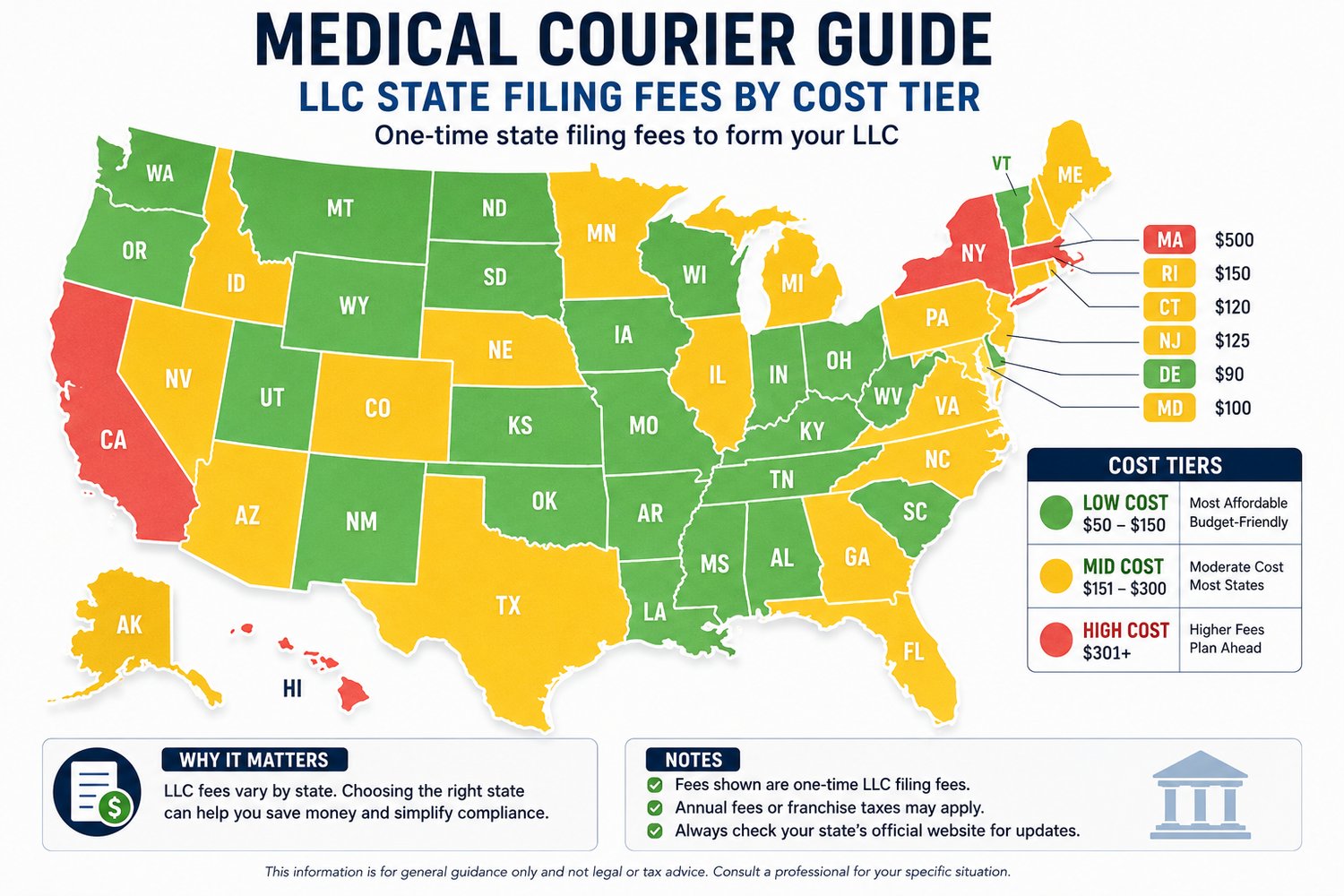
Filing is done online in most states. The state filing fee ranges from $50 in states like Kentucky and Arkansas to $150 in states like California and Massachusetts. Some states charge annual renewal fees on top of the initial filing — confirm your state's requirements before filing.
Step 3 — Appoint a Registered Agent
A registered agent is the person or service designated to receive official legal and government correspondence on behalf of your LLC. You can serve as your own registered agent using your home address — or use a registered agent service for $50 to $100 per year if you prefer to keep your personal address off public records.
For most independent medical couriers starting out, self-appointment as registered agent using your business address is the simplest and most cost-effective option.
Step 4 — Get Your EIN
An Employer Identification Number — EIN — is your LLC's federal tax identification number. It is required to open a business bank account, apply for commercial auto insurance in your business name, and file business taxes correctly.
EIN registration is free through the IRS website at irs.gov and takes approximately ten minutes to complete online. The EIN is issued immediately upon completion. Do this the same day your Articles of Organization are approved.
What to Do Immediately After Forming Your LLC
Four actions complete your business setup within days of LLC approval.
Open a Business Bank Account A dedicated business checking account keeps business income and expenses separate from personal finances — which simplifies tax preparation, supports the liability separation the LLC creates, and is required by most commercial insurance carriers before issuing a policy in your business name.
Apply for Commercial Auto Insurance in Your LLC Name Your commercial auto policy must be issued in your LLC name to be accepted by healthcare facilities as proof of professional coverage. For the complete coverage breakdown — medical courier insurance guide covers every policy type with cost ranges and provider recommendations.
Update Your HIPAA Certificate Some HIPAA training providers allow you to update your certificate to reflect your LLC name. Request this update if available — having your LLC name on your HIPAA certificate strengthens the professional documentation package you present to facilities.
Begin Facility Outreach With LLC registered, EIN obtained, commercial insurance in your business name, and HIPAA certificate current — you are fully prepared for professional facility outreach. For the complete direct contract acquisition approach — how to get medical courier contracts covers the outreach system that converts facility calls into signed agreements.
LLC Formation Cost by State — What to Expect
State Initial Filing Fee Annual Fee Notes Florida $125 $138.75 Annual report required Texas $300 None Higher initial fee, no annual California $70 $800 minimum Annual franchise tax applies New York $200 $9 biennial Publication requirement adds cost Georgia $100 $50 Straightforward process Ohio $99 None No annual fee Illinois $150 $75 Annual report required National Average $50 – $150 $0 – $800 Varies significantly by state California's $800 annual minimum franchise tax makes it the most expensive state for LLC operation among active courier markets. Florida and Georgia offer straightforward formation and renewal processes at mid-range cost. Texas has a higher initial fee but no annual renewal cost for most single-member LLCs below the revenue threshold.
When the LLC Can Wait — and When It Cannot
The LLC can wait if you are starting with company employment at a medical courier firm rather than pursuing independent direct contracts. Employee positions do not require a registered business entity — the employer handles business structure on their end.
The LLC cannot wait if you are pursuing direct facility contracts as an independent operator. The moment you approach a facility for a direct contract — the LLC should already be registered, the EIN already obtained, and the commercial insurance already issued in the business name.
Approaching facilities without these elements in place signals that you are not yet operationally ready. Most facility coordinators who experience that signal do not circle back when you are ready later.
For the complete checklist of everything that needs to be in place before your first facility conversation — medical courier requirements explained covers every document alongside the LLC and insurance requirements.
The Medical Courier Business Starter Kit at SteadyIncomeTools.com includes a state-by-state LLC cost comparison, the complete Articles of Organization guidance, EIN registration walkthrough, and the post-formation checklist that gets your courier business fully structured and facility-ready within two weeks of starting.
Directional Close
Priya's eleven-day delay was not a setback. It was the fastest possible recovery from a gap she did not know existed.
The facility waited because the opportunity was real and she had already demonstrated professionalism on every other dimension. Most facilities will not wait. The courier who calls next — with the LLC already registered — gets the contract.
Form the LLC before the first call. The eleven days it takes to register are the same eleven days you use to build your target facility list and prepare your outreach approach.
By the time the LLC is approved — your list is ready, your insurance is ordered, and your first call is scheduled. That sequence costs nothing extra and eliminates every delay that stops other new couriers before they start.
The tax implications of your LLC structure become increasingly important as your courier income grows. Read medical courier taxes explained to understand exactly how your LLC affects what you owe and what you can deduct from day one.
You Might Also Like
- How to Become a Medical Courier in 2026 — the complete step by step starting point
- Medical Courier Requirements Explained — every credential and document in one place
- Medical Courier Insurance Guide — the commercial coverage that must be issued in your LLC name
- Medical Courier Taxes Explained — how your LLC affects what you owe and what you can deduct
Frequently Asked Questions
Do medical couriers need an LLC? An LLC is not legally required to operate as a medical courier in most states — but it is practically required for professional direct contract work with healthcare facilities. Most hospitals, diagnostic labs, and clinical networks prefer or require contracting with a registered business entity rather than an individual. An LLC also provides personal liability protection that separates your personal assets from business-related claims — which matters when transporting medical specimens and medications under a signed facility contract. Formation costs $50 to $150 and takes five to ten business days.
What does an LLC do for a medical courier? An LLC does two specific things for an independent medical courier. First it creates legal separation between your personal finances and your business operations — meaning business-related claims reach your business assets before they can reach your personal savings, vehicle, or property. Second it signals professional legitimacy to healthcare facilities that evaluate contractors carefully before granting access to their specimens and premises. Both outcomes have real consequences for contract eligibility and facility confidence in your operation from the first outreach conversation.
How much does it cost to form an LLC for medical courier work? LLC formation costs range from $50 to $300 depending on state filing fees. Most active medical courier markets fall in the $70 to $150 range for initial formation. Some states also charge annual renewal fees — Florida charges $138.75 annually, California charges an $800 minimum annual franchise tax, and Ohio charges no annual fee. The EIN required after LLC formation is free through the IRS website. Total first-year LLC cost for most independent medical couriers ranges from $120 to $350 including formation fee and first-year renewal where applicable.
How long does it take to form an LLC for medical courier work? LLC formation takes five to ten business days in most states from the date Articles of Organization are filed with the Secretary of State. Some states offer expedited processing for an additional fee — typically $50 to $100 — that reduces formation time to one to three business days. Online filing through your state's Secretary of State website is the fastest method and is available in most states. The EIN can be obtained from the IRS website on the same day LLC approval is confirmed and takes approximately ten minutes to complete.
Should a medical courier be a sole proprietor or LLC? An LLC is the stronger choice for independent medical couriers pursuing direct facility contracts in 2026. A sole proprietorship provides no separation between personal and business liability — meaning any business-related claim reaches personal assets directly. It also prevents commercial auto insurance from being issued in a business name — which most facilities require on the Certificate of Insurance they request before contracting. The LLC provides both liability separation and professional credibility at a cost of $50 to $150 that most couriers recover within one to two runs under a direct facility contract.
Does an LLC reduce taxes for medical couriers? A single-member LLC does not by itself reduce the tax rate an independent medical courier pays. Single-member LLCs are pass-through entities by default — income is reported on Schedule C and subject to the same self-employment and income tax rates as a sole proprietorship. However an LLC opens the door to an S-Corporation tax election at higher income levels — typically above $40,000 in annual net profit — which can reduce self-employment tax liability meaningfully by allowing a portion of income to be classified as distributions rather than earned income. The tax planning benefit grows as courier income increases.
What do you need after forming an LLC for medical courier work? Four actions complete your business setup immediately after LLC formation. Open a dedicated business checking account in your LLC name. Apply for commercial auto insurance issued in your LLC name — facilities require the certificate to reflect your business entity. Obtain your EIN from the IRS website at no cost. Then begin direct facility outreach with your complete professional documentation package — LLC registration, Certificate of Insurance, HIPAA certificate, and background check results — all in hand before the first call.
Can you form an LLC in one state and operate as a medical courier in another? Yes — you can form your LLC in one state and operate courier routes in another through a process called foreign qualification. You register your LLC in your home state and then register it as a foreign entity in any additional state where you operate. Foreign qualification typically costs $100 to $200 per additional state and requires annual renewal. For most independent medical couriers operating within a single metro area or state, forming the LLC in the state where you physically operate and reside is the simplest and most cost-effective approach.
Comments ()