
Dominic made $4,200 in his first month running direct medical courier contracts. He felt like he had cracked the code.
Then his accountant called in April.
He owed $1,380 in self-employment tax and federal income tax on top of that — money he had already spent. He had not set aside a single dollar during the year because nobody had told him that independent contractors pay their own taxes quarterly.
His second year looked completely different. Same income. Better system. Zero surprises.
Quick Answer Medical couriers operating as independent contractors pay self-employment tax of 15.3 percent on net earnings plus federal and state income tax. Total effective tax rate for most independent medical couriers ranges from 25 to 35 percent of net profit after deductions. Quarterly estimated tax payments are required — missing them triggers IRS penalties. The mileage deduction alone reduces taxable income significantly for most working couriers.
Key Takeaways
- Independent medical couriers pay self-employment tax of 15.3 percent plus income tax — no employer withholds on your behalf
- Quarterly estimated tax payments are due in April, June, September, and January
- The IRS standard mileage rate for 2026 reduces taxable income by cents per mile on every business mile driven
- Vehicle expenses, equipment, insurance, HIPAA training, and LLC fees are all deductible business expenses
- Setting aside 25 to 30 percent of every payment received covers most couriers' tax obligations
- An LLC does not automatically reduce your tax rate — but it opens the door to additional deductions
Independent contractor taxes are the single most common financial surprise for new medical couriers. The income feels significant. The tax bill feels larger. And the gap between the two is almost always the result of one thing — not knowing what to set aside and when to send it.
According to the IRS, self-employed individuals who expect to owe more than $1,000 in taxes for the year are required to make quarterly estimated tax payments. Most independent medical couriers earning $2,000 or more per month cross that threshold within their first quarter of operation.
The good news is that once the system is set up — it is genuinely simple. Know your rate. Know your deductions. Know your due dates. Set aside the right percentage. File four times per year instead of once.
How Medical Courier Taxes Work as an Independent Contractor
When you work as an employee — a courier company withholds your Social Security, Medicare, and income taxes from every paycheck. You see a reduced check. You file once in April. Done.
When you operate as an independent contractor — nothing is withheld. Every payment from every facility arrives in full. The tax obligation still exists. It is just entirely your responsibility to calculate and pay it on schedule.
That distinction creates two specific obligations that every independent medical courier needs to understand before their first invoice is paid.
Tax Type Rate Who Pays When Due Self-Employment Tax 15.3% of net profit You — both employer and employee share Quarterly Federal Income Tax 10% – 22% for most couriers You — based on total taxable income Quarterly State Income Tax 0% – 9.9% depending on state You — varies by state Quarterly or annual Total Effective Rate 25% – 35% after deductions You Quarterly
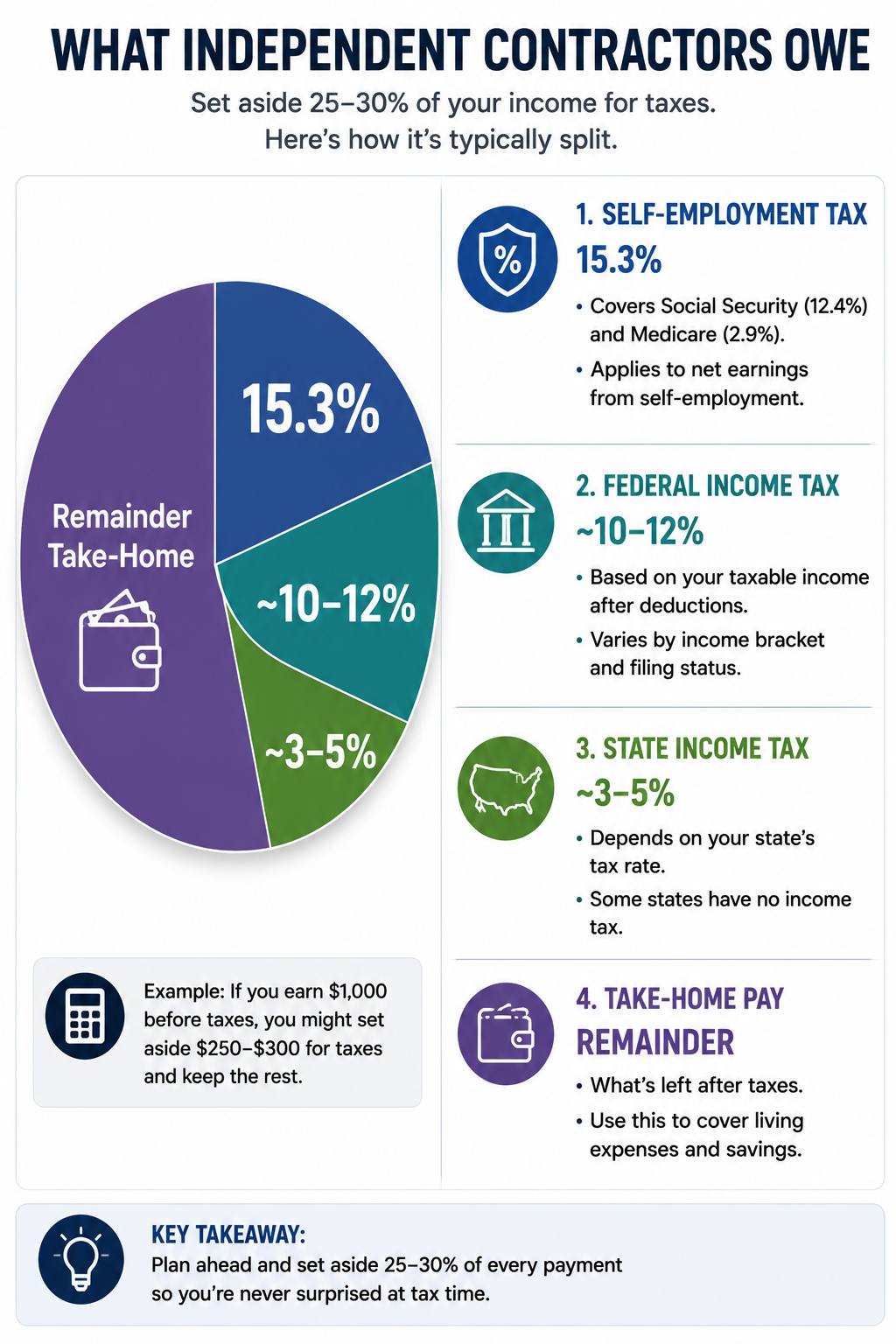
The self-employment tax rate of 15.3 percent covers Social Security at 12.4 percent and Medicare at 2.9 percent. As an employee, your employer pays half of this. As an independent contractor, you pay both halves — which is why the rate feels high compared to what W2 employees pay.
The deduction that softens this is significant — you can deduct 50 percent of your self-employment tax from your gross income when calculating your federal income tax. Most tax software handles this automatically.
The Medical Courier Business Starter Kit at SteadyIncomeTools.com includes a quarterly tax tracker, deduction worksheet, and the estimated payment schedule that keeps independent couriers current with the IRS from their first month of operation.
Quarterly Estimated Tax Payments — The Schedule Every Courier Must Know
Missing a quarterly estimated tax payment does not just mean catching up later. It triggers an underpayment penalty from the IRS — calculated on the amount you should have paid and the number of days it was late.
The 2026 quarterly estimated tax payment due dates are:
Quarter Income Period Payment Due Date Q1 January – March April 15, 2026 Q2 April – May June 16, 2026 Q3 June – August September 15, 2026 Q4 September – December January 15, 2027 Set a recurring calendar reminder for each due date the moment you receive your first courier payment. Treat each due date as a fixed business expense — not an optional deadline.
The simplest payment system for most couriers is setting aside 28 to 30 percent of every facility payment received into a separate savings account dedicated to taxes. When a quarterly due date arrives — the money is already there.
Medical Courier Tax Deductions — What You Can Write Off
The tax obligation for independent medical couriers is real. So is the deduction list that reduces it. Every legitimate business expense reduces your net profit — and your net profit is what taxes are calculated on.
These are the deductions most working medical couriers qualify for every year.
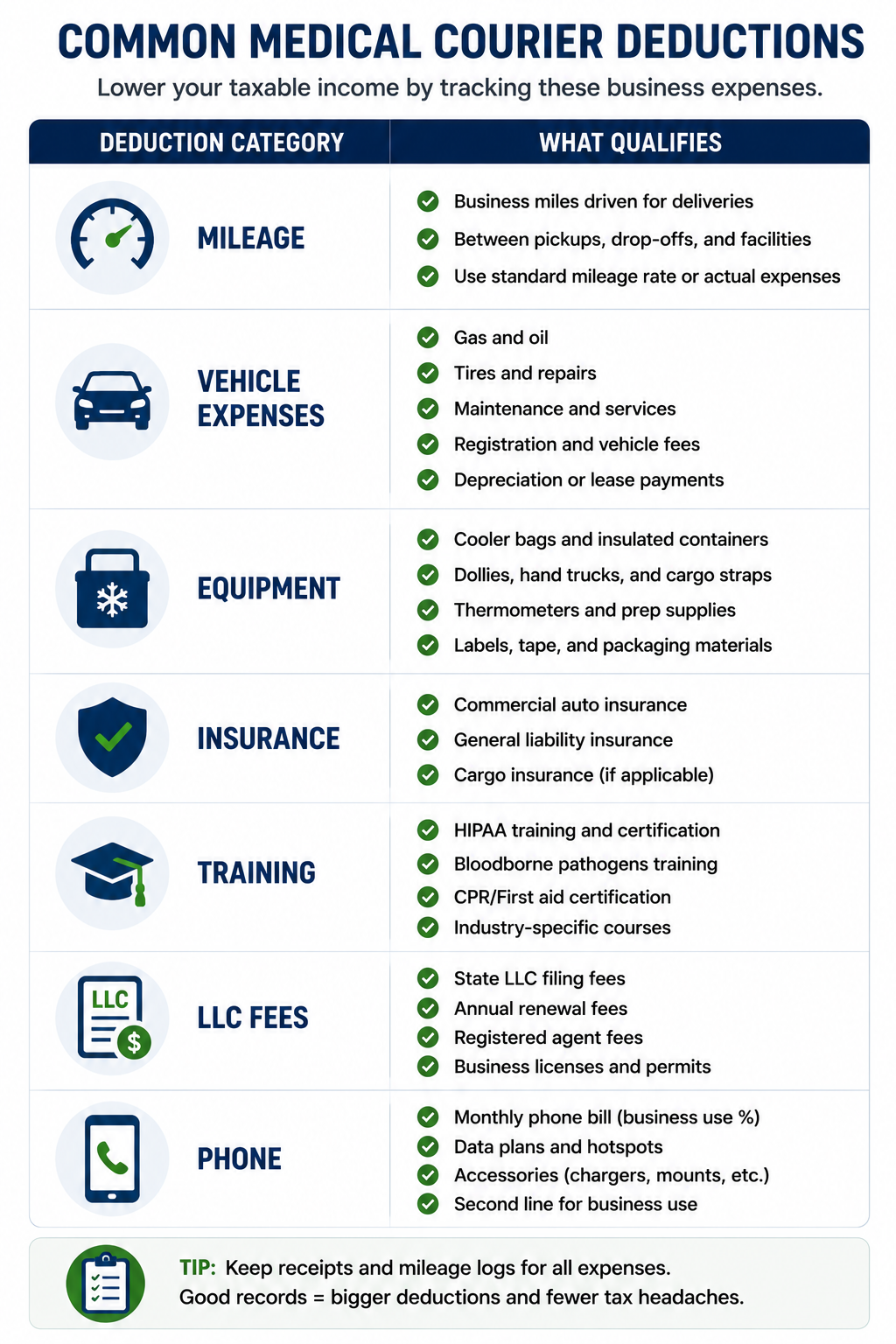
Mileage Deduction
The IRS standard mileage rate applies to every mile driven for business purposes — pickup routes, facility visits, supply runs, and bank trips for business deposits. At the current IRS rate, a courier driving 1,000 business miles per month generates a mileage deduction that meaningfully reduces taxable income over a full year.
Track every business mile from day one. A mileage tracking app — MileIQ, Everlance, or Stride — runs in the background and logs miles automatically. Manual tracking in a notebook also qualifies — the IRS accepts either method.
Vehicle Expenses
If you choose the actual expense method instead of the standard mileage rate, you can deduct the business-use percentage of all vehicle costs — fuel, oil changes, tire replacements, insurance, registration, and depreciation. Most couriers find the standard mileage rate simpler and equally effective — but both methods are IRS-approved.
Equipment and Supplies
Every piece of transport equipment is a deductible business expense — insulated coolers, gel ice packs, biohazard bags, nitrile gloves, cleaning supplies, and clipboard materials. Keep every receipt from every supply purchase.
Insurance Premiums
Commercial auto insurance and general liability insurance premiums paid for business coverage are fully deductible business expenses. This is one of the larger annual deductions for most independent medical couriers.
HIPAA Training and Certifications
The cost of your HIPAA compliance certificate, any renewal training, and any additional professional development directly related to your courier work is deductible as a business education expense.
LLC Formation and Annual Fees
Your LLC registration fee, annual state filing fees, and any registered agent fees are deductible business expenses in the year they are paid. For the full LLC decision framework — should you form an LLC for medical courier work covers both the liability and tax implications in detail.
Phone and Communication
The business-use percentage of your cell phone bill is deductible — including the portion used for route coordination, facility calls, and GPS navigation during runs. Most couriers qualify to deduct 50 to 80 percent of their monthly phone expense depending on personal versus business use.
The Deduction That Changes the Math Most — Mileage
A medical courier driving 800 business miles per month at the current IRS standard mileage rate generates a significant annual mileage deduction. Over twelve months that deduction alone reduces taxable net profit by several thousand dollars — which at a 25 to 30 percent effective tax rate translates directly into hundreds of dollars in reduced tax liability.
The mileage deduction is the single highest-value tax reduction available to most working medical couriers — and it requires nothing more than accurate mileage tracking from day one.
For the full income picture that puts these deductions in context — medical courier salary: what drivers really earn in 2026 shows gross and net income by work structure so you can model your actual take-home after taxes and deductions.
How to File Medical Courier Taxes
Independent medical couriers file taxes using Schedule C — Profit or Loss From Business — attached to their personal Form 1040. Schedule C is where you report gross courier income, subtract all allowable business deductions, and arrive at net profit — which is the figure your self-employment tax and income tax are calculated on.
The forms most independent medical couriers use at tax time:
Form Purpose Schedule C Report business income and deductions Schedule SE Calculate self-employment tax Form 1040-ES Calculate and submit quarterly estimated payments 1099-NEC Income reporting from facilities paying $600+ annually Most facilities paying independent couriers $600 or more in a calendar year are required to issue a 1099-NEC by January 31 of the following year. You are required to report all courier income — including payments from facilities that do not issue a 1099 because they paid less than $600.
What Dominic Did Differently in Year Two
Dominic set up a dedicated business checking account and a separate tax savings account on January 1 of his second year.
Every facility payment went into the business account. Twenty-eight percent transferred automatically to the tax savings account on the day each payment arrived.
He made four quarterly payments on schedule. He tracked every business mile with MileIQ. He kept every equipment and supply receipt in a dedicated folder.
His April tax bill in year two was $340 — not $1,380. Same income. Better system.
The system is not complicated. It just has to be set up before the first payment arrives — not after the first April surprise.
For the complete setup that gets your courier business structured correctly from the start — how to become a medical courier in 2026 covers the full launch sequence including business banking and tax system setup.
The Medical Courier Business Starter Kit at SteadyIncomeTools.com includes a quarterly tax tracker spreadsheet, deduction worksheet, mileage log template, and the estimated payment calculator that tells you exactly what to set aside from every facility payment you receive.
Directional Close
Dominic's first April was a $1,380 lesson. His second April cost him $340 and zero stress. The difference was not income — it was system.
Tax preparation for independent medical couriers is not complicated once the system is in place. The quarterly schedule is fixed. The deduction list is knowable. The set-aside percentage is calculable from day one.
Set the system up before your first facility payment arrives. Everything after that is maintenance.
The next step in building a properly structured courier operation is understanding the LLC decision in full. Read should you form an LLC for medical courier work to understand both the liability protection and the tax implications before you file your first quarterly payment.
You Might Also Like
- How to Become a Medical Courier in 2026 — the complete step by step starting point
- Should You Form an LLC for Medical Courier Work — liability protection and tax implications explained
- Medical Courier Salary: What Drivers Really Earn in 2026 — gross and net income breakdown by work structure
- How to Get Medical Courier Contracts — the outreach system that builds your contract income base
Frequently Asked Questions
How much tax do medical couriers pay as independent contractors? Independent medical couriers pay self-employment tax of 15.3 percent on net profit — covering both the employer and employee share of Social Security and Medicare — plus federal income tax at their applicable rate and state income tax where applicable. Total effective tax rate for most independent medical couriers ranges from 25 to 35 percent of net profit after allowable business deductions. Setting aside 28 to 30 percent of every facility payment received covers the obligation for most couriers without over-withholding.
Do medical couriers need to pay quarterly taxes? Yes — independent medical couriers who expect to owe more than $1,000 in federal taxes for the year are required by the IRS to make quarterly estimated tax payments. Most couriers earning $2,000 or more per month cross that threshold within their first quarter of operation. Quarterly payments are due in April, June, September, and January. Missing a quarterly payment triggers an underpayment penalty calculated on the amount owed and the number of days the payment was late.
What can medical couriers deduct on their taxes? Independent medical couriers can deduct all ordinary and necessary business expenses including business mileage at the IRS standard rate, vehicle expenses if using the actual expense method, transport equipment and supplies, commercial auto and liability insurance premiums, HIPAA training and certification costs, LLC formation and annual filing fees, and the business use percentage of their cell phone bill. The mileage deduction is typically the highest-value single deduction for most working medical couriers and requires accurate mileage tracking from the first day of operation.
What is the mileage deduction for medical couriers in 2026? The IRS standard mileage rate for business miles driven in 2026 applies to every mile driven for courier business purposes including pickup routes, facility visits, supply runs, and business bank trips. A courier driving 800 business miles per month generates a substantial annual mileage deduction that reduces taxable net profit by several thousand dollars over a full year. Mileage tracking apps including MileIQ, Everlance, and Stride log business miles automatically and produce IRS-compliant mileage reports at tax time.
What forms do medical couriers use to file taxes? Independent medical couriers file taxes using Schedule C to report business income and deductions, Schedule SE to calculate self-employment tax, and Form 1040-ES for quarterly estimated payments. Facilities that pay a courier $600 or more in a calendar year issue a 1099-NEC by January 31 of the following year. All courier income must be reported regardless of whether a 1099-NEC was issued — including payments from facilities that paid less than the $600 threshold that triggers the 1099 reporting requirement.
Should medical couriers open a separate business bank account? Yes — a dedicated business checking account is strongly recommended for independent medical couriers from their first month of operation. Keeping business income and expenses separate from personal finances simplifies tax preparation, makes deduction tracking accurate, and supports the professional business entity structure that direct facility contracts require. A dedicated tax savings account alongside the business checking account — with an automatic transfer of 28 to 30 percent of every facility payment — eliminates the quarterly estimated tax surprise that catches most first-year independent couriers unprepared.
Does an LLC reduce medical courier taxes? Forming an LLC as a single-member entity does not by itself change the tax rate an independent medical courier pays — single-member LLCs are treated as pass-through entities by default, meaning income is still reported on Schedule C and subject to the same self-employment and income tax rates. However, an LLC opens the door to an S-Corporation tax election at higher income levels — typically above $40,000 in annual net profit — which can reduce self-employment tax liability meaningfully. The LLC decision involves both liability protection and tax planning considerations that grow more significant as courier income increases.
What happens if a medical courier does not pay quarterly taxes? An independent medical courier who does not pay quarterly estimated taxes when required will owe the full annual tax amount at the April filing deadline plus an IRS underpayment penalty. The penalty is calculated based on the amount that should have been paid each quarter and the number of days it remained unpaid — accruing from each missed quarterly due date through the April filing date. The penalty rate varies by IRS published rates but consistently makes late payment more expensive than timely quarterly payment. First-year couriers who miss all four quarterly payments typically face a penalty of $200 to $600 on top of their full tax liability.
Comments ()