

If you have a reliable vehicle and you are trying to decide between Amazon Flex and medical courier work — you are asking exactly the right question before committing your time to either one. Both involve driving. Both are independent contractor arrangements. Both can generate meaningful side income. But the way they pay, the way they grow, and the way they affect your life over time are fundamentally different.
The honest comparison between medical courier and Amazon Flex is not as close as most delivery side hustle articles suggest. When you look at effective hourly rates, income ceilings, client relationship stability, and the long-term trajectory of each path — the differences are significant enough to change which one you choose if you are making the decision based on complete information.
This breaks down every dimension of the comparison so you can make the right call for your specific situation.
What Amazon Flex Actually Is — And How It Works
Amazon Flex is Amazon's independent contractor delivery program. You download the app, claim delivery blocks — typically two to four hour windows — and deliver Amazon packages to residential and business addresses in your area.
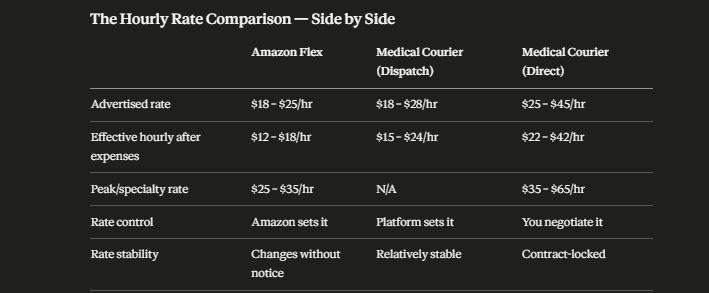
The pay structure is straightforward on the surface. Amazon advertises $18 to $25 per hour for Flex blocks. The reality of effective hourly earnings — after accounting for the time spent claiming blocks, waiting for package loads, navigating inefficient delivery sequences, and the fuel and vehicle costs of heavy urban residential delivery — is more complicated.
What Amazon Flex drivers actually report earning:
- Advertised block rate: $18 – $25/hour
- Effective hourly rate after expenses and dead time: $12 – $18/hour in most markets
- Surge/peak rates during high-demand periods: $25 – $35/hour
- Consistency of surge availability: Unpredictable — varies by market and season
The income is real. The ceiling is set by Amazon's rate structure and the availability of blocks in your market — both of which are outside your control.
What Medical Courier Actually Pays — The Honest Numbers
Medical courier income operates on a completely different structure than Amazon Flex — because you are contracting directly with healthcare facilities rather than working within an app's rate system.
Dispatch platform rates (fastest to access):
- $18 – $28/hour equivalent
- Similar to Amazon Flex advertised rates but with more consistent actual delivery per hour because medical runs are routed rather than residential scatter
Direct healthcare facility contract rates:
- $25 – $45/hour for standard specimen and pharmaceutical routes
- $35 – $65/hour for specialty and stat runs
- After-hours and weekend premium: 20 – 40% above standard rates
The critical difference: Amazon Flex pays what Amazon decides to pay. Medical courier direct contracts pay what you negotiate — and your negotiated rate is set once and holds for the duration of the contract, regardless of what Amazon does with its app rates next quarter.
For the complete income breakdown with realistic first-month numbers — what a medical courier is and what the income potential actually looks like covers every income tier in detail.
Hourly Rate Comparison — Side by Side
 The
The
The Schedule Comparison — Which One Is More Flexible
Amazon Flex Schedule Reality
Amazon Flex is theoretically available whenever you want to work — you claim blocks when they appear in the app. The practical reality is more constrained.
Popular blocks in busy markets disappear within seconds of becoming available. Peak blocks that pay higher rates require you to be watching the app at unpredictable moments. Slower markets have fewer blocks available — meaning the income consistency varies significantly by location.
The flexibility is real but reactive — you are available when Amazon needs you rather than choosing windows that fit your life.
Medical Courier Schedule Reality
Medical courier work is structured around healthcare facility operating needs — which creates predictable, scheduled availability windows rather than on-demand block claiming.
Early morning specimen routes run Monday through Friday at defined times. After-hours pharmaceutical runs cover specific evening windows. Weekend coverage fills Saturday and Sunday circuits that healthcare facilities need consistently regardless of demand fluctuations.
You agree to a schedule with your client. The schedule holds. You plan your week around it rather than watching an app waiting for blocks to appear.
For people building this around a full-time job — the structured schedule of medical courier work is a significant practical advantage over the reactive availability that Amazon Flex requires.
The Expense Comparison — What Each Actually Costs You
Both Amazon Flex and medical courier work use your personal vehicle — but the expense profile of each is meaningfully different.
Amazon Flex Expenses
Fuel — Residential delivery involves significant stop-and-start urban driving. High fuel consumption per mile compared to routed courier runs.
Vehicle wear — Frequent stops, package loading and unloading, and urban driving patterns create above-average vehicle wear per mile.
No additional insurance required — Amazon requires commercial insurance for Flex drivers, which many drivers skip at their own risk. Personal auto policies may not cover commercial delivery activity.
No business registration required — Lower setup barrier but also lower professional standing with no LLC or business documentation.
Medical Courier Expenses
Commercial auto insurance — $100 – $200/month. Required and non-negotiable. The most significant ongoing expense of medical courier work.
LLC registration — $50 – $150 one-time. Required for professional contractor relationships.
Transport equipment — $65 – $130 one-time for basic coolers and specimen bags.
Fuel — Routed medical courier runs are more fuel-efficient than residential scatter delivery because stop sequencing is optimized and distances between stops are planned.
Net expense comparison: Medical courier has higher upfront and ongoing overhead — but the higher gross rates produce better net income after expenses in virtually every market comparison. For the complete expense breakdown — what it actually costs to start a medical courier business covers every item with exact figures.
The Income Ceiling Comparison — Where Each Path Leads in 12 Months
This is where the comparison becomes decisive — not what you earn in month one but what you can build toward.
Amazon Flex Income Ceiling
Amazon Flex income is capped by two variables you do not control — the app's pay rate and your physical driving capacity. There is no path within Amazon Flex to earning significantly more per hour through skill development, relationship building, or business growth. The ceiling is set by the algorithm.
A Flex driver working 20 hours per week earns approximately $240 – $360 per week today. Working 20 hours per week in 12 months earns approximately the same amount — because nothing about the relationship between you and Amazon changes as a result of your experience or reliability.
Medical Courier Income Ceiling
Medical courier income scales with business development — not with hours driven.
Month 1: $400 – $1,200 (setup + first contracts developing) Month 3: $1,500 – $2,500 (direct contracts running consistently) Month 6: $2,000 – $4,000 (multiple direct contracts established) Month 12: $3,500 – $7,000+ (route portfolio built, possible second driver)
The income grows because the client relationships grow — and client relationships in medical courier work compound in a way that Amazon Flex app relationships never do. A hospital that has worked with you for six months is not going to replace you with a lower-cost option the way Amazon adjusts block rates. That relationship has real value that accumulates over time.
For the complete picture of how medical courier pay compares to food delivery and other side hustles — including where Amazon Flex fits in the broader delivery side hustle landscape — that article covers every comparison with honest numbers.
The Professional Development Comparison
One year of Amazon Flex experience adds to your driving hours and your familiarity with your city's street layout. It does not add to your professional credibility, your business relationships, or your ability to earn more per hour next year than you do today.
One year of medical courier experience builds a professional reputation within the healthcare community in your market, a portfolio of direct client relationships, a compliance and documentation track record, and the operational knowledge of a healthcare logistics professional. All of those things increase your earning potential — through higher contract rates, specialty run opportunities, and the possibility of scaling to a multi-driver operation.
The experience compounds in medical courier work. It does not compound in Amazon Flex.
Which One Should You Choose
If you need income starting this week with zero upfront investment and no setup process — Amazon Flex gets you earning faster. The barrier to entry is a driver's license and a smartphone.
If you want meaningfully higher income, stable client relationships, a growing rate structure, and a side hustle with a genuine business ceiling — medical courier is the better investment for anyone willing to spend one to two weeks on setup before their first run.
The couriers who switched from Amazon Flex to medical courier work consistently report the same experience — they wish they had made the switch earlier. The income is better. The schedule is more predictable. The professional relationships are more satisfying. And the path forward actually leads somewhere worth going.
The Medical Courier Launch Kit gives you the complete setup system — compliance checklist, outreach scripts, contract templates, and a 30-day launch sequence — so the one to two week setup process is organized and efficient rather than a research project that delays your first run.
For the complete business foundation — the Medical Courier Business System covers everything from first contract through building a multi-driver operation.
If you want to see what the first month of medical courier income actually looks like in practice — how one person lost their job and built a medical courier business from scratch covers the real story with honest month-by-month numbers.
And once you decide to move forward — how to run your first medical courier route like a professional covers exactly what to do on day one of your first active contract.
You Might Also Like
- Medical Courier vs Food Delivery — Which Side Hustle Actually Pays More in 2026
- How to Make Your First 1000 Dollars as a Medical Courier in 30 Days
- What Is a Medical Courier and How Much Can You Actually Make in 2026
- Medical Courier Startup Costs — What You Actually Need to Get Started
Ready to take the next step? Read how to write a medical courier contract that protects you — so your first direct client relationship is protected professionally from day one.
Frequently Asked Questions
Does medical courier pay more than Amazon Flex?
Yes — consistently and significantly in most markets. Amazon Flex drivers report effective hourly earnings of $12 to $18 per hour after expenses and dead time. Medical couriers working through dispatch platforms earn $15 to $24 per hour effective rate. Medical couriers on direct healthcare facility contracts earn $22 to $42 per hour. The gap widens further as medical couriers build direct client relationships and move away from dispatch platform rates.
Is Amazon Flex or medical courier easier to start?
Amazon Flex is easier to start — a driver's license and a smartphone are the only requirements and you can be earning within days of app approval. Medical courier requires LLC registration, commercial auto insurance, HIPAA awareness training, and a background check before approaching clients — a setup process that takes one to two weeks and costs $300 to $500. The higher setup bar is what creates the professional environment that supports higher medical courier rates.
Can I do both Amazon Flex and medical courier at the same time?
Yes — and some couriers use Amazon Flex for immediate income in weeks one and two while their medical courier compliance setup completes and their first direct contracts develop. As medical courier income grows, most couriers reduce or eliminate Amazon Flex work because the medical courier rates are meaningfully better for the same driving hours.
Why does medical courier pay more than Amazon Flex?
Medical courier pays more because the professional accountability standard is higher and the client relationship is direct rather than mediated by an app. Healthcare facilities pay for reliability, HIPAA compliance knowledge, and professional documentation that Amazon Flex does not require. The higher professional bar filters out casual drivers and supports premium contract rates that an app-based delivery program cannot match.
Does Amazon Flex or medical courier offer better schedule flexibility?
Both offer meaningful flexibility but in different ways. Amazon Flex flexibility is reactive — you claim blocks when they appear in the app and work when Amazon needs drivers. Medical courier flexibility is structured — you agree to specific windows with clients and plan your week around a defined schedule. Most people building income around existing employment find the structured schedule of medical courier more compatible with their life than the reactive block-claiming of Amazon Flex.
What is the long-term income potential of medical courier vs Amazon Flex?
Medical courier has a significantly higher long-term income ceiling. Amazon Flex income is capped by Amazon's rate structure and your physical driving hours — it does not grow through business development. Medical courier income grows as you add direct contracts, build specialty certifications, and eventually add drivers or vehicles to your operation. A multi-driver medical courier operation generates $80,000 to $150,000+ annually — an income level that Amazon Flex can never produce regardless of how many hours you drive.

Comments ()