
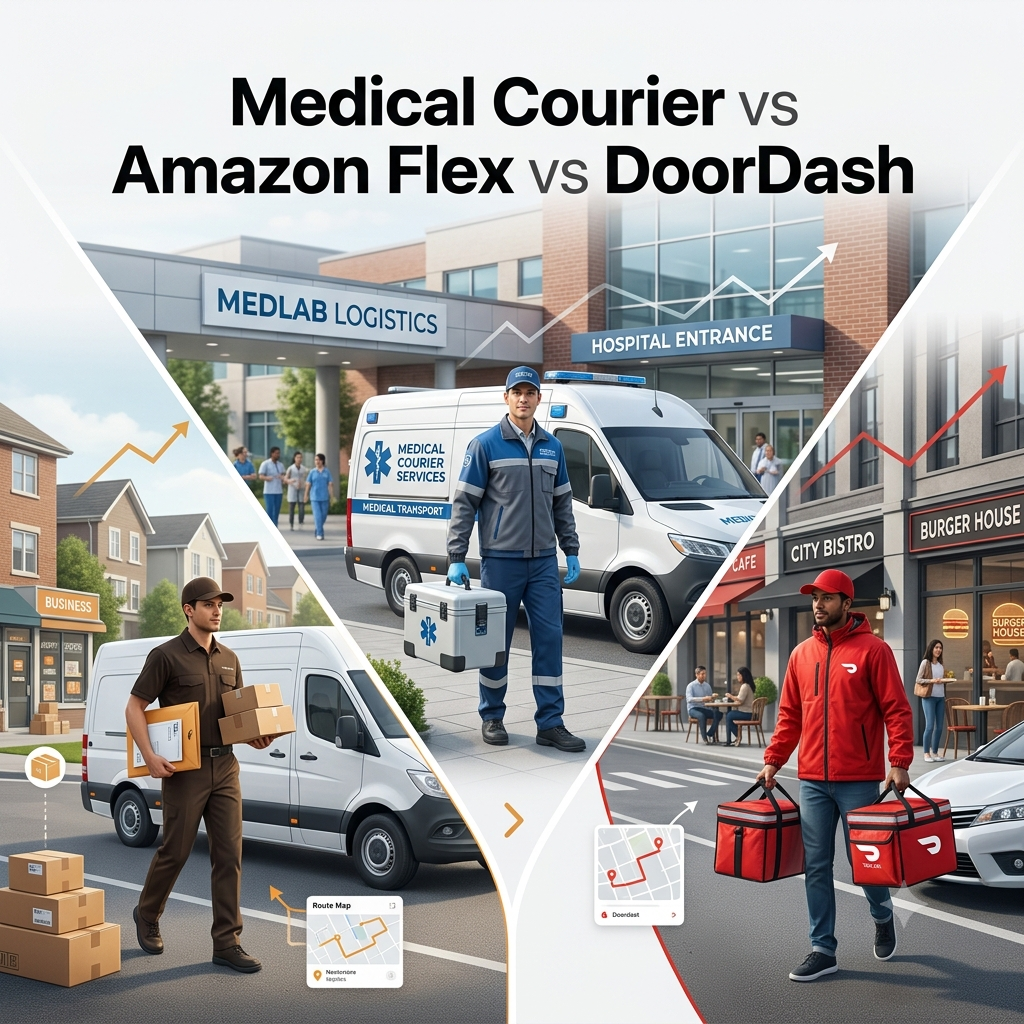
Chris drove for DoorDash for fourteen months. He knew every shortcut in his city. He knew which restaurants ran late. He knew exactly which hours were worth driving and which were not.
He was earning $19 per hour after expenses — on a good week. On a slow week it was $14.
A neighbor mentioned medical courier work. Same city. Same vehicle. Same hours available. First direct contract: $34 per hour. Scheduled routes. No algorithm. No customer ratings.
He kept his DoorDash account active for two more weeks — just to compare. He has not opened the app since.
Quick Answer Medical courier work pays significantly more than Amazon Flex or DoorDash in 2026 — especially under direct facility contracts. Medical couriers earn $28 to $65+ per hour compared to $18 to $25 for Amazon Flex and $15 to $22 for DoorDash after expenses. The stability difference is equally significant — medical courier contracts provide scheduled predictable income that gig platforms cannot match.
Key Takeaways
- Medical courier direct contracts pay $28 to $65+ per hour — two to three times more than DoorDash or Amazon Flex
- DoorDash net income after expenses averages $15 to $22 per hour — lower than most drivers expect
- Amazon Flex pays $18 to $25 per hour but income depends entirely on block availability and algorithm access
- Medical courier routes are scheduled and contracted — income does not fluctuate with consumer demand
- The startup cost difference between medical courier and gig work is $300 to $600 — a one-time investment
- Medical courier work builds professional relationships and direct contracts — gig work builds nothing transferable
More drivers are asking the same question in 2026 — which platform or opportunity actually pays more when you account for real expenses, real hours, and real income stability.
According to a Gridwise driver earnings report, gig delivery drivers across major platforms earn an average of $14 to $17 per hour after accounting for fuel, vehicle wear, and platform fees — significantly below the figures platforms advertise in their recruitment materials.
Medical courier work under direct facility contracts operates in a completely different income structure. The comparison below is based on real operational costs and real take-home income — not recruitment advertising figures.
The Full Income Comparison
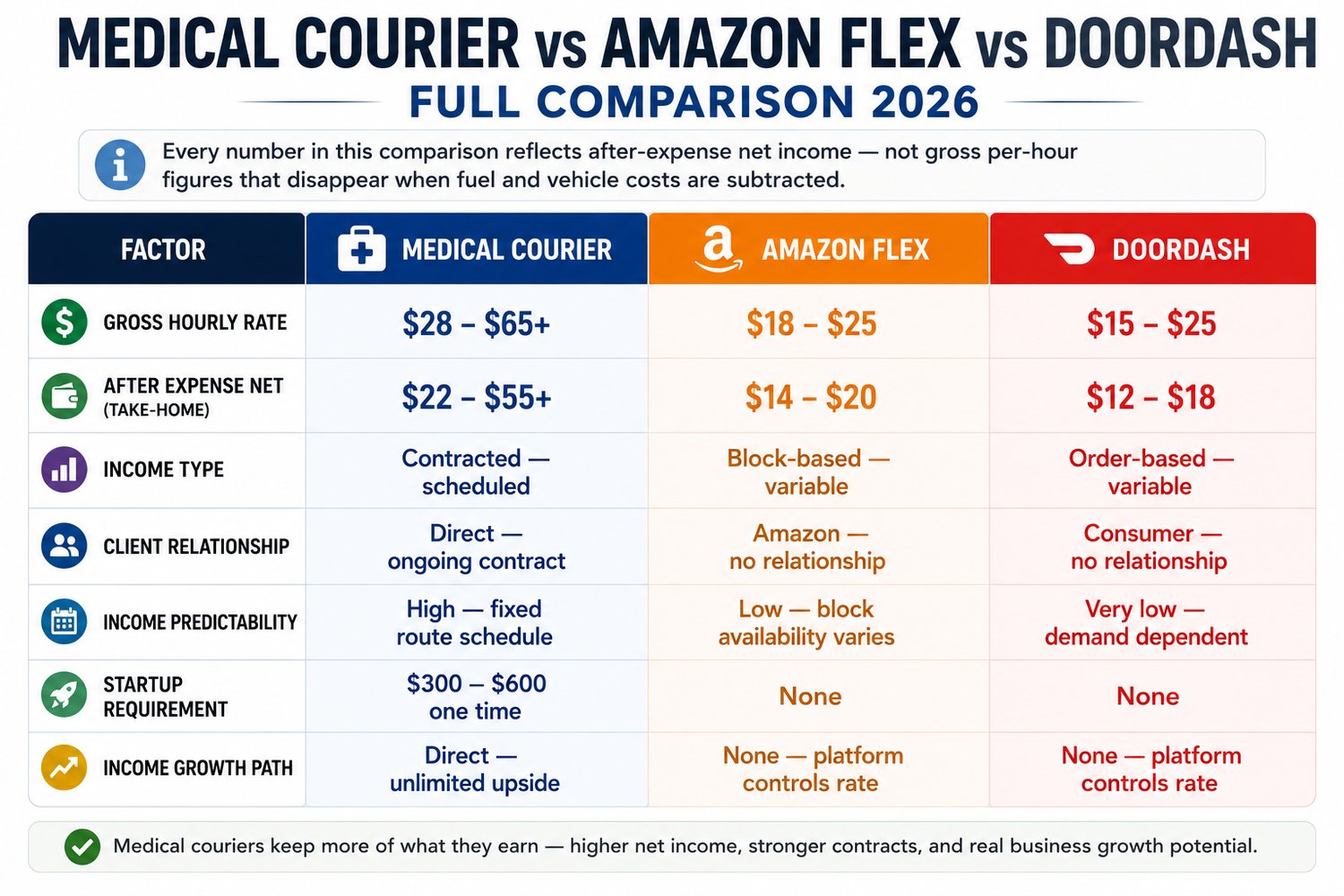
Every number in this comparison reflects after-expense net income — not gross per-hour figures that disappear when fuel and vehicle costs are subtracted.
Factor Medical Courier Amazon Flex DoorDash Gross hourly rate $28 – $65+ $18 – $25 $15 – $25 After expense net $22 – $55+ $14 – $20 $12 – $18 Income type Contracted — scheduled Block-based — variable Order-based — variable Client relationship Direct — ongoing contract Amazon — no relationship Consumer — no relationship Income predictability High — fixed route schedule Low — block availability varies Very low — demand dependent Startup requirement $300 – $600 one time None None Income growth path Direct — unlimited upside None — platform controls rate None — platform controls rate
The startup cost is the most common objection to medical courier work from drivers already active on gig platforms. Three hundred to six hundred dollars feels like a barrier when DoorDash and Amazon Flex require nothing upfront.
At a net income difference of $10 to $20 per hour, that startup investment is recovered within the first two to four shifts under a direct medical courier contract.
The Medical Courier Business Starter Kit at SteadyIncomeTools.com covers the complete startup sequence — compliance documents, outreach scripts, contract templates, and the 90-day income plan that gets new couriers past the startup cost and into contracted income faster than building the system alone.
Medical Courier vs DoorDash — The Real Numbers
DoorDash advertises earnings of up to $25 per hour in some markets. The reality after fuel, vehicle depreciation, and platform fees is significantly different for most drivers.
DoorDash — What Drivers Actually Earn
DoorDash income depends on three variables entirely outside your control — consumer order volume, algorithm order assignment, and market-level base pay. All three fluctuate daily and weekly with no guaranteed floor.
A DoorDash driver working a four-hour dinner shift in a mid-size market earns $55 to $70 gross before expenses. After fuel, vehicle depreciation at IRS rates, and insulated bag replacement, net income for that shift is $44 to $56 — or $11 to $14 per hour in take-home terms.
Top-market DoorDash drivers in dense urban areas during peak hours earn closer to $18 to $22 per hour net — but those conditions require precise timing, market knowledge, and consistent algorithm favorability that is difficult to sustain reliably.
Medical Courier — The Same Hours
A medical courier running a four-hour morning specimen route under a direct facility contract at $35 per run earns $140 for that block of time — regardless of consumer demand, algorithm assignment, or market conditions.
After fuel and vehicle depreciation, net income for that same four-hour block is $115 to $125. That is $28 to $31 per hour net — consistently, on a fixed schedule, five days per week.
Comparison Point DoorDash Medical Courier 4-hour shift gross $55 – $70 $120 – $160 4-hour shift net after expenses $44 – $56 $100 – $135 Net hourly equivalent $11 – $14 $25 – $34 Schedule control Algorithm dependent Fixed — your schedule Income floor None — can earn $0 Contracted — guaranteed per route
Medical Courier vs Amazon Flex — The Real Numbers
Amazon Flex pays better than DoorDash on a gross basis — but introduces a different variable that limits income potential. Block availability.
Amazon Flex — What Drivers Actually Earn
Amazon Flex drivers select delivery blocks through the app — typically two to four hour blocks paying $18 to $25 per hour gross. The income looks attractive until two realities set in.
Block availability is inconsistent and often competitive. In many markets, high-demand blocks disappear within seconds of posting. Drivers who cannot access blocks consistently earn far less than the advertised hourly rate suggests when total time — including waiting for blocks — is factored in.
After fuel and vehicle costs on a package delivery route, Amazon Flex net income averages $14 to $20 per hour for drivers who successfully secure consistent blocks.
Medical Courier — The Same Comparison
A medical courier under a direct contract does not compete for blocks. Routes are scheduled in advance — Monday through Friday morning pickups at confirmed facilities. The income for next week is calculable today. At three direct contracts running five days per week, a medical courier earns $3,000 to $5,500 per month from a fixed schedule that requires no app monitoring, no block competition, and no algorithm management. Comparison Point Amazon Flex Medical Courier Gross hourly rate $18 – $25 $28 – $65+ Net after expenses $14 – $20 $22 – $55+ Schedule Block dependent — variable Fixed — contracted schedule Income next week Unknown Calculable today Client relationship Amazon only Direct — multiple facilities Income growth path None — Amazon controls rate Unlimited — add contracts
The Stability Comparison — What the Numbers Miss
Income per hour is one dimension of the comparison. Income stability is the dimension that determines whether the work is actually sustainable as a primary or significant supplemental income source.
DoorDash and Amazon Flex income fluctuates with consumer behavior, platform algorithm changes, market saturation, and seasonal demand patterns. A DoorDash driver who earns $900 in a strong week may earn $420 the following week with no change in their own behavior or effort.
Medical courier income under direct contracts does not fluctuate with consumer behavior. A facility that needs daily morning specimen pickup needs it every morning — not more on weekends and less on Tuesdays. Not more during dinner hours and less during the afternoon.
The scheduled, contracted nature of medical courier work produces income stability that gig platforms structurally cannot provide — because gig platforms are built on variable consumer demand, and variable consumer demand produces variable driver income by design.
The Growth Comparison — What Happens at Month Six
At month six of DoorDash driving, income is approximately the same as month one. The platform controls the rate. The algorithm controls the volume. There is no mechanism for individual income growth beyond working more hours.
At month six of medical courier work under direct contracts — a courier who started with one facility and followed the referral strategy consistently has two to four contracts running simultaneously. Monthly income has grown from $700 to $2,800 to $4,500 or more — from the same vehicle, the same hours, and the same geographic area.
For the complete income growth trajectory by contract stage — medical courier salary: what drivers really earn in 2026 maps every income tier from first contract through full operation.
The One Reason Gig Work Still Makes Sense
Gig platforms — DoorDash, Amazon Flex, and others — have one genuine advantage over medical courier work. Zero barrier to entry and same-day income.
If you need income starting tomorrow and cannot wait two to four weeks for compliance documents to process — gig platforms provide that immediate option. That is a real advantage in a specific circumstance.
The strategic use of gig work is as a bridge — earning income while medical courier compliance documents are being processed. Once the LLC is registered, the commercial insurance is active, the HIPAA certificate is obtained, and the background check is complete — the bridge has served its purpose.
For the complete compliance setup timeline — medical courier requirements explained covers every document with processing time and cost so you can run both in parallel during the transition.
What Chris Did With the Comparison
Chris ran the numbers on his fourteenth month of DoorDash driving. He had earned $26,400 gross. After fuel, vehicle costs, and self-employment taxes he had kept $17,800.
His first full month of medical courier work under two direct contracts produced $4,200 gross. After the same expense categories he kept $3,100 — from morning routes that were done before noon every day.
He did not close the DoorDash account out of frustration. He closed it because the comparison made the decision obvious.
The vehicle was the same. The city was the same. The math was not the same at all.
The Medical Courier Business Starter Kit at SteadyIncomeTools.com includes the complete transition plan for drivers currently on gig platforms — the parallel setup approach that keeps gig income flowing while medical courier compliance documents are processed and the first facility outreach begins.
Directional Close
Chris did not need a new skill. He did not need a new vehicle. He needed a different structure for the same work he was already doing in the same city he already knew.
The comparison between medical courier work and gig platforms is not close once the full numbers are on the table. It is not even a question of preference — it is a question of whether the two to four week setup investment is worth two to three times the hourly income on a permanent scheduled basis.
For most drivers asking that question — the answer becomes obvious the moment the real after-expense numbers are side by side.
The next step is understanding exactly what that setup requires. Read how to become a medical courier in 2026 for the complete compliance and outreach sequence that takes a current gig driver to a contracted medical courier in two to four weeks.
You Might Also Like
- Medical Courier Salary: What Drivers Really Earn in 2026 — the full income breakdown by work structure
- Medical Courier Requirements Explained — every document needed to make the transition
- Medical Courier Insurance Guide — the commercial coverage that separates professional couriers from gig drivers
- How to Get Medical Courier Contracts — the outreach strategy that replaces the gig platform entirely
Frequently Asked Questions
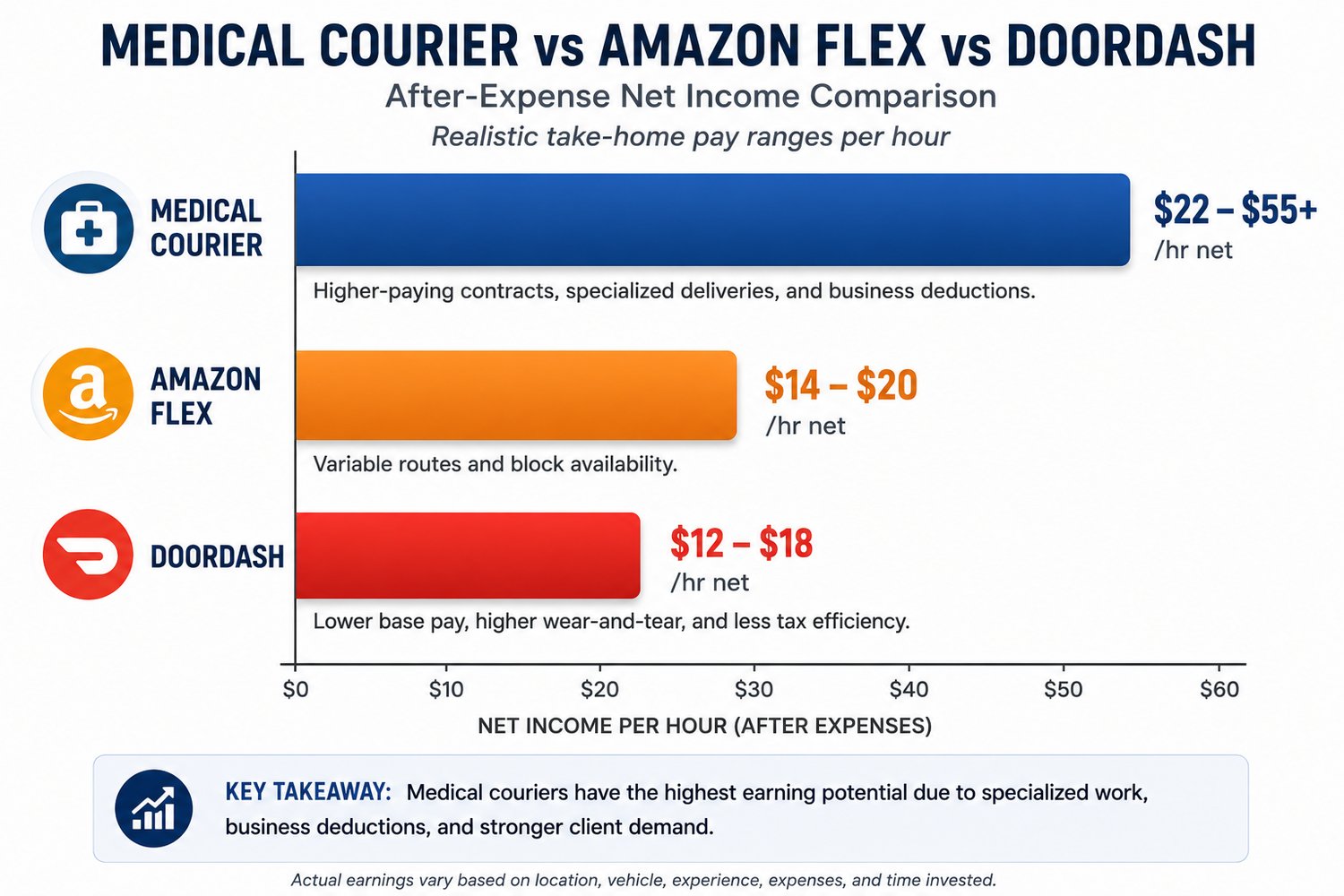
Does medical courier work pay more than DoorDash? Yes — medical courier work pays significantly more than DoorDash in 2026 on both a gross and after-expense net basis. DoorDash drivers earn $12 to $18 per hour net after fuel, vehicle depreciation, and platform considerations in most markets. Medical couriers operating under direct facility contracts earn $22 to $55 or more per hour net after the same expense categories. The income difference compounds over time because medical courier contracts grow through referrals while DoorDash income remains flat regardless of experience or tenure on the platform.
Does medical courier work pay more than Amazon Flex? Yes — medical courier direct contracts consistently pay more than Amazon Flex on an after-expense net basis. Amazon Flex pays $14 to $20 per hour net after fuel and vehicle costs for drivers who successfully secure consistent blocks. Medical couriers under direct facility contracts earn $22 to $55 or more per hour net from scheduled routes that do not require block competition or algorithm management. Amazon Flex income is also capped by platform-controlled rates with no individual growth path — medical courier income grows as additional direct contracts are added.
Is medical courier work more stable than gig delivery? Yes — medical courier work under direct facility contracts is significantly more stable than DoorDash, Amazon Flex, or any gig delivery platform. Gig platform income fluctuates with consumer demand, algorithm changes, market saturation, and seasonal patterns entirely outside the driver's control. Medical courier contracts provide scheduled fixed routes — a facility that needs daily morning specimen pickup needs it every morning regardless of consumer behavior. The income from next week is calculable today — which is structurally impossible on any gig delivery platform.
How much does it cost to switch from DoorDash to medical courier work? The one-time startup cost for transitioning from gig delivery to independent medical courier work ranges from $300 to $600. This covers LLC registration at $50 to $150, the first month of commercial auto insurance at $100 to $200, HIPAA training at $25 to $75, a background check at $30 to $60, and basic transport equipment at $65 to $130. At a net income difference of $10 to $20 per hour between DoorDash and medical courier direct contracts, the startup investment is typically recovered within the first two to four route shifts under a signed facility contract.
Can you do medical courier work and DoorDash at the same time? Yes — many drivers run gig platforms in parallel during the two to four week medical courier compliance setup period as a bridge income strategy. Once LLC registration, commercial insurance, HIPAA training, and background check are complete and the first direct facility contract is signed, most drivers find that the scheduled morning medical courier routes eliminate the need for gig work during those hours. Some couriers continue occasional gig delivery during afternoon hours before adding additional medical courier contracts — though the hourly rate difference makes that comparison increasingly unfavorable as the medical courier contract schedule fills.
Why does medical courier work pay more than gig delivery? Medical courier work pays more than gig delivery for three structural reasons. First — direct contracts eliminate the platform margin that gig companies extract between what facilities or consumers pay and what drivers receive. Second — healthcare facilities pay a compliance premium for licensed, insured, HIPAA-trained professional couriers that consumer delivery platforms do not command. Third — medical courier income grows through direct relationship building and referrals with no platform-imposed rate ceiling — while gig platform income is permanently capped by the platform's pricing structure regardless of driver experience or tenure.
What are the downsides of medical courier work compared to gig delivery? Medical courier work has two genuine disadvantages compared to gig delivery platforms. The startup requirement of $300 to $600 for compliance documents and equipment creates a barrier that DoorDash and Amazon Flex do not — both of which allow same-day income with zero upfront cost. The setup timeline of two to four weeks also means medical courier work cannot provide immediate income the way gig platforms can. For drivers who need income starting tomorrow, gig platforms remain the faster option. For drivers who can invest two to four weeks in setup, the income and stability difference makes medical courier work the significantly stronger long-term choice.
Is it hard to switch from Amazon Flex to medical courier work? Switching from Amazon Flex to medical courier work is straightforward for drivers who already have a reliable vehicle and a clean driving record — both of which Amazon Flex also requires. The additional steps are obtaining a HIPAA training certificate, securing commercial auto insurance in an LLC name, and completing a background check. Total setup time is two to four weeks run in parallel with continued Amazon Flex work during the transition. Most drivers who complete the setup and land their first direct facility contract describe the transition as simpler than they expected — the operational skills from package delivery transfer directly to medical courier route management.

Comments ()