

Denise drove for a courier company for eleven months at $17 per hour. She thought that was what medical courier work paid.
Then a lab coordinator she had been picking up from for eight months asked if she would consider a direct contract. Same route. Same vehicle. Same morning schedule.
The rate she was offered was $38 per hour. She signed the contract that afternoon. The difference was not skill. It was not experience. It was one conversation she had not known to initiate sooner.
Quick Answer Medical courier salary in 2026 ranges from $16 per hour for company employees to $65 or more per hour for independent couriers running multiple direct facility contracts. The national average sits around $20 to $24 per hour — but that number is pulled down by the lowest-paying work structures. Couriers who eliminate staffing layers and build direct client relationships consistently earn two to three times more than those who do not.
Key Takeaways
- National average medical courier pay is $20 to $24 per hour — but work structure matters more than location
- Employee couriers at courier companies earn $16 to $22 per hour with no income upside
- Independent contractors on platforms earn $18 to $28 per hour with moderate flexibility
- Direct contract couriers earn $28 to $65+ per hour depending on route type and volume
- Couriers running three or more direct contracts earn $5,000 to $9,000+ per month
- Part-time medical courier work on two morning routes generates $1,600 to $2,400 per month consistently
Medical courier salary is not a fixed number. It is a range — and where you land in that range depends almost entirely on your work structure, not your hours or your location.
According to the Bureau of Labor Statistics, the median annual wage for couriers and messengers sits around $38,000 across all categories. Medical courier specialists operating under direct facility contracts consistently report earnings well above that median — because healthcare facilities pay a compliance premium for trained, insured, professional couriers that general delivery work does not command.
Understanding the structure behind the numbers is the fastest way to move from the bottom of the range to the top.
Medical Courier Salary by Work Structure
The single biggest factor in medical courier pay is how many layers exist between you and the facility writing the check.
Every staffing layer extracts margin from your labor before it reaches you. Identifying and eliminating those layers is the highest-leverage income move available to any working medical courier.
Work Structure Hourly Rate Monthly Income Full Time Income Upside Employee — courier company $16 – $22/hr $2,400 – $3,500 None — fixed wage Independent contractor — platform $18 – $28/hr $2,800 – $4,200 Limited — platform controls volume Direct contract — single facility $28 – $45/hr $3,200 – $5,500 Strong — grows with referrals Direct contract — multiple facilities $35 – $65+/hr $5,000 – $9,000+ High — no ceiling
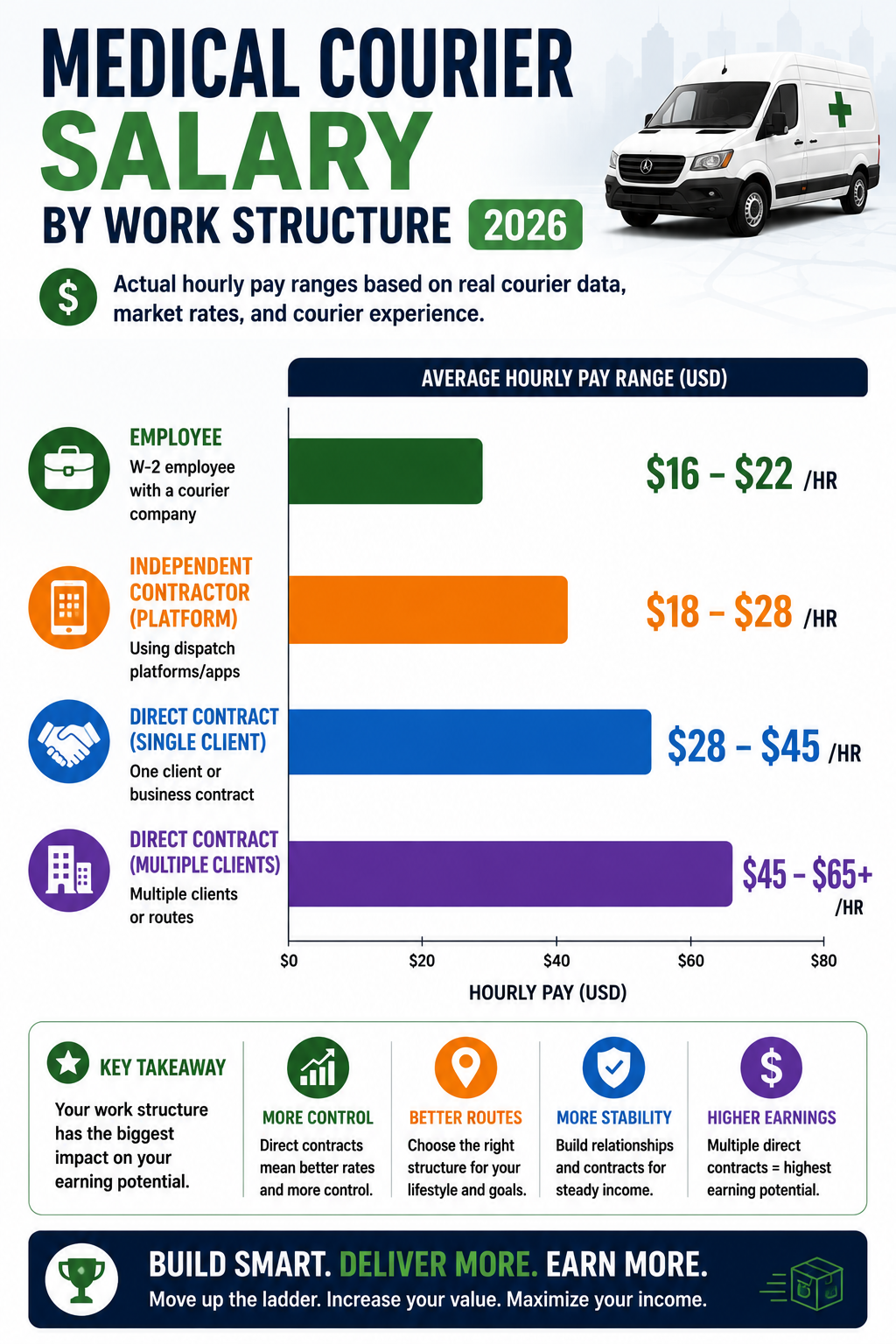
Denise's story is not unusual. It is the standard trajectory for couriers who understand that medical courier salary is not fixed — it is a starting point determined by the structure they chose on day one.
The structure is changeable. The steps that change it are specific and affordable.
If you want the complete system for moving from platform work to direct contracts — including outreach scripts, rate negotiation approach, and contract templates — the Medical Courier Business Starter Kit at SteadyIncomeTools.com covers every step of that transition.
Medical Courier Salary by State
Geography affects medical courier pay — but less than most couriers expect. Urban markets pay more because facility density is higher and competition for reliable professional couriers is stronger.
The work structure income gap within any state is consistently larger than the geographic variation between states. A direct contract courier in Ohio earns more than an employee courier in California.
State Average Hourly Rate Notes California $22 – $38/hr High cost of living premium, dense urban markets New York $21 – $36/hr NYC metro significantly above state average Texas $18 – $32/hr Large rural routes, strong direct contract market Florida $17 – $30/hr High facility volume, competitive market Illinois $19 – $33/hr Chicago metro drives state average up Georgia $18 – $30/hr Growing healthcare hub, Atlanta market strong Ohio $17 – $28/hr Mid-range market, consistent route availability National Average $20 – $24/hr Blended across all structures and markets Ranges reflect independent contractor and direct contract rates. Employee rates sit at the lower end of each range.
What Actually Drives the Pay Difference
Three factors explain virtually all of the variation in medical courier salary. Two of them are fully within your control.
Work structure is the dominant factor. A courier under a direct hospital contract earns $35 to $50 per hour for the same pickup and delivery work that a courier company employee earns $18 per hour to perform. The hospital pays roughly the same rate either way. The difference is how much margin the staffing layer extracts before it reaches the driver.
Route type determines rate complexity. Standard specimen pickup routes pay consistent flat rates per run. Stat routes — urgent same-day transport — command premium rates of $45 to $80 per run due to time sensitivity. Temperature-controlled specimen transport pays above standard rates because of handling requirements and liability.
Volume and reliability compound over time. Facilities that trust a courier increase their volume commitments. Couriers covering multiple time windows — morning specimen routes plus afternoon medication delivery plus occasional stat runs — earn significantly more from the same vehicle.
For the complete breakdown of how to find and structure direct contracts — how to get medical courier contracts covers the outreach and negotiation approach that shifts couriers from platform work to direct facility relationships.
How Part-Time and Full-Time Income Compare
Medical courier work is genuinely flexible. The fixed route structure — scheduled morning pickups, set afternoon runs, on-call stat transport — makes it compatible with other income streams in a way that shift-based work is not.
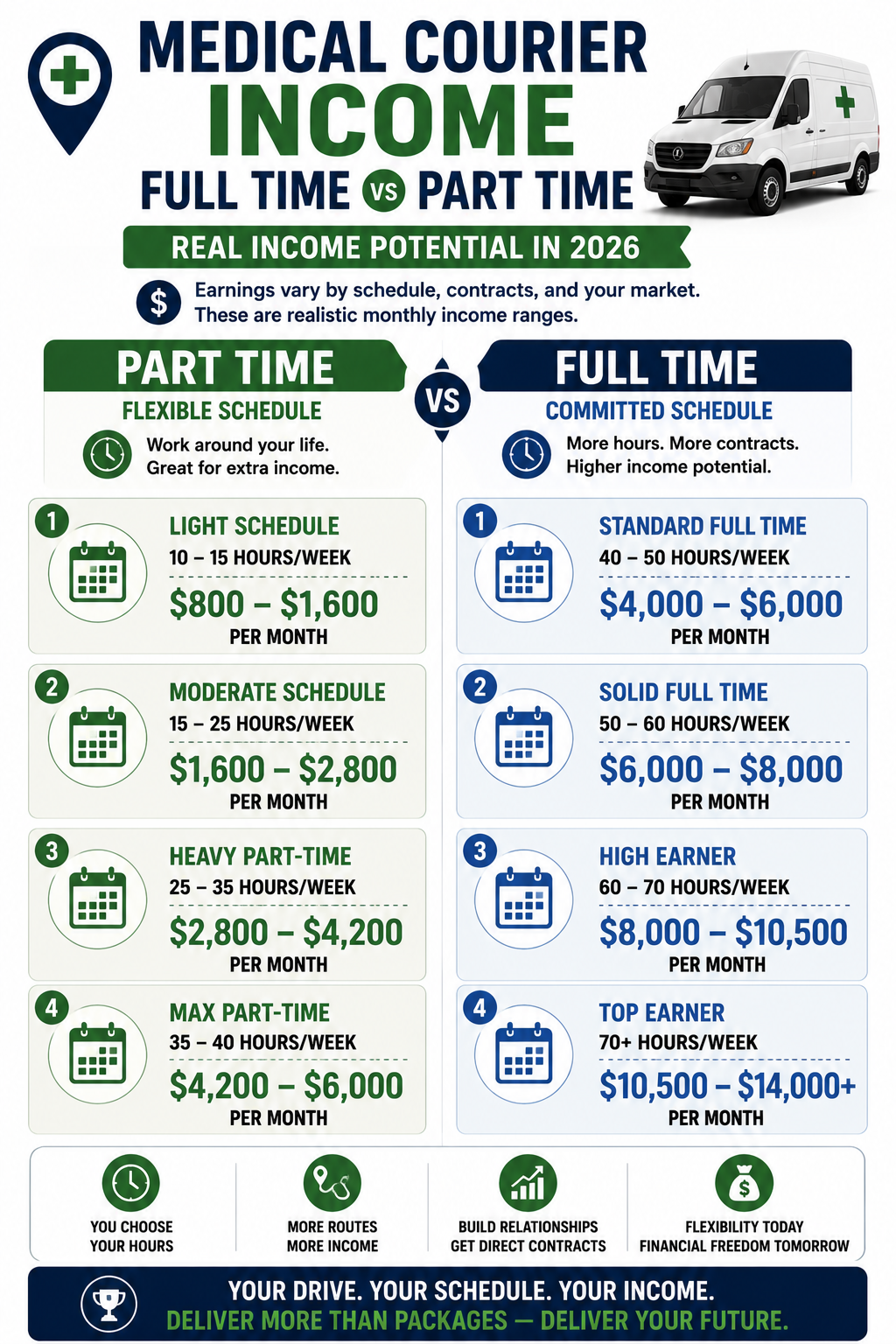
Schedule Routes Per Week Estimated Monthly Income Part-time — 2 morning routes 10 runs $1,600 – $2,400 Part-time — 4 morning routes 20 runs $2,800 – $3,800 Full-time — mornings and afternoon 30 – 35 runs $4,500 – $6,500 Full-time — multiple contract types 40+ runs $6,000 – $9,000+ Estimates based on direct contract rates of $28 to $45 per run for standard routes.
📊 INFOGRAPHIC PLACEMENT Title: Medical Courier Income Full Time vs Part Time Type: Side by side bar comparison — part time left, full time right Data: 4 schedule tiers with monthly income ranges Placement: Directly below the schedule comparison table
The Three Moves That Shift Your Income Up
The gap between $17 per hour and $45 per hour is not a skills gap. It is a structure gap. Closing it requires three specific moves — in order.
Move 1 — Go from employee to independent contractor. Register your LLC. Secure commercial auto insurance. Complete HIPAA training. Get your background check. That four-item compliance package costs $300 to $600 total and takes two to four weeks. It is the only thing standing between employee rates and contractor rates. For the full setup checklist — how to become a medical courier in 2026 covers every step in order.
Move 2 — Go from platform contracts to direct facility contracts. Platforms charge facilities a margin for connecting them with couriers — then pay couriers what remains. Direct contracts eliminate that margin entirely. The facility pays the same or less. You earn significantly more. The transition is a phone call — not a negotiation.
Move 3 — Add a second and third contract. The vehicle costs are already paid. The insurance is already active. Every additional direct contract after the first adds near-pure revenue with minimal additional overhead. A courier with three direct morning contracts earns $3,000 to $4,500 per month before noon — from the same vehicle that earned $1,800 per month under a single platform arrangement.
The Medical Courier Business Starter Kit at SteadyIncomeTools.com includes the rate negotiation scripts, direct contract templates, and income tracking tools that help new couriers move from platform rates to direct contract rates faster than building the system from scratch.
Directional Close
Denise did not get a raise. She got a conversation. The rate she earned for eleven months at a courier company was not what the work was worth — it was what the structure she had chosen was worth.
The structure is a decision. The decision is reversible. And the compliance setup that makes direct contracts available costs less than one week of courier company wages.
Before you make your first outreach call to a facility — make sure your requirements are fully in order. Read medical courier requirements explained so you walk into every facility conversation with everything they need to say yes.
You Might Also Like
- How to Become a Medical Courier in 2026 — the complete step by step starting point
- Medical Courier Companies Hiring in 2026 — if you want employee income while building toward direct contracts
- Medical Courier Insurance Guide — the commercial coverage that unlocks professional rates
- How to Get Medical Courier Contracts — the outreach strategy that fills your schedule with direct clients
Frequently Asked Questions
What is the average medical courier salary in 2026? The national average medical courier salary in 2026 sits between $20 and $24 per hour across all work structures. That average is pulled down significantly by employee roles at courier companies paying $16 to $22 per hour. Independent contractors operating under direct facility contracts consistently earn $28 to $65 per hour for the same underlying work. Couriers comparing their pay to the national average without accounting for work structure are often measuring themselves against the least optimized income arrangement in the field.
How much can a medical courier make per month? Monthly medical courier income ranges from approximately $2,400 for part-time employee couriers to over $9,000 for full-time independent couriers running multiple direct facility contracts. Part-time couriers on two direct contract morning routes consistently earn $1,600 to $2,400 per month. Full-time couriers covering morning specimen routes plus afternoon delivery and occasional stat transport earn $5,000 to $8,000 per month. The most important income variable is not hours worked — it is whether the courier has eliminated staffing layers between their labor and the facility payment.
Do medical couriers make more than Amazon Flex drivers? Yes — medical couriers under direct contracts earn significantly more than Amazon Flex drivers on a per-hour basis. Amazon Flex drivers typically earn $18 to $25 per hour before vehicle expenses with income dependent on app availability and order volume. Medical couriers under direct facility contracts earn $28 to $65 per hour on scheduled routes that do not depend on algorithms or consumer demand. The stability difference is also substantial — direct contract medical courier work provides predictable scheduled income rather than variable gig-dependent earnings.
What type of medical courier routes pay the most? Stat routes — urgent same-day transport of time-sensitive specimens or medications — pay the highest per-run rates in medical courier work, typically $45 to $80 per run depending on distance and urgency. Temperature-controlled specimen transport and pharmaceutical delivery also command above-standard rates due to handling requirements and liability. Standard morning specimen pickup routes pay lower per-run rates but provide the reliable scheduled volume that forms the income foundation for most professional medical couriers.
How does medical courier pay compare between states? California and New York markets pay the highest medical courier rates — averaging $22 to $38 and $21 to $36 per hour respectively — due to high cost of living adjustments and dense urban healthcare markets. Midwest markets like Ohio average $17 to $28 per hour. However the work structure income gap within any state is consistently larger than the geographic variation between states. A direct contract courier in any mid-range state consistently earns more than an employee courier in a high-cost market.
Can medical courier work be done part-time and still generate meaningful income? Yes — part-time medical courier work under direct contracts generates meaningful supplemental income without requiring full-time hours. Two morning specimen pickup routes running Monday through Friday produce $1,600 to $2,400 per month consistently. Four morning routes produce $2,800 to $3,800 per month. The fixed route structure makes part-time medical courier work genuinely compatible with employment, caregiving responsibilities, or other income streams in a way that gig-based delivery work is not.
Why do some medical couriers earn so much more than others? The income gap between medical couriers is almost entirely explained by work structure rather than skill, experience, or location. Couriers working as employees have their rates set by the employer with no upside path. Couriers on independent contractor platforms earn more but still operate within a margin structure that reduces their take. Couriers who build direct relationships with healthcare facilities — bypassing both employment and platform layers — earn the full facility rate for their labor. The compliance requirements that enable direct contracts cost $300 to $600 total and take two to four weeks to complete.
How do medical couriers increase their income over time? Medical courier income grows through three specific moves executed in order. First — transition from employee to independent contractor by completing the four-item compliance setup. Second — move from platform-based contracts to direct facility relationships through local phone outreach. Third — add a second and third direct contract after the first is running smoothly. Each additional direct contract adds near-pure revenue since the vehicle, insurance, and compliance costs are already covered. Couriers who complete all three moves typically double or triple their hourly rate within six months of starting.
Comments ()