

Diane had worked ICU nights for fourteen years. She knew the difference between a medical record that told the truth and one that had been carefully adjusted after the fact. She had seen it happen. She knew what it looked like.
What she did not know — until a colleague mentioned it over coffee one morning after a particularly brutal overnight shift — was that law firms were actively looking for nurses with exactly that knowledge and paying $150 an hour for it.
She went home that morning and looked it up. By the following year she had built a part-time legal nurse consulting practice that generated more income in twenty hours per week than her full-time nursing salary had in forty.
Her clinical knowledge did not change. The market paying for it did.
Legal nurse consulting sits in one of those rare professional intersections where deep domain expertise meets high legal stakes — and where the people who have that expertise are consistently paid at a rate that reflects how genuinely difficult it is to find someone who can do what they do.
If you are a registered nurse who has spent years developing clinical knowledge that feels routine to you — the legal industry has a different word for what you know. They call it expert opinion. And they pay accordingly.
What a Legal Nurse Consultant Actually Does
A legal nurse consultant — LNC — provides clinical expertise to attorneys, insurance companies, healthcare organizations, and risk management firms working on cases that involve medical questions.
The work is not clinical. You are not treating patients. You are applying your clinical knowledge to legal and administrative contexts — analyzing medical records, identifying standards of care, explaining complex medical concepts to attorneys who need to understand them, and in some cases testifying as an expert witness.
The specific work that LNCs do most commonly:
Medical record review and analysis — Reading through medical records and identifying what happened, what the standard of care required, where deviations occurred, and what the clinical significance of those deviations was. This is the core of most LNC work and the skill that most experienced nurses can develop faster than they expect once they understand what attorneys are looking for.
Case screening — Evaluating whether a potential malpractice case has clinical merit before an attorney invests significant resources pursuing it. A nurse who can read a set of records and accurately assess merit in two hours saves an attorney dozens of hours of investigation on cases that were never viable.
Expert witness identification — Helping attorneys identify and vet clinical expert witnesses for specific case types. An ICU nurse who knows which physicians and specialists would be most credible on a ventilator management case is providing value that no non-clinical staff member can replicate.
Chronology development — Creating clear, organized timelines of medical events from complex and often disorganized medical records. An attorney trying to understand a three-year treatment history across twelve providers needs a clinical professional who can synthesize that information into something a jury can follow.
Deposition and trial support — Preparing attorneys for depositions of medical witnesses by explaining the clinical concepts involved, anticipating the testimony, and identifying the questions that will most effectively expose gaps in the opposing witness's position.
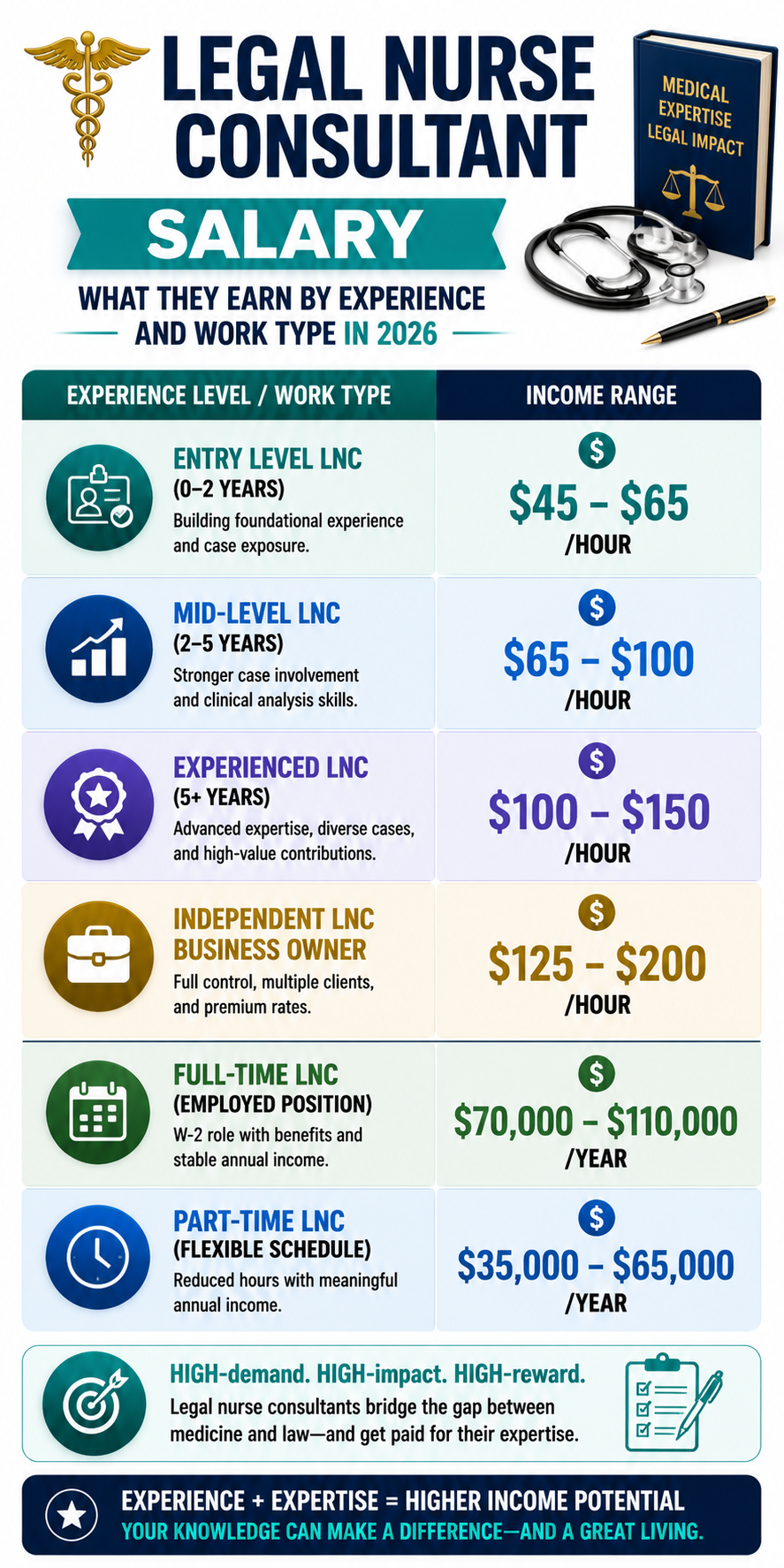
The Legal Nurse Consultant Salary — Honest Numbers by Experience Level
The legal nurse consultant salary question is one that produces a wide range of answers depending on whether the person is working as an independent consultant, an employee of a law firm or insurance company, part-time or full-time, and how many years of LNC experience they bring to their cases.
Here is the honest breakdown.
Entry Level LNC — $45 to $65 Per Hour
New LNCs who have completed their certification and are building their first cases. The lower end of the range reflects the time required to develop case analysis efficiency and the smaller client base of a new practice.
Annual income at this level working part-time (20 hours per week): $46,800 to $67,600
Mid-Level LNC — $65 to $100 Per Hour
LNCs with two to five years of active consulting experience and an established client base. Case analysis efficiency has improved. Referrals are supplementing active outreach. Specialty expertise is developing.
Annual income at this level working part-time (20 hours per week): $67,600 to $104,000
Experienced LNC — $100 to $150 Per Hour
LNCs with five or more years of active practice, established attorney relationships, recognized specialty expertise, and a reputation that generates consistent inbound referrals.
Annual income at this level working part-time (20 hours per week): $104,000 to $156,000
Independent LNC Business Owner — $125 to $200 Per Hour
LNCs who have built a recognized independent practice with multiple attorney clients, potential subcontractor relationships with other nurse consultants, and the ability to take on larger case loads or project-based arrangements with major law firms or insurance companies.
Annual income at full capacity: $130,000 to $208,000+
The income gap between a nurse working the floor and a nurse consulting on legal cases is not a credential gap. It is a positioning gap — and closing it starts with understanding what the credential actually requires.
What the CLNC Certification Is — And Whether You Need It
The Certified Legal Nurse Consultant designation — CLNC — is the primary professional credential in this field. It is offered through the National Alliance of Certified Legal Nurse Consultants (NACLNC) and through Vickie Milazzo Institute, which is the most widely recognized CLNC training program in the industry.
What the certification requires:
- Active RN license in good standing
- Completion of an approved legal nurse consulting training program
- Passing the CLNC certification examination
What it costs:
The Vickie Milazzo Institute CLNC certification program costs approximately $3,000 to $5,000 depending on the format — live seminar, online, or self-study. Additional costs include the certification examination fee and ongoing continuing education requirements for recertification.
Do you need it to start?
Technically no — there is no legal requirement that an LNC be CLNC certified to work with attorneys. Some LNCs build successful practices without formal certification, particularly those with highly specialized clinical backgrounds that are independently credible to attorneys.
Practically yes — for most nurses building a new LNC practice, the CLNC certification provides the structured training that compresses the learning curve, the credential that signals professionalism to potential attorney clients, and the professional community that provides early case opportunities and referral relationships.
For nurses who are uncertain whether LNC work is right for them before investing in full certification — starting with the free resources available through NACLNC and the Vickie Milazzo Institute gives a realistic picture of the work before the financial commitment.
Who Hires Legal Nurse Consultants — And How to Find Them
Understanding who your clients are before you start outreach is the foundation of an efficient LNC practice launch.
Personal injury and medical malpractice attorneys — The largest client category for most LNCs. These attorneys work on cases where clinical questions determine case viability and outcome. They need nurses who can assess records quickly, communicate findings clearly to non-clinical audiences, and work efficiently within legal timelines.
Defense attorneys — Medical malpractice defense firms need the same clinical expertise as plaintiff attorneys — for the opposite purpose. Many LNCs work with both plaintiff and defense attorneys on different cases, which expands the available client base significantly.
Insurance companies — Liability insurers, workers compensation carriers, and medical malpractice insurers use LNCs to review claims, assess clinical merit, and provide guidance on case management and settlement decisions.
Risk management departments — Hospitals and large healthcare organizations employ or contract LNCs to review adverse events, assess liability exposure, and improve clinical documentation practices.
How to find attorney clients:
The most effective outreach for new LNCs is direct — a professional letter and resume sent to personal injury and medical malpractice law firms in your geographic area, followed by a phone call and an offer of a complimentary initial case consultation.
Most attorneys who have worked with strong LNCs in the past have experienced the value directly and are receptive to meeting new consultants. Those who have not need to understand what an LNC does and why it is worth their investment — which your initial consultation can demonstrate directly.
Bar association directories list attorneys by practice area in most states. Personal injury and medical malpractice attorneys are identifiable by specialty — your outreach list is buildable from public sources within a few hours of research.
For the broader strategy of identifying and monetizing specialized professional expertise — the professional skills clients are actively paying for right now covers the market landscape for professional knowledge across multiple fields.
The Income Reality for Nurses Building an LNC Practice Alongside Clinical Work
The most common entry point for LNC work is not full-time departure from clinical nursing — it is building the practice alongside existing clinical employment until the LNC income justifies a reduction in clinical hours.
A nurse working three 12-hour shifts per week in a clinical role has four days per week available for case work. At the entry-level LNC rate of $50 per hour — ten hours of case work per week across four available days generates $500 per week — $2,000 per month — from a schedule that does not require leaving clinical employment.
As the practice grows and rates increase — the math changes. An experienced LNC billing $125 per hour for fifteen hours of case work per week generates $1,875 per week — $7,500 per month — from a part-time commitment that most clinical nurses can sustain alongside reduced clinical hours.
The trajectory from first case to established practice typically takes twelve to eighteen months — which is longer than most VA or freelance timelines but produces a higher income ceiling than most other nursing side income options.
For the nurses who are burning out in clinical roles and looking for a path that uses their expertise without the physical and emotional toll of bedside work — why nurses are burning out and how to rebuild income and energy covers the full picture of income options available to nurses at different stages of burnout and career transition.
The Nurses Who Build the Most Successful LNC Practices
The nurses who build the most successful legal nurse consulting practices in the first two years share a specific combination of qualities — not credentials, not specialty, but approach.
They treat it as a business from day one. They send consistent outreach. They follow up professionally. They invest in understanding what attorneys need from a consulting relationship — which is different from what clinical supervisors needed from a nursing relationship. They price their services at the rate the market supports rather than at a rate their anxiety suggests.
And they start before they feel completely ready — because the learning curve of LNC work is largely experiential. The first case teaches you more than any training program can prepare you for. The fifth case is significantly easier than the first. The twentieth case is where expertise begins to feel like genuine mastery.
For the complete landscape of how nurses are diversifying their income in 2026 beyond bedside work — how to diversify your nursing income beyond the bedside covers every major income path available to RNs who want to leverage their clinical expertise in non-clinical contexts.
The Resources That Support Your Income Rebuilding
The Nurse Income Coach covers the complete income diversification strategy for registered nurses — including legal nurse consulting, health coaching, telehealth consulting, and the other high-income paths available to nurses who want to leverage their clinical expertise outside of traditional bedside roles.
For the broader income recovery strategy that applies to nurses facing displacement or burnout — what to do in the first 30 days after a layoff covers the stabilization and income-building approach that works for professionals across every field navigating career disruption.
For the top income streams nurses are building in 2026 — the top income streams for nurses who want to work less and earn more covers the full landscape of nursing income diversification with honest income ranges and realistic timelines for each path.
Worth Reading Next
- Why Nurses Are Burning Out and How to Rebuild Income and Energy
- How to Diversify Your Nursing Income Beyond the Bedside in 2026
- The Top Income Streams for Nurses Who Want to Work Less and Earn More
- Side Hustle Ideas for Women That Actually Pay in 2026
The article that most directly connects to what comes next for nurses reading this is what legal nurse consulting pays and how to break into it — which goes deeper on the specific outreach strategy for finding attorney clients and the first case process that most new LNCs find more accessible than they expected before they tried it.
Frequently Asked Questions
How much do legal nurse consultants make per hour in 2026?
Legal nurse consultant hourly rates in 2026 range from $45 to $65 per hour for entry-level LNCs building their first cases, $65 to $100 per hour for mid-level consultants with two to five years of experience, $100 to $150 per hour for experienced LNCs with established attorney relationships, and $125 to $200 per hour for independent LNC business owners with recognized specialty expertise. The rate reflects the complexity of the cases handled and the consultant's track record rather than years of clinical nursing experience specifically.
What is the average legal nurse consultant salary per year?
Full-time legal nurse consultants earn between $70,000 and $110,000 annually as employees of law firms or insurance companies. Independent LNC business owners working full-time earn $130,000 to $200,000 or more depending on their specialty and client base. Part-time LNCs working 15 to 20 hours per week alongside clinical nursing employment earn $35,000 to $65,000 annually from their consulting practice — a meaningful income supplement that grows significantly as rates increase with experience.
Do you need to be a CLNC to work as a legal nurse consultant?
There is no legal requirement to hold CLNC certification to work with attorneys as a nurse consultant. However, the CLNC certification from programs like Vickie Milazzo Institute provides structured training that compresses the learning curve, a recognized credential that signals professionalism to potential attorney clients, and access to a professional community that provides early case opportunities and referrals. Most nurses building a new LNC practice find the certification investment pays for itself within the first two to three cases.
How do legal nurse consultants find their first clients?
Most new LNCs find their first attorney clients through direct outreach — a professional letter and resume sent to personal injury and medical malpractice law firms in their geographic area, followed by a phone call and an offer of a complimentary initial case consultation. Bar association directories list attorneys by practice area in most states, making the outreach list buildable from public sources. Networking through state bar association events, legal nurse consulting associations, and referrals from certified colleagues also produces early client opportunities.
Can a nurse do legal consulting part time?
Yes — and part-time LNC work alongside clinical nursing employment is the most common entry point for most nurses building a consulting practice. A nurse working three 12-hour clinical shifts per week has four days available for case work. Ten hours of case work per week at entry-level LNC rates generates $2,000 per month — which grows significantly as rates increase with experience and as the attorney client base expands through referrals.
What clinical backgrounds make the strongest legal nurse consultants?
ICU and critical care nurses, emergency department nurses, surgical and perioperative nurses, labor and delivery nurses, and oncology nurses tend to build the strongest LNC practices because these specialties are involved in the highest proportion of medical malpractice and personal injury cases. However, every clinical specialty has legal applications — long-term care nurses work on nursing home negligence cases, psychiatric nurses work on mental health commitment and medication cases, and home health nurses work on home care liability cases. The specialty matters less than the depth of clinical knowledge and the ability to communicate it clearly to non-clinical audiences.
What is the Nurse Income Coach and how does it help nurses build alternative income?
The Nurse Income Coach covers the complete income diversification strategy for registered nurses — including legal nurse consulting, health coaching, telehealth consulting, virtual nursing, and other high-income paths available to nurses who want to leverage their clinical expertise outside of traditional bedside roles. It is built for nurses at every stage of career transition — from those who want to supplement clinical income with a side practice to those who want to replace their clinical income entirely with non-bedside work.

Comments ()