

The email came on a Thursday afternoon. Seventeen years with the same company — seventeen years of early mornings, late nights, performance reviews that always landed in the top tier, and the quiet assumption that loyalty meant something. It took four sentences to end it.
By Thursday evening James was sitting at his kitchen table trying to explain to his wife why the health insurance they had built their family's medical needs around was going to run out in sixty days. He was 53. The job market he was about to re-enter was not the one he had left seventeen years ago. He did not know that yet. He was still in the shock of Thursday.
If you are reading this article, you are probably in your own version of that Thursday. Maybe it was an email. Maybe it was a meeting that ended with HR walking you out. Maybe it was a phone call that lasted six minutes and changed everything that comes after it.
However it happened — the next 30 days matter more than most people realize while they are living through them. Not because you need to have everything figured out. Because the decisions you make in the first 30 days after a layoff determine whether you recover on your terms or on the terms that financial pressure eventually forces on you.
This is the honest, specific, actionable guide to those 30 days.
First — What You Are Feeling Is Not Weakness
Before the action plan — this needs to be said clearly.
The disorientation, the anger, the fear, the grief that feels disproportionate to what happened — none of that is weakness. It is the rational response to a genuine loss. You did not just lose a job. You lost the structure your days were built around, the professional identity that shaped how you understood your own value, and the financial foundation your household depends on — all at once, without warning, through a decision you had no part in making.
For workers who built careers over twenty or thirty years — who gave their best years, their expertise, and their loyalty to organizations that have decided to replace them with cheaper labor, younger faces, or automated systems that approximate what they did at a fraction of the cost — the loss carries an additional layer that is worth naming.
It feels personal. It is not personal. It is economic. Companies are making financial calculations — not judgments about your value as a professional or a human being. The person who eliminated your role has almost certainly never seen your performance reviews. They looked at a spreadsheet and made a decision that happened to have your name on it.
That distinction matters — not because it makes the loss smaller but because it changes what it means for your next chapter. A financial calculation eliminated your position. A financial calculation does not determine what your expertise is worth in the broader market. Those are two entirely different questions — and only one of them has been answered.
The First Week — Stabilize Before You Plan
The worst financial decisions after a layoff happen in the first week when the shock is freshest and the urgency feels most acute. The best thing you can do in week one is not make any major decisions — it is create the conditions under which you can make good ones.
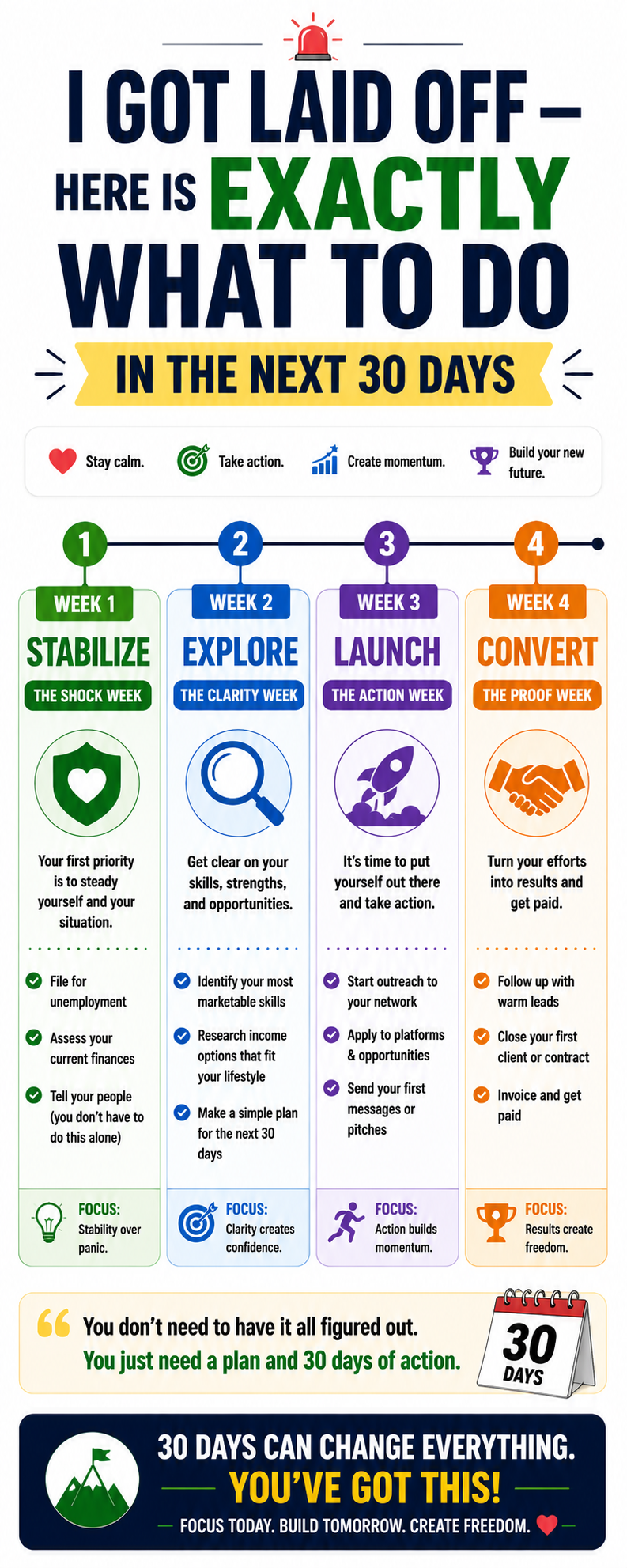
File for unemployment benefits immediately.
Do not wait. Do not assume you are not eligible. File online through your state's unemployment portal the same week your layoff occurs. Most states have a one-week waiting period before benefits begin — which means every day you delay filing is a day of benefits you will not recover.
Unemployment benefits replace 40 to 60 percent of your previous income up to your state's maximum weekly benefit. They are not enough to sustain your household indefinitely — but they create breathing room that prevents the financial pressure of week three from forcing decisions that week three is not the right time to be making.
Review your severance agreement carefully before signing anything.
Most severance agreements include a release of legal claims in exchange for severance payment. You typically have 21 days to consider the agreement and 7 days to revoke your signature after signing. If you are over 40 — the Older Workers Benefit Protection Act gives you these rights specifically.
Do not sign on the day it is presented. Take the time to read it. If the severance amount is significant — consult an employment attorney for a brief review before you sign. Some severance offers are negotiable. A two-hour attorney consultation that costs $300 and produces an additional two weeks of severance pays for itself immediately.
Tell your people — the right ones.
Your professional network is about to become one of your most important assets. But activating it effectively requires people to know what happened and what you are looking for. A brief, professional message to trusted colleagues, former managers, and professional contacts — explaining that you are exploring new opportunities and would appreciate any introductions or insights — plants seeds that produce opportunities over the following weeks and months.
You do not need to share every detail. You need people to know you are available and for what.
The Second Week — Get Clear on Your Actual Options
The conventional wisdom after a layoff is to update your resume and start applying. Do that — and simultaneously do something the conventional wisdom almost never suggests: get clear on your income options beyond traditional employment before the job search becomes your only strategy.
The job search is not a plan. It is a process with an unpredictable timeline. The average professional job search takes three to six months from application to start date in most fields. During those months your savings are depleting at a rate your severance may or may not cover. The financial pressure that builds during a prolonged job search is the primary driver of accepting an offer that is less than right because the alternative is watching the bank account continue to fall.
The professionals who navigate layoffs most effectively are the ones who build income in parallel with the job search — so that when the right offer eventually arrives, they are choosing it from a position of financial stability rather than desperate relief.
Your income options beyond traditional employment:
Freelancing with your existing skills — The market for experienced professional judgment in operations, marketing, finance, administration, HR, and project management is active and paying rates that would surprise most people who have never explored it. For the complete breakdown of which skills command the highest freelance rates right now — the skills you already have that clients are paying for right now covers the full market landscape.
Virtual assistant work — Particularly relevant for professionals with administrative, operational, or executive support backgrounds. The VA market is paying $45 to $85 per hour for experienced specialized VAs — rates that exceed what most displaced professionals were earning per hour in their last role. For the complete income breakdown — how much virtual assistants are actually making in 2026 covers the honest numbers by niche and experience level.
Medical courier work — For professionals with a reliable vehicle who want income that does not require rebuilding professional relationships or marketing themselves online, medical courier work offers $28 to $45 per hour through direct healthcare facility contracts with startup costs under $500. For the real story of how fast this income can start — how one person lost their job and built a medical courier business covers the complete first-month timeline.
AI automation services — The fastest-growing professional service category in 2026. Professionals who learn which AI tools exist and how to implement them for small business operations are commanding $100 to $200 per hour for work that requires no technical background — only the professional judgment to understand what a business needs and the practical knowledge to configure the tools that deliver it. For the complete entry point — how to start an AI automation agency with no tech background covers the path from zero to first client.
The Third Week — Start Moving Before You Feel Ready
This is the week that separates the people who recover on their own terms from the ones who spend six months in a job search that produces mounting pressure and diminishing confidence.
Week three is the week to start outreach — to potential freelance clients, to VA clients, to medical courier contacts, to anyone in your professional network who might need what you do or know someone who does.
It will not feel ready. The LinkedIn profile will not be perfect. The service offer will not be fully articulated. The rate will not be set with complete confidence. Start anyway.
Here is what happens when you start in week three instead of week five. The outreach messages you send in week three convert to conversations in week four. Those conversations convert to first engagements in weeks five and six. The income from those engagements arrives in weeks six through eight.
If you wait until week five to start — you push that entire timeline back by two weeks. Two weeks of additional financial depletion. Two weeks of additional anxiety. Two weeks of additional distance from the version of the situation where income is arriving and the pressure is beginning to ease.
Start in week three. Start imperfectly. Start.
For the specific outreach approach that produces first clients within two to four weeks of starting — how to build freelance income in 30 days after a layoff covers the complete day-by-day plan.
The 30-Day Action Plan — Specific Steps in Order
Days 1 through 3: File for unemployment benefits. Review your severance agreement. Tell your immediate professional network you are available. Do not make any major decisions.
Days 4 through 7: Assess your financial runway honestly. How many months of essential expenses does your severance plus savings cover? This number determines the urgency of your income-building timeline. Write it down. Look at it clearly. Then make a plan that fits it.
Days 8 through 14: Identify your three most marketable skills using the framework in the skills you already have that clients are paying for right now. Research which income model fits your background best — freelancing, VA work, medical courier, or AI services. Update your LinkedIn profile to reflect your availability. Set your rate.
Days 15 through 21: Send your first ten outreach messages to people in your professional network. Apply to two income platforms relevant to your chosen path. Begin your target list for direct outreach. Send five targeted messages per day.
Days 22 through 30: Follow up on every open conversation from week three. Schedule discovery calls with anyone who responded positively. Close your first client or contract. Send your first invoice.
The people who recover fastest from a layoff are not the ones who had the best plan. They are the ones who started the plan before it felt ready to start.
The Specific Reality for Workers Over 50
There is a conversation happening in the economic data that most mainstream career advice refuses to address directly — and if you are in your fifties and navigating a layoff, you deserve to hear it without softening.
The job market for workers over 50 is measurably harder than for younger workers. Age bias in hiring is real, documented through research, and in most cases expressed through mechanisms that are legally deniable — rejection without feedback, silence after strong interviews, being told you are overqualified for roles you genuinely want. The discrimination is rarely explicit. It is systemic. And the consequence of systemic bias is a job search that takes longer, produces less, and erodes confidence in ways that make the process progressively harder rather than easier over time.
None of this means the path forward does not exist. It means the path forward is probably not exclusively through the traditional hiring process — and that acknowledging that clearly is more useful than pretending the job search will proceed the way it would have fifteen years ago.
The professionals over 50 who recover most effectively from layoffs in 2026 are almost universally the ones who build income through channels where age is a professional advantage — freelancing, VA work, consulting, and service businesses where decades of experience is the credential rather than a liability.
For the specific income levels that older workers are reaching through these channels — how experienced professionals start freelancing after 40 covers the positioning approach and the honest income trajectory.
What James Did
James filed for unemployment on Friday — the day after the email. He reviewed his severance agreement over the weekend and signed it after confirming it did not restrict him from freelancing in his field.
In week two he identified that his background in operations management mapped directly onto the kind of fractional COO and operations consulting work that growing businesses were actively seeking. He updated his LinkedIn profile on Tuesday. By Friday he had sent twelve messages to people in his professional network.
By the end of week four he had two discovery calls scheduled and one preliminary conversation that was moving toward an engagement.
By week eight he had two consulting clients generating $4,200 per month combined — alongside a job search that was still active but no longer his only option.
The job search eventually produced an offer he genuinely wanted. He negotiated it from a position of financial stability rather than desperation. He accepted it on his terms.
The consulting income did not disappear when he returned to employment. It became a second income stream that has continued alongside his new role — because the client relationships he built during the layoff did not stop needing what he provided just because he found a job.
The Resources That Accelerate the Recovery
The Freelance Jumpstart Audio Edition covers the complete income recovery process — skill identification, positioning, rate setting, client acquisition, and income growth — in audio format built for people managing the disruption and stress of a recent layoff.
The 7-Day Freelance Jumpstart gives you the structured day-by-day action plan that moves you from identifying your skills on day one to active client outreach by day four — compressing the learning curve that most people navigate over months into a single focused week.
For professionals whose background is in administrative or executive support — the Admin to VA System covers the transition from administrative employment to premium VA income with the specific positioning, rate-setting, and client acquisition frameworks that make that transition happen faster than starting from general freelance advice.
And for the complete guide to becoming a virtual assistant from scratch — how to become a virtual assistant in 2026 covers every step from niche selection through first client in one place.
Worth Reading Next
- How to Build Freelance Income in 30 Days After a Layoff
- How Experienced Professionals Start Freelancing After 40
- How Much Do Virtual Assistants Make in 2026 — Honest Income by Niche
- The Medical Courier Business Nobody Talks About — How to Start Earning With Your Car
One more article that makes this one more useful — how to build freelance income in 30 days after a layoff takes the action plan from this article and builds the complete week-by-week outreach sequence around it — so you know not just what to do in the next 30 days but exactly how to do it every single day.
Frequently Asked Questions
What should I do immediately after getting laid off?
The first three days after a layoff should focus on stabilization rather than planning. File for unemployment benefits immediately — do not wait. Review your severance agreement carefully before signing and take the full 21 days you are legally entitled to consider it. Tell your professional network you are available without sharing every detail. Assess your financial runway honestly — how many months of essential expenses does your severance plus savings cover? That number determines the urgency of everything that follows.
How do I replace my income quickly after a layoff?
The fastest income replacement paths for experienced professionals are freelancing with existing professional skills, virtual assistant work for those with administrative or operational backgrounds, and medical courier work for those with reliable vehicles who want immediate income without extensive client relationship building. All three can generate meaningful first income within two to four weeks of starting outreach — significantly faster than the three to six month average timeline of a traditional job search.
Should I start freelancing or keep looking for a job after a layoff?
Pursue both simultaneously. Freelancing generates income during the job search gap — which removes the financial pressure that causes most laid-off professionals to accept the first available offer rather than the right one. The freelance income also maintains professional momentum, keeps skills current, and builds a network of client relationships that produce long-term value regardless of whether the job search eventually produces a return to traditional employment.
How long does it take to recover financially from a layoff?
The recovery timeline depends on three variables — your financial runway from severance and savings, the income you build during the recovery period, and the timeline of the job search if you pursue traditional employment. Professionals who build alternative income in parallel with the job search consistently recover faster than those who rely exclusively on the job search — because the parallel income reduces the financial pressure that extends job searches by causing people to accept unsuitable offers and then search again.
Is it too late to start freelancing at 50 or 55 after a layoff?
No — and the specific evidence suggests that professionals over 50 with relevant experience often build freelance income faster than younger professionals specifically because their professional networks are larger, their domain expertise is deeper, and their professional credibility is more immediately visible to clients. The job market for older workers is genuinely harder than it was a decade ago. The freelance market for experienced professionals is genuinely strong — because the qualities that create challenges in the hiring process are the same qualities that create advantages in the expertise market.
What are my legal rights when I get laid off?
Your legal rights after a layoff depend on your specific situation, your state, and your employment agreement. General rights that apply in most situations include the right to file for unemployment benefits, the right to COBRA health insurance continuation for up to 18 months at your own cost, and if you are over 40 the right to 21 days to consider a severance agreement and 7 days to revoke after signing. If you believe your layoff involved age discrimination or other illegal motivation — consult an employment attorney before signing any severance agreement that includes a release of legal claims.What is the Freelance Jumpstart Audio Edition and why is it useful after a layoff?
The Freelance Jumpstart Audio Edition covers the complete income recovery process after a layoff — skill identification, positioning, rate setting, client acquisition, and income growth — in audio format designed for people managing the disruption and emotional weight of a recent job loss. It works during walks, drives, and any window where focus is possible but sitting at a desk is not practical. It is built for experienced professionals rebuilding income rather than beginners starting from scratch — which makes it specifically relevant for workers over 40 navigating layoffs in 2026.

Comments ()