
There is a version of stay at home parenthood that is quietly unsustainable — where the financial contribution of the parent at home is invisible on paper, the household income is tighter than it should be, and the professional skills that person spent years developing sit unused while the cost of everything keeps rising.
If that description feels familiar — virtual assistant work is one of the most structurally compatible income options available to stay at home moms in 2026. Not because it is easy or because the clients come to you automatically. Because the way VA work is structured — remote, async, schedule-flexible — fits around the actual shape of a parenting day in a way that most income opportunities simply do not.
The moms earning $2,000 per month as virtual assistants did not find a magic shortcut. They found an income model that works around school drop-off, nap time, and the inevitable unpredictability of life with children — and they treated it seriously enough to build something real from it.
This is exactly how they are doing it.
Why Virtual Assistant Work Fits a Parent's Schedule Better Than Most Income Options
The honest answer is structural. Most income opportunities for parents require one of three things that are difficult to guarantee with children at home — fixed hours, physical presence, or real-time availability during business hours.
VA work requires none of those things when structured correctly. The most effective VA arrangements are built around async communication — clients send tasks and requests, VAs complete them within agreed timeframes, and neither party needs to be online simultaneously for the work to get done.
That async structure is what makes VA income genuinely compatible with parenting in a way that a part-time job with fixed hours is not. A part-time job requires you to be at a specific place at a specific time regardless of whether your child is sick, school is closed, or the morning simply did not go as planned. A VA retainer requires you to deliver specific outcomes within agreed windows — which you can arrange around school hours, nap times, and early mornings without anyone needing to know your domestic schedule.
The parents who build the most stable VA incomes are the ones who define their availability windows honestly from the beginning — with clients who understand and agree to those windows before work starts — and who deliver reliably within those windows regardless of the chaos happening on the other side of their laptop screen.
The Real Income Picture for Stay at Home Mom VAs
These are realistic numbers — not best-case projections — for moms working during available windows rather than full business hours.
School hours only (8:30am to 2:30pm — approximately 25 hours per week): A VA working school hours at a specialized rate of $45 to $65 per hour — covering executive support, bookkeeping, or operations work — can generate $1,800 to $3,250 per week at full capacity. Realistically, with one to two retainer clients covering 15 to 20 hours per week of actual billable work — school-hours VA income generates $1,350 to $2,600 per month.
Nap time and early morning combined (approximately 10 to 15 hours per week): For moms with younger children who do not have school-hours windows — nap times and early morning blocks of one to two hours generate 10 to 15 focused hours per week. At specialized rates of $40 to $60 per hour — this produces $800 to $1,800 per month from genuinely limited available time.
Evening hours (after children are in bed — approximately 8 to 12 hours per week): Evening VA work — typically content scheduling, bookkeeping, project coordination, or email management that does not require real-time client interaction — generates $640 to $1,200 per month at $80 per week of focused output.
The $2,000 per month target — what it actually requires:
Reaching $2,000 per month consistently requires approximately 15 to 20 hours of billable client work per week at $25 to $35 per hour — which is the general VA rate range. Or 10 to 12 hours per week at $45 to $55 per hour — which is the specialized VA rate range accessible to moms with relevant professional backgrounds.
The moms who reach $2,000 per month fastest are almost always the ones who chose a specialized niche that commands higher rates — because 10 specialized hours per week at $50 per hour is more achievable around a parenting schedule than 20 general hours per week at $25 per hour.
For the complete niche breakdown that shows where your professional background commands the highest rates — the virtual assistant niches that pay the most in 2026 covers every major VA specialization with honest rate ranges.
The Income Timeline — What the First Six Months Actually Look Like
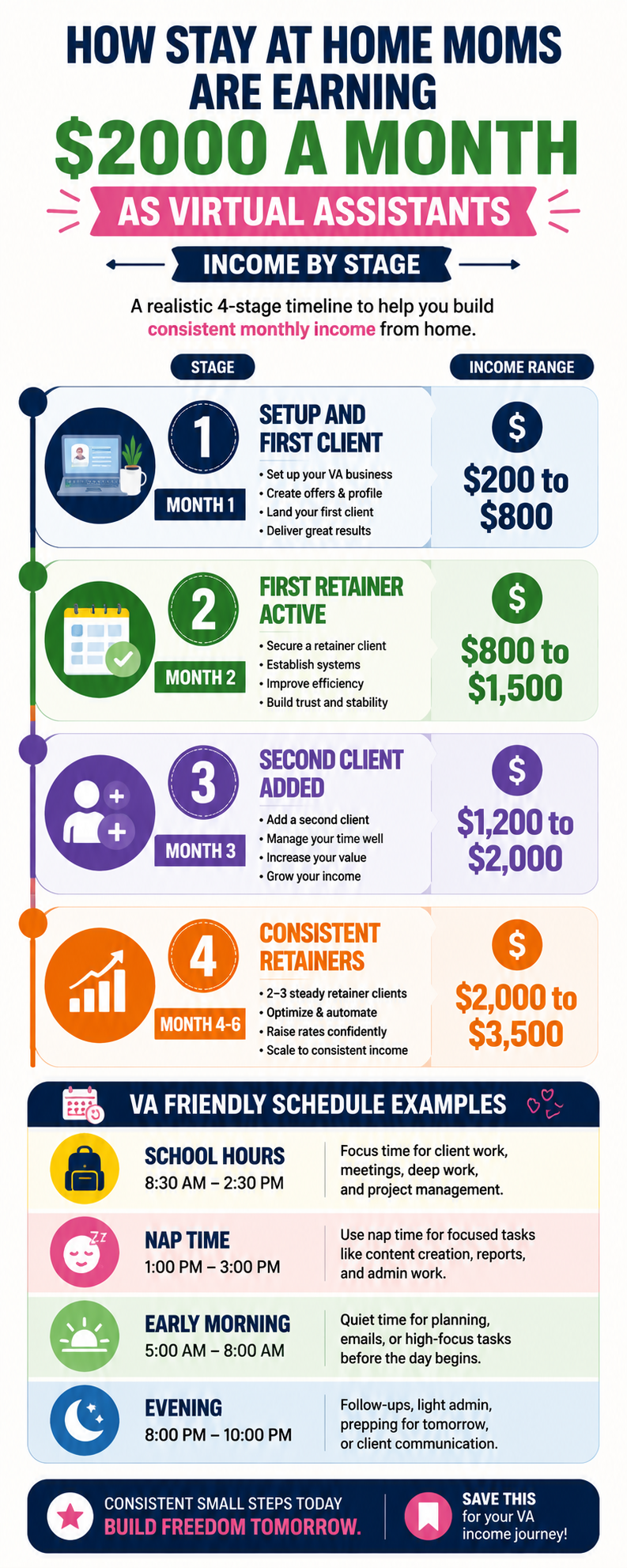
Month one — $200 to $800: Setup and first client. Most of this month is spent on positioning, outreach, and converting the first one or two client conversations. Income is modest because the pipeline is just beginning to convert. The goal is not $2,000 this month — it is one signed client and proof that the model works.
Month two — $800 to $1,500: First retainer running consistently. Outreach continuing. First referral conversation beginning. The income grows because the first client is generating a consistent monthly fee and the outreach from month one is producing additional conversations.
Month three — $1,200 to $2,000: Second client added. Two retainer relationships generating consistent monthly income. The operational systems are in place — client communication is routine, deliverables are consistent, and the week-to-week management of the VA practice is no longer consuming as much mental energy as it did in month one.
Months four through six — $2,000 to $3,500: Consistent two to three client retainers. Referrals beginning to supplement outreach as a client acquisition source. Rate increase discussion with first clients as the track record justifies it. Income is stable and growing rather than variable and uncertain.
That trajectory is not theoretical. It is what stay at home moms who treat their VA practice as a real business — not a casual side project — consistently experience when they start with the right positioning and stay consistent through the first 90 days.
How to Structure VA Work Around a Real Parenting Schedule
The biggest mistake stay at home moms make when starting VA work is planning around an ideal schedule rather than a real one.
A real parenting schedule accounts for the morning that starts 45 minutes late because of a breakfast standoff. The day the school calls at 10am because someone has a fever. The week that every routine falls apart because a child is going through something and needs more than usual.
Building VA income around a real parenting schedule means:
Defining your availability windows before you approach a single client.
Not after. Before. Know exactly which hours you are reliably available — not theoretically available on a good week, reliably available on an average week. For most moms with school-age children, that is 9am to 2pm Monday through Friday. For moms with younger children, it is nap time plus evenings.
Building buffer into every client commitment.
If your school-hours window runs from 9am to 2pm — do not commit to client work that requires your full five hours of availability every day. Build 30 to 60 minutes of buffer for the inevitable days that start late, run long, or require unexpected flexibility.
Communicating your availability clearly before work begins.
Every client relationship should start with an explicit conversation about your working hours and response time expectations. Something like: "I work Monday through Friday during school hours and respond to all messages within 24 hours on weekdays. I am not available for real-time responses outside those hours, but I am consistent and reliable within that window."
Clients who understand and agree to this from the beginning build their expectations accordingly. The conflicts that derail VA relationships almost always happen when availability was never clearly defined upfront.
The VA Niches That Work Best for Parenting Schedules
Not every VA niche is equally compatible with the interrupted, async-oriented working pattern that parenting requires. These are the ones that work best.
Bookkeeping and financial administration — Almost entirely async. Clients send transactions and reports. You process them on your schedule. Delivery is weekly or monthly rather than daily. One of the highest-retention VA niches and one of the most compatible with unpredictable daily schedules.
Social media and content scheduling — Primarily async. Content gets batched and scheduled in focused sessions. Community management can be handled in small windows throughout the day rather than requiring continuous online presence. Highly compatible with nap time and early morning work.
Executive and administrative support — Mixed async and occasional real-time. Calendar management, email triage, and document preparation are all async-compatible. The most compatible arrangement for parents is explicit async delivery with a defined daily response window rather than real-time availability.
Project coordination — Primarily async. Project management happens through tools like Asana and Trello where updates are delivered and reviewed on each party's schedule. Weekly check-ins are the primary real-time requirement.
The niche to approach with more caution: Customer service VA work — particularly for clients who expect rapid response times during business hours — is less compatible with a parenting schedule because the responsiveness expectation is often closer to real-time than async. Unless the client specifically needs after-hours or off-peak coverage — customer service VA work can create availability pressure that conflicts with parenting demands.
Setting Boundaries That Protect Both Your Family and Your Business
The income opportunity in VA work is real — and so is the risk of letting client expectations expand beyond the boundaries that made it compatible with parenting in the first place.
Healthcare facility contacts and business owner clients alike will — entirely without malicious intent — gradually expand their expectations of your availability if those expectations are not clearly defined and consistently held from the beginning.
The boundaries that work:
Hold your response time window consistently. If you committed to 24-hour weekday responses — deliver 24-hour weekday responses every time. Not sometimes. Every time. Consistency builds the trust that makes clients comfortable with your availability structure rather than anxious about it.
Address scope expansion immediately and professionally. When a client asks for work outside your agreed scope — acknowledge the request and address it as a scope adjustment: "That falls outside our current arrangement — I am happy to add it at my additional services rate of $X. Would you like me to add it to this month's invoice?"
Protect recovery time between your parenting responsibilities and your VA work. If school pickup is at 3pm and you have a client deliverable due — build in enough time between pickup and delivery that a delayed pickup or an after-school conversation does not create a missed deadline.
For the complete approach to building a VA business that is sustainable alongside family life — how to build a virtual assistant business without burning out covers the operational systems and client boundaries that keep a growing VA practice from consuming the parent who built it.
The Resources That Support Your VA Launch
The Virtual Assistant Side Hustle covers the complete VA business launch — niche selection, rate setting, client acquisition, and retainer building — with specific guidance on structuring your practice around a limited-availability schedule.
For the admin-to-VA transition — the Admin to VA System covers how professional administrative backgrounds translate into premium VA positioning — which is particularly relevant for stay at home moms returning to professional income after stepping back from corporate roles.
For the parallel experience of another income option that fits a parenting schedule — how stay at home parents are building income with medical courier work covers how early morning and weekend windows support a completely different income model for parents who want to compare their options.
And for the broader freelance context that VA work fits into — how to build freelance income after a layoff covers how VA work fits into the income recovery strategy for parents who are also navigating a career transition.
The Article That Connects Most to What Comes Next
If you have a clear sense of what your VA practice will look like and who your first clients will be — how to find your first virtual assistant client without experience covers the outreach approach that works specifically for parents with limited available hours — so your first client conversations happen during your actual available windows rather than requiring the kind of always-on availability that parenting makes impossible.
From the Same Series
- How to Become a Virtual Assistant in 2026 — The Complete Beginner Guide
- Virtual Assistant Niches That Pay the Most in 2026
- How to Set Your Virtual Assistant Rate Without Underselling Yourself
- How to Build a Virtual Assistant Business Without Burning Out
Frequently Asked Questions
Can a stay at home mom really earn 2000 a month as a virtual assistant?
Yes — and it is one of the more realistic income targets for stay at home moms specifically because of how VA work is structured. Reaching $2,000 per month consistently requires approximately 10 to 12 hours of billable client work per week at specialized rates of $45 to $55 per hour — or 15 to 20 hours per week at general VA rates of $25 to $35 per hour. Both are achievable within school hours or a combination of nap time and evening windows for most parents.
What VA work can a stay at home mom do around a family schedule?
The VA niches most compatible with a parenting schedule are bookkeeping and financial administration, social media and content scheduling, project coordination, and executive administrative support — all of which are primarily async and can be delivered within defined daily windows rather than requiring real-time continuous availability. Customer service VA work that requires rapid real-time responses during business hours is the least compatible with an active parenting schedule.
How many hours per week does a stay at home mom need to work to earn 2000 a month as a VA?
At specialized VA rates of $45 to $55 per hour — which are accessible to moms with relevant professional backgrounds in administration, bookkeeping, marketing, or operations — approximately 10 to 12 billable hours per week produces $1,800 to $2,640 per month. At general VA rates of $25 to $35 per hour — approximately 15 to 20 billable hours per week produces $1,500 to $2,800 per month. Choosing a specialized niche significantly reduces the hours required to reach the income target.
How does a stay at home mom handle VA clients when her schedule is disrupted?
Proactive communication is the answer. When a sick child or schedule disruption affects your availability — contact your client immediately with a brief professional message explaining the situation and your adjusted timeline. Clients who agreed to your defined availability windows understand occasional disruptions communicated proactively. The disruptions that damage VA client relationships are the ones communicated silently or late — not the ones handled professionally in advance.
What professional backgrounds make stay at home moms good candidates for VA work?
Any professional background involving organizational skills, communication, administrative coordination, financial management, marketing, or customer relationship management qualifies a stay at home mom for VA work at above-entry-level rates. Former executive assistants, office managers, marketing coordinators, bookkeepers, project managers, and customer service managers all have direct professional experience that maps to high-demand VA niches without requiring additional training or certification.
How long does it take a stay at home mom to reach 2000 a month as a VA?
Most stay at home moms who follow a structured approach — niche selection, specific positioning, professional network outreach, and consistent client development — reach the $2,000 per month target within three to four months of starting. Month one income is typically $200 to $800 as the first client is landing. Month two reaches $800 to $1,500 as the first retainer runs consistently. Month three typically crosses or approaches $2,000 as the second client is added.
What is the difference between the Virtual Assistant Side Hustle and the Admin to VA System for stay at home moms?
The Virtual Assistant Side Hustle covers the complete VA business launch for anyone starting from scratch — including moms returning to professional income after time at home. The Admin to VA System is specifically for moms with administrative or executive support backgrounds who want to position their existing professional experience for premium VA rates rather than entry-level general VA rates — which makes it particularly relevant for moms who stepped back from corporate administrative roles to raise children and are now ready to re-enter professional income on their own terms.

Comments ()