
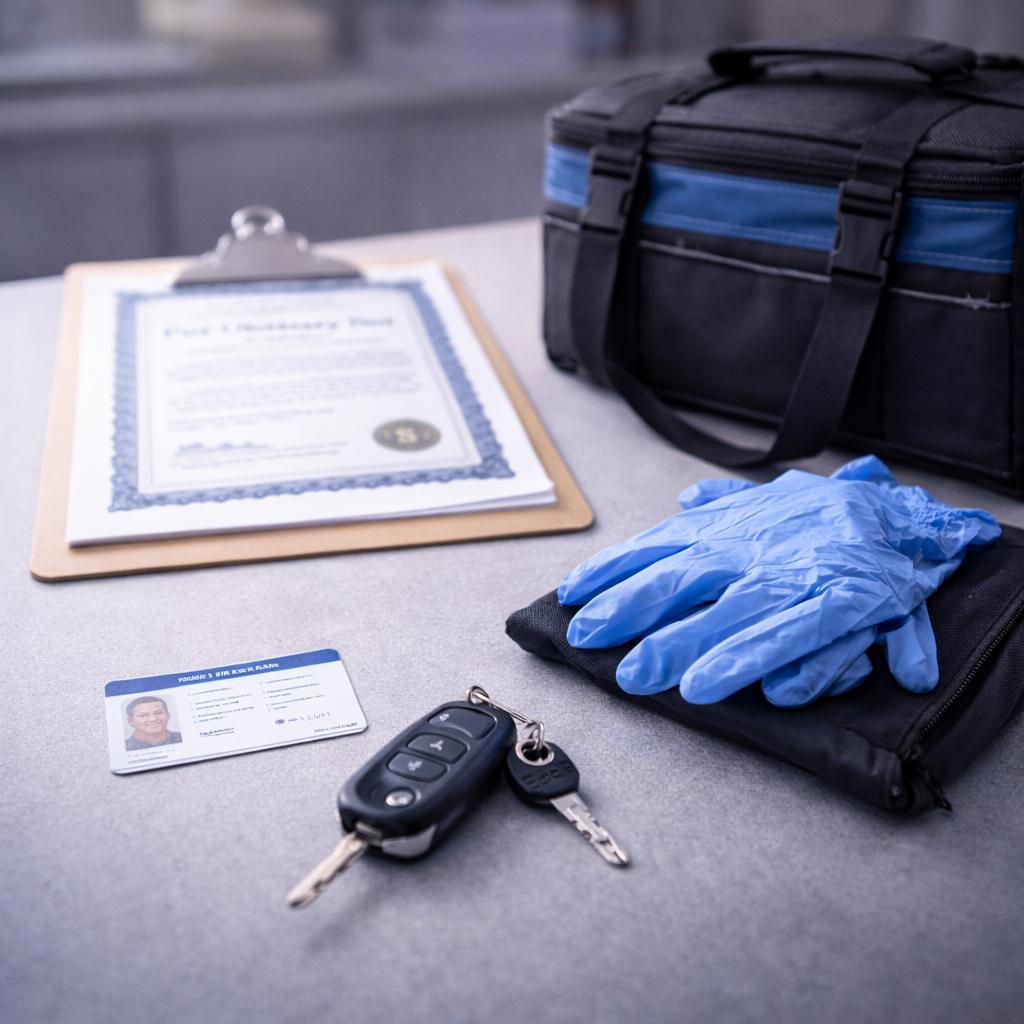
The requirements to become a medical courier are more straightforward than most people expect — and more specific than general delivery work demands. Getting clear on exactly what certifications and requirements you need before you start saves you from either over-preparing for months or showing up to a client conversation without the documentation they expect.
Most people can meet every requirement to become a medical courier within one to two weeks. None of it requires a medical background, a commercial driver's license, or years of industry experience. What it requires is a specific set of professional documentation that signals to healthcare clients that you operate at their standard — not a gig worker's standard.
This covers every requirement clearly, what each one costs, and where to get it.
The Core Requirements — What Every Medical Courier Needs
These are non-negotiable across virtually every market and every type of healthcare client. Meet all of these before you approach your first contract.
1. Valid Driver's License With Clean Record
What it is: A standard state-issued driver's license with no major violations in the past three to five years.
What healthcare clients check: Most medical courier clients and dispatch platforms run a motor vehicle record (MVR) check as part of their contractor onboarding. They're looking for DUI convictions, reckless driving citations, multiple at-fault accidents, or license suspensions. Minor violations — a single speeding ticket — rarely disqualify a contractor. A pattern of violations does.
What to do: Pull your own MVR before you approach any client. Your state's DMV provides this for $5 to $15. Knowing what's in your record before a client checks it lets you address anything proactively rather than being caught off guard.
Cost: $5 – $15 for self-pull MVR check
2. Commercial Auto Insurance
What it is: An auto insurance policy that covers your vehicle for business use — specifically for transporting items or people for commercial purposes.
Why it matters: Your personal auto insurance policy almost certainly excludes coverage when your vehicle is being used for business purposes. If you're in an accident while on a medical courier run with only personal coverage, your claim can be denied entirely. Healthcare clients also verify your insurance before contracting — and they expect commercial coverage, not a personal policy.
What to get: A commercial auto insurance policy or a business-use rider on your existing policy. Discuss your specific situation with your insurance provider — the right coverage depends on your vehicle, your state, and the specific nature of your courier work.
Cost: $100 – $200/month for most independent medical couriers depending on vehicle, location, and coverage level
Important note: Get this in place before your first run. This is the requirement with the highest financial consequence if you skip it.
3. LLC or Business Registration
What it is: Registering your courier operation as a legal business entity — typically a single-member LLC for independent medical couriers.
Why it matters: Healthcare facilities contract with businesses — not individuals. An LLC registration signals that you operate professionally, provides personal liability protection if something goes wrong on a run, and is required by most dispatch platforms and many direct healthcare clients before they'll process contractor paperwork.
How to do it: Go to your state's Secretary of State website. File your LLC formation documents online. The process takes 20 to 45 minutes. Processing time varies by state — some are same-day, others take one to two weeks.
Cost: $50 – $150 one-time filing fee depending on your state
4. HIPAA Awareness Training
What it is: Basic training on the Health Insurance Portability and Accountability Act — the federal law that governs how patient health information must be handled, transported, and protected.
Why it matters: Medical couriers transport items that fall under HIPAA protection. Healthcare clients need confidence that you understand what that means — how to handle packages containing patient information appropriately, how to maintain confidentiality, and what your obligations are if something is lost or compromised.
What level of training you need: You don't need a clinical-level HIPAA certification. Basic HIPAA awareness training that covers the fundamentals and produces a certificate of completion is sufficient for most medical courier client requirements.
Where to get it:
- HHS.gov offers free HIPAA training materials
- Coursera and similar platforms offer HIPAA awareness courses for $25 – $75 with a certificate of completion
- Several courier-specific training platforms offer medical courier HIPAA modules specifically
Cost: $0 – $75 depending on the source
5. Background Check
What it is: A criminal background check covering your history at the national and county level.
Why it matters: Every healthcare facility and most dispatch platforms require a clean background check before onboarding a contractor. They're checking for felony convictions, fraud, drug-related offenses, and theft — items that would disqualify someone from working in a healthcare-adjacent environment.
What to do: Run your own background check before a client does. Services like Checkr, Sterling, or Accurate produce the kind of comprehensive reports most healthcare clients accept. Know what's in your record before you're in a client conversation about it.
Cost: $30 – $60 for a comprehensive self-check
6. Reliable Vehicle With Adequate Space
What it is: A clean, well-maintained vehicle large enough to transport coolers, specimen transport bags, and standard medical supply packaging.
Minimum requirements: Most medical courier runs can be completed in a standard sedan, SUV, or minivan. Your vehicle needs to be clean — inside and out — presentable when you arrive at clinical environments, and reliable enough that breakdowns aren't a regular risk.
Temperature control: You don't need a refrigerated vehicle to start. You do need quality specimen transport coolers for runs that require temperature-controlled transport. Medical-grade coolers with ice packs run $50 – $200 and are required for specimen transport in most markets.
Cost: Vehicle you already own + $50 – $200 for transport coolers
Additional Certifications That Increase Your Contract Value
These aren't required to start — but they open higher-paying contract categories and differentiate you from couriers who only hold the basics.
OSHA Bloodborne Pathogens Training
What it covers: Proper handling protocols for items that may contain blood or other potentially infectious materials. Required by some healthcare clients for specimen transport contractors.
Where to get it: OSHA-authorized training providers, online platforms, Red Cross Cost: $20 – $60 Time: 2 – 4 hours
DOT Hazardous Materials Awareness
What it covers: Basic awareness of DOT regulations for transporting materials classified as hazardous — relevant for couriers who transport certain pharmaceutical or laboratory chemicals.
Where to get it: DOT-authorized training providers and online platforms Cost: $50 – $150 Time: 4 – 8 hours
Defensive Driving Certificate
What it covers: Advanced driving safety techniques. Not required by most clients — but it demonstrates professional commitment and can reduce your commercial insurance premium.
Where to get it: AAA, National Safety Council, state DMV programs Cost: $25 – $75 Time: 4 – 6 hours
Dry Ice and Temperature-Sensitive Cargo Handling
What it covers: Proper protocols for transporting temperature-sensitive specimens and materials using dry ice, cold packs, and validated containers.
Where to get it: IATA (International Air Transport Association) training modules, lab logistics training providers Cost: $50 – $150 Time: 2 – 4 hours
What to Prepare Before Approaching Your First Client
Once your core requirements are in place, organize your documentation into a professional package before your first client conversation.
Your courier compliance package should include:
- Copy of your commercial auto insurance certificate (COI — Certificate of Insurance)
- Copy of your LLC registration or business license
- HIPAA awareness training certificate of completion
- Background check results
- Copy of your driver's license
- Any additional certifications you've completed
Having all of this prepared as a PDF you can email on request — rather than scrambling to pull documents together after a client asks — immediately signals that you operate professionally.
For the baseline understanding of what medical couriers do before discussing requirements — including what healthcare clients expect from the couriers they work with — that article covers the full role context.
And for which companies to approach once your certifications and requirements are in place — the company rankings and direct-contract strategy guide is your next step after completing your compliance package.
The Medical Courier Business System includes a complete requirements checklist, a compliance documentation template, step-by-step setup instructions for each requirement, and a professional courier package template you can customize and send to clients from day one.
Once your compliance package is ready — how to move from meeting requirements to landing your first contract covers the exact outreach process that converts your preparation into a signed first contract.
Frequently Asked Questions
What certifications do you need to be a medical courier?
The core requirements for most markets are commercial auto insurance, an LLC or business registration, HIPAA awareness training with a certificate of completion, a clean background check, and a clean driving record. Additional certifications like OSHA bloodborne pathogens training and DOT hazardous materials awareness open higher-paying specialty contract categories but aren't required to start.
Do you need a special license to be a medical courier?
No special license beyond a standard driver's license is required for most medical courier work. A commercial driver's license (CDL) is not required for courier vehicles under 26,000 pounds gross vehicle weight rating — which covers virtually all standard medical courier vehicles. Specific run types involving controlled substances or human tissue may have additional state-specific requirements worth checking in your market.
How much does it cost to meet medical courier requirements?
The core requirements cost approximately $300 to $600 to complete — commercial auto insurance ($100 – $200/month), LLC registration ($50 – $150 one-time), HIPAA training ($0 – $75), background check ($30 – $60), and basic specimen transport equipment ($50 – $200). Most people complete the full setup within one to two weeks and are ready to approach their first client shortly after.
Is HIPAA certification required for medical couriers?
Most healthcare clients require HIPAA awareness training with a certificate of completion — not a full clinical HIPAA certification. Basic HIPAA awareness training that covers the fundamentals of patient information protection, proper handling of HIPAA-covered packages, and confidentiality obligations is sufficient. Free training is available through HHS.gov. Paid options with certificates run $25 – $75.
Do medical couriers need commercial auto insurance?
Yes — commercial auto insurance is non-negotiable for medical courier work. Personal auto insurance policies typically exclude coverage during commercial use, which means you'd have no coverage in an accident while on a courier run with personal-only insurance. Commercial coverage or a business-use rider is required before your first run and is verified by most healthcare clients and dispatch platforms during contractor onboarding.
How long does it take to meet all medical courier requirements?
Most people complete all core requirements within one to two weeks. LLC registration processing time varies by state — one to ten business days in most cases. Commercial insurance can be obtained same-day in many cases. HIPAA training takes two to four hours. Background checks process within one to three business days. The limiting factor is usually LLC processing time and insurance setup — both of which can run simultaneously.

Comments ()