

Reading Time: 14 minutes Last Updated: July 2026
Denise has been an ICU nurse for fifteen years. She still remembers the version of herself who used to show up early because she loved the work — but lately she sits in the parking garage for ten minutes before every shift, gathering the energy to walk in. She hasn't stopped caring about patients. It's just that somewhere between the staffing shortages, the mandatory overtime, and the paycheck that never quite reflects what the job takes out of her, the math stopped making sense.
If any part of that sounds familiar, this article was written for you. Real nurse burnout recovery and income are more connected than most career advice admits — and learning how to rebuild your income is often the first practical step toward rebuilding your energy.
Quick Answer
Nurses are burning out because the demands of the job have grown faster than the rewards — longer shifts, heavier patient loads, and pay that depends entirely on trading hours for dollars. The most practical way to rebuild is to reduce your financial dependence on one employer by developing a second income stream that fits your schedule. Financial breathing room restores choices, and choices restore energy.
Key Takeaways
- Burnout is not just an energy problem — for most nurses, it is also a control problem, and income is the fastest lever of control you can pull.
- The nurses recovering from burnout in 2026 are not all leaving the bedside. Many are simply reducing how much of their financial life depends on it.
- Picking up extra shifts is the most common response to money stress — and the one most likely to deepen burnout.
- A second income stream built on your existing clinical knowledge does not require a business degree, a big investment, or quitting your job.
- The right income path depends on your schedule, energy pattern, and skills — not on what worked for another nurse online.
- Progress comes from one small, consistent step per week — not from a dramatic career leap.
Who This Is For
This article is for nurses who still care about the work but feel the current arrangement draining more than it gives back. You might be a bedside nurse running on fumes after years of short staffing, a night-shift nurse whose finances feel as unpredictable as her sleep, or an experienced RN quietly wondering how long you can keep doing this.
It's also for nurses who aren't in crisis — just tired of feeling financially boxed in. If you've ever looked at your paycheck after a brutal stretch of shifts and thought "this can't be the only way," you're exactly who this was written for.
You don't need to want out of nursing for this to apply. Many of the nurses profiled in why nurses are leaving bedside for side hustles did not actually leave — they changed how much power the bedside held over their finances.
Why This Matters
Burnout carries real costs beyond exhaustion. It affects your health, your relationships, your patient care, and your long-term earning power — because burned-out nurses are far more likely to reduce hours, take unplanned leave, or exit the profession before they intended to.
The cost of doing nothing is rarely dramatic. It compounds quietly: another year of the same schedule, the same paycheck ceiling, the same feeling that your options are shrinking as your fatigue grows.
The opportunity in 2026 is genuinely different than it was even five years ago. Remote health work, telehealth support roles, freelance clinical writing, and digital tools have opened income paths that fit around a nursing schedule rather than competing with it. The nurses who understand this are not working harder — they are arranging their income differently.
The Problem: Why Nurse Burnout Feels Impossible to Fix
The standard advice for nurse burnout is self-care: sleep more, meditate, set boundaries, take your PTO. None of that is wrong. But it quietly ignores the structural half of the problem.
The biggest misconception is that burnout is purely an energy issue. For most nurses, it is a leverage issue — when 100% of your income depends on one employer, you have very little room to say no to anything. No to the extra shift. No to the unsafe assignment. No to staying in a unit that is grinding you down.
The second misconception is that the only escape is a dramatic exit — leaving nursing, going back to school, or making a risky leap into business. That belief keeps nurses stuck, because the leap feels too big, so they take no step at all.
The obstacle is not a lack of options. It is that nobody maps the options against the reality of a 12-hour shift schedule, rotating days, and a body that is already tired.
Why It Happens
The industry side. Healthcare staffing has not recovered to sustainable levels in most systems, and patient acuity keeps rising. Fewer nurses are absorbing more work, and that pressure lands on the people still at the bedside.
The market side. Nursing wages have grown, but slower than the cost of living in most regions — and far slower than the workload. The gap between what the job demands and what it pays is the raw material of burnout.
The employer side. Hospital compensation is built around one lever: more hours. Extra income means extra shifts, which means less recovery, which means deeper burnout. The system's only financial offer makes the underlying problem worse.
The skills side. Most nurses were never shown that their clinical judgment, documentation skills, patient education ability, and healthcare literacy have real market value outside their unit. So the most valuable asset they own sits unused — while they trade more hours to the only buyer they know.
The Solution: The 5-Stage Framework for Nurse Burnout Recovery and Income
Rebuilding from burnout is not one decision. It is a sequence — and the order matters more than the speed.
Stage 1 — Stabilize Your Energy Before Adding Anything
You cannot build a second income stream on an empty tank. Before adding anything new, subtract something: one voluntary extra shift per month, one committee you dread, one obligation that exists only out of guilt. The goal is to create a small, protected pocket of weekly time and energy — even two hours is enough to start.
Stage 2 — Take Inventory of What You Already Own
Your clinical experience is not just "nursing." It is patient education, health literacy translation, documentation, triage judgment, medication knowledge, and calm communication under pressure. Each of those maps to income paths — from turning your medical knowledge into side income through writing and consulting, to telehealth support, to health coaching.
Stage 3 — Match a Path to Your Actual Life
This is where most advice fails. The right path for a day-shift nurse with weekends off is wrong for a rotating night-shift nurse — energy patterns, available hours, and recovery needs are completely different. Choose based on three filters: when your usable hours actually occur, how much people-facing energy you have left after shifts, and how quickly you need the income to matter.
Stage 4 — Build One Stream, Not Five
Burnout recovery and income building share a rule: one thing at a time. Pick a single path and give it 90 days of small, consistent effort before judging it. Nurses who try three side projects simultaneously usually end up with three abandoned projects and a deeper sense of failure.
Stage 5 — Let Income Buy Back Leverage
The purpose of the second stream is not just money — it is the ability to say no. When outside income covers even one bill, declining a voluntary shift stops feeling reckless. That regained control is where energy genuinely starts coming back, which is why financial rebuilding and burnout recovery reinforce each other.
Step-by-Step Action Plan
Step 1: Run a one-week energy audit. For seven days, note when you feel most and least depleted. Your future working pocket lives in the "most functional" windows — not in the hours you wish you had.
Step 2: Cut one recurring drain. Identify one voluntary commitment costing energy without returning value, and release it. This is your first act of leverage.
Step 3: List your transferable skills. Write down ten things you do competently at work that a business, patient, or publication would pay for. Be literal — "explain complex conditions in plain language" is a paid skill.
Step 4: Shortlist two income paths that fit your schedule. Use the reality filters from Stage 3. If you want a structured comparison, the ranked breakdown of best side hustles for nurses by income potential and flexibility covers the honest numbers for each.
Step 5: Pick one and define a tiny first milestone. Not "start a business" — something completable in two hours, like drafting a profile, outlining a service, or contacting one person in the field.
Step 6: Protect a weekly two-hour block for 90 days. Same day, same window if possible. Consistency at a small scale beats intensity at an unsustainable one.
Step 7: Reassess at day 90 — energy first, income second. If the path is generating momentum without draining you, deepen it. If it is costing more energy than it returns, that is data, not failure — adjust the path, keep the habit.
One Piece of Hard-Won Advice
Track your first outside dollar, not your first big month. The psychological turning point for burned-out nurses is rarely a specific income number — it is the first proof that money can reach you from somewhere other than the hospital. That single data point breaks the belief that you have no options, and belief is what burnout attacks first. Engineer that proof as early and as small as possible.
Where the Rebuild Usually Stalls
By this point, you understand why burnout is partly a leverage problem and what the rebuild sequence looks like. Where most nurses stall is the gap between understanding the framework and choosing their specific path — because choosing feels risky when you are already exhausted.
So they research. They watch videos on legal nurse consulting one week, telehealth the next, health coaching after that. Six months later they know a little about everything, have started nothing, and feel more stuck than when they began. The problem was never information. It was the absence of a structured way to match the options against their own schedule, energy, and goals.
Pick Your Path Forward
If you want to learn the basics... → You are already doing it — keep reading the related articles below.
Want to know which path fits your life? → Take the FREE 15-Minute Nurse Income Assessment
Ready to put the rebuild on paper? → Get the Nurse Side Income Toolkit
Want steady guidance through every stage? → Start with the Nurse Side Income AI System
Three Ways to Keep Going
If you're just exploring: Take the FREE 15-Minute Nurse Income Assessment — a short guided self-audit that matches your schedule, energy, and skills to the income path that actually fits your life.
If you're serious about getting started: The Nurse Side Income Toolkit organizes the entire starting process — options, comparisons, and first steps — into one system built around a nurse's schedule.
If you want a complete roadmap: The Nurse Side Income AI System gives you an interactive, shift-friendly coaching system that walks you from choosing your path to building it — step by step, on your timeline.
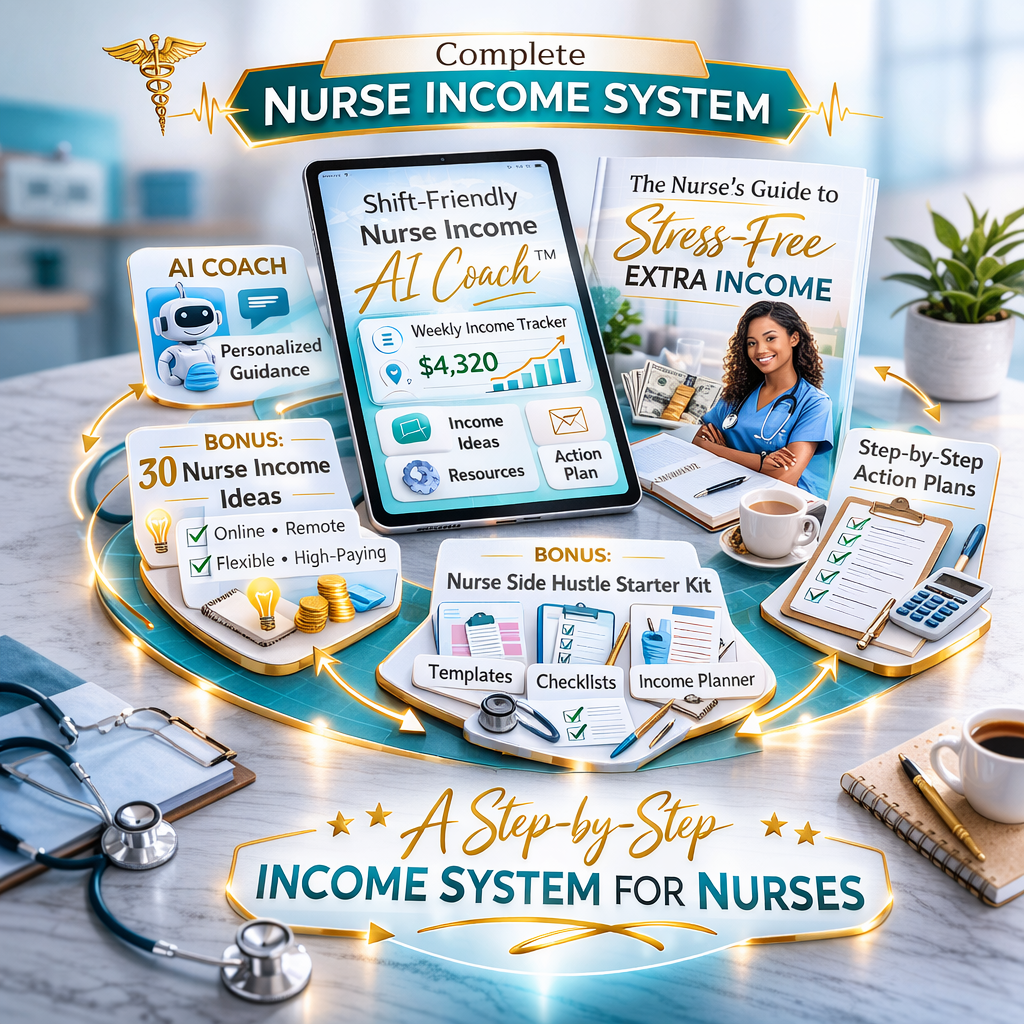
Skip the Six Months of Circling
This article explains the process. The Nurse Side Income Toolkit organizes the worksheets, planners, comparisons, and checklists into one system — so you are not piecing everything together from scattered videos, blogs, and forum threads on your one free evening a week.
It will not do the work for you, and it does not promise a specific income. What it replaces is the six months of circling the starting line that keeps most nurses stuck.
What's Actually in the Toolkit
Six working documents, no filler: an Income Path Finder, a Skills Assessment, a 30-Day Action Planner, Opportunity Comparison Worksheets, a Decision Framework, and a Progress Tracker.
Made for Nurses Running on Empty
Everything here was built for nurses who want a realistic path to extra income without quitting, without hustle-culture noise, and without gambling their license. Small steps, honest framing, and plans sized for the energy you actually have left after three twelves.
Still Catching Your Breath?
That's completely fine — this is a big topic, and today might just be the research stage. Start with the free 15-minute Nurse Income Assessment and come back whenever you're ready for the next step. The framework will still be here.
The Traps That Deepen the Hole
Mistake 1: Solving money stress with more shifts. Extra shifts are the highest-cost dollars a burned-out nurse can earn. They deepen the exact depletion you are trying to escape.
Mistake 2: Waiting until you feel rested to start. Rest alone rarely arrives on schedule in nursing. Start at a tiny scale now — two hours weekly — rather than waiting for a recovery window the schedule will never grant.
Mistake 3: Copying another nurse's path without checking fit. The path that worked for a per-diem nurse with flexible days may collapse against your rotating nights. Fit beats popularity every time.
Mistake 4: Treating the first 90 days as a verdict on your worth. Early results are information about the path, not a judgment of you. Nurses who adjust calmly outlast nurses who quit at the first flat week.
Mistake 5: Building in isolation from your own budget. If you do not know which bill your first outside income should cover, you cannot feel the leverage it buys. Name the target bill before you earn the first dollar.
Your First Week, Mapped Out
- Complete the seven-day energy audit — start tonight, two minutes per day.
- Cancel or decline one voluntary commitment that drains you.
- Write your ten-skill inventory in a single sitting.
- Read one article on each of your two shortlisted paths.
- Take the free 15-minute assessment to pressure-test your shortlist.
- Block your first two-hour session on the calendar for next week.
FAQ
Is nurse burnout really connected to income, or is it just workload?
Both — and they feed each other. Workload creates the exhaustion, but financial dependence on one employer removes your ability to say no to that workload. Nurses with a second income stream consistently report that the leverage mattered as much as the money, because it restored the sense of choice that burnout erodes.
Do I need to leave bedside nursing to rebuild my income?
No. Most nurses building outside income in 2026 keep their clinical role and add a stream that fits around it. Some eventually transition further, but that is an option the income creates — not a requirement to start. Keeping your license active and your clinical experience current often makes your outside work more valuable, not less.
How much time does a nurse side income realistically require?
Sustainable starts happen at two to five hours per week. Anything demanding more than that from a full-time nurse usually collapses within a month. The paths worth considering are the ones that produce progress at that small scale — which is why matching the path to your actual schedule matters more than choosing the highest-paying option.
What if I have no energy for anything after my shifts?
Then your first project is subtraction, not addition. Cut one recurring drain, protect your recovery for two to four weeks, and start with the lowest-energy steps — the audit and the skill inventory — which can be done from your couch. If exhaustion feels constant and overwhelming, talking with your doctor is a worthwhile step alongside any career planning.
Are nurse side incomes allowed under hospital employment policies?
Most hospital systems permit outside work, but policies vary — especially around healthcare-adjacent services and use of your credentials. Review your employment agreement and your state board's guidance before launching anything patient-facing. Choosing paths with clear boundaries from your employer's business is the simplest way to stay safe.
How do I choose between all the different nurse income options?
Filter by fit before income: when your usable hours occur, how much people-energy you have post-shift, and how fast you need results. Then compare only the two or three paths that survive the filter. A structured self-assessment shortens this dramatically — it is the exact problem the free 15-minute assessment was built to solve.
Is passive income a realistic goal for a burned-out nurse?
Eventually, yes — immediately, rarely. Most passive streams require an active building phase first. The realistic sequence is active income at small scale now, then gradually shifting toward assets that earn without your hours once your first stream runs on habit.
What is the very first step if I am starting from zero?
The energy audit. It costs nothing, takes two minutes a day, and produces the one piece of data every later decision depends on: when you are actually functional. Every nurse who skips it ends up scheduling their side income into hours their body cannot deliver.
Related Articles
- Why Nurses Are Leaving Bedside for Side Hustles
- How Nurses Can Start a Side Hustle This Weekend Without Burning Out
- What Nurses Can Do to Make Extra Money Outside of the Hospital in 2026
- Best Side Hustles for Nurses Ranked by Income Potential and Flexibility
Denise didn't quit the ICU. Eight months after her parking-garage low point, she still works three shifts a week — but a small clinical writing practice now covers her car payment, and last month she turned down mandatory overtime twice without her stomach dropping. The burnout didn't vanish. The trap did.
That's the honest version of what rebuilding looks like. Nobody escapes in one leap. You renegotiate — one protected step at a time, and the first one fits inside this week.
Comments ()