
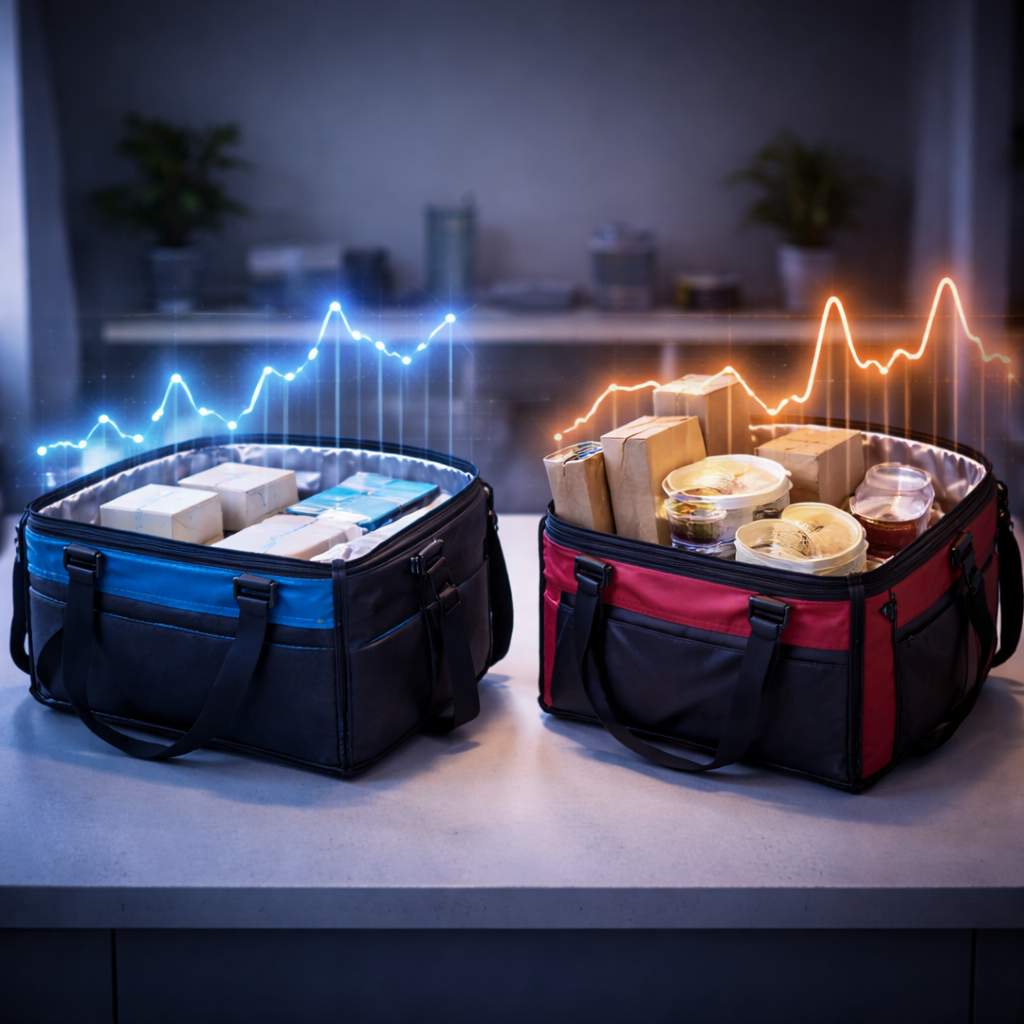
If you're already doing food delivery — or you're considering it — the comparison between medical courier and food delivery is worth sitting with before you commit more hours to either one. Most people who look into medical courier after doing food delivery for a while have the same reaction: why didn't anyone tell me about this sooner.
Medical courier vs. food delivery isn't a close comparison when you look at the full picture. The hourly rates are different. The income ceilings are different. The client relationships are different. And the long-term trajectory of each path is very different. This breaks it all down honestly so you can make the decision with real numbers in front of you.
The Basic Pay Comparison — What Each Actually Earns Per Hour
Before expenses. Before taxes. Here's what each side hustle generates at the rate most drivers actually experience — not the best-case scenario the apps advertise.
Food Delivery Reality
Food delivery apps advertise per-order rates that look reasonable in isolation. The reality of effective hourly earnings — accounting for wait times at restaurants, slow periods between orders, app downtime, and unpredictable surge patterns — is more sobering.
DoorDash effective hourly rate: $12 – $18/hour in most markets Uber Eats effective hourly rate: $11 – $17/hour in most markets Instacart effective hourly rate: $14 – $20/hour in most markets
These numbers reflect what drivers actually report earning after tracking their total hours — including the dead time between orders that the apps don't count as "active" but that you're still spending waiting.
Medical Courier Reality
Through a dispatch company: $18 – $28/hour Direct contract with healthcare facility: $25 – $45/hour Specialty and stat runs: $35 – $65+ per run After-hours and weekend premium rates: 20 – 40% above standard contract rates
The gap is real and it's consistent. Medical courier pays more per hour at every level of comparison — entry-level through established operation.
The Expense Comparison — What Each Side Hustle Costs You
Gross income doesn't tell the whole story. Both types of delivery work cost money to operate — and those costs affect your actual take-home significantly.
Food Delivery Costs
Vehicle wear and mileage — Food delivery involves significant urban mileage — frequent stops, idling, short trips that are harder on a vehicle than highway miles. The IRS standard mileage deduction rate in 2026 is 67 cents per mile, which means a driver doing 30,000 miles per year has $20,100 in deductible mileage expenses — a real cost to the vehicle even if partially offset by tax deductions.
Fuel — Food delivery is stop-and-go mileage. Less fuel-efficient than routed medical courier runs that cover distance at consistent speeds.
App dependency — You have zero control over what the app pays per order. Rates change. Algorithms shift. Your income can drop overnight with no warning and no recourse.
Medical Courier Costs
Vehicle wear and mileage — Medical courier runs are typically more efficient — routed circuits rather than scattered urban point-to-point trips. Less idling. More consistent speeds. Lower wear per mile in most operational patterns.
Commercial auto insurance — The most significant additional cost compared to food delivery. Commercial auto insurance runs $100 – $200/month depending on your vehicle, location, and coverage level. Some food delivery drivers carry business-use riders at lower cost — medical courier requires full commercial coverage.
LLC registration — One-time cost of $50 – $150 depending on your state. Not a recurring significant expense.
HIPAA training — Free through HHS. Paid options available for $25 – $75 if you want a certificate to present to clients.
Net cost difference — Medical courier has higher upfront and ongoing compliance costs. But the higher gross rates more than compensate — the net hourly income is still substantially higher than food delivery after accounting for all expenses.
The Income Ceiling Comparison — Where Each Path Leads
This is where the comparison becomes most decisive — not what you earn in month one but what you can earn in year two and beyond.
Food Delivery Income Ceiling
The food delivery income ceiling is set by two variables you don't control — the app's pay rate and the number of hours you can physically drive. There is no path within food delivery to earning significantly more per hour than the app pays. The only levers are driving more hours or switching to a higher-paying market.
A food delivery driver working 20 hours per week at $15/hour effective rate earns approximately $1,200/month. Working 40 hours per week at the same rate earns $2,400/month. The ceiling scales with hours — not with business development, not with client relationships, not with the quality of your service.
Medical Courier Income Ceiling
The medical courier income ceiling scales with your business development rather than your hours.
Solo courier, part-time: $800 – $2,000/month Solo courier, full-time direct contracts: $45,000 – $85,000 annually Multi-driver operation with established contracts: $80,000 – $150,000+ annually
A medical courier who builds direct client relationships, adds specialty certifications, and eventually adds a second vehicle and driver creates an income stream that grows without a proportional increase in personal driving hours. That path doesn't exist in food delivery.
For a full breakdown of what medical couriers earn and why the pay structure is different from food delivery — including what realistic part-time and full-time income looks like at different stages — that article covers the income picture in detail.
The Stability Comparison — How Reliable Is Each Income
Food Delivery Stability
Food delivery income is highly variable. Peak hours, bad weather, sporting events, and algorithm changes all affect your earnings unpredictably. The apps have no obligation to maintain your income level. Rate cuts happen without notice. Your access to the platform can be suspended or terminated with limited recourse.
The income is real but it's fragile — dependent entirely on the app's continued operation, its rate structure, and the consumer demand patterns that shift seasonally and economically.
Medical Courier Stability
Healthcare doesn't slow down. Hospitals process specimens on Christmas Day. Pharmacies fill prescriptions in blizzards. Blood banks operate around the clock regardless of economic conditions. The demand that drives medical courier work is institutional and non-discretionary — it exists because the healthcare system requires it, not because consumers are choosing to order something.
Direct contracts with healthcare facilities are also more durable than gig app relationships. A hospital that relies on your morning specimen route and has been working with you for six months doesn't replace you on a whim. Client relationships in medical courier work create income stability that gig delivery simply can't replicate.
The Professional Development Comparison
Food delivery builds driving hours. Medical courier builds professional credibility.
A year of medical courier experience — the compliance knowledge, the healthcare facility relationships, the professional documentation, the operational systems — is a foundation you can build a legitimate business on. It opens doors to larger contracts, specialty certifications, and eventually a multi-driver operation.
A year of food delivery experience builds your familiarity with a city's street layout. That's useful — but it doesn't compound into anything beyond the next hour of driving.
For a look at what a typical medical courier day looks like compared to food delivery — including how the daily work experience differs between the two — that article covers the day-to-day reality of each.
The Setup Comparison — How Hard Is It to Start Each One
This is the one area where food delivery has a genuine advantage. Signing up for DoorDash or Uber Eats takes 30 minutes and you can be earning the same day. The barrier to entry is essentially zero.
Medical courier takes more upfront investment — LLC registration, commercial insurance, HIPAA training, compliance documentation, and direct client outreach before your first paid run. Plan for one to two weeks of setup before you approach your first client and two to four weeks before your first contract is active.
That setup investment is real. It's also what filters out the casual competition and creates the professional environment that supports higher rates.
The complete guide to starting a medical courier business from scratch covers every setup step with realistic time and cost estimates so you know exactly what's involved before you start.
Which One Should You Actually Choose
If you need income this week with zero upfront investment — food delivery is faster to start.
If you want meaningfully higher income, a more stable client base, and a side hustle with a real business ceiling — medical courier is the better choice for anyone willing to invest one to two weeks in the setup process.
The people who switch from food delivery to medical courier consistently report the same thing — they wish they'd made the switch sooner. The income is better. The clients are more professional. The work is more predictable. And the path forward actually leads somewhere.
The Medical Courier Business System gives you the complete setup framework — compliance checklist, contract templates, pricing guide, and outreach scripts — so the one to two week setup process is organized and efficient rather than a weeks-long research project.
Once you've decided on the medical courier path, the article on the best medical courier companies to contract with once you decide to start covers where to find your first contracts and which companies and facilities to approach first.
Frequently Asked Questions
Does medical courier pay more than food delivery?
Yes — consistently and significantly. Food delivery drivers typically earn $11 to $18 per hour effective rate after accounting for wait times and slow periods. Medical couriers earn $18 to $28 per hour through dispatch companies and $25 to $45 per hour on direct healthcare facility contracts. The gap widens further as medical couriers build direct client relationships and move away from third-party dispatch rates.
Is medical courier harder to start than food delivery?
Yes — the setup requires more upfront effort. Medical courier requires LLC registration, commercial auto insurance, HIPAA awareness training, and direct client outreach before your first run. Food delivery requires a driver's license and a smartphone. The higher setup bar is what creates the professional environment that supports higher rates — and most couriers complete the setup in one to two weeks.
Can I do both food delivery and medical courier at the same time?
Yes — and many couriers start this way. Running food delivery for immediate income while building your medical courier client base and completing setup requirements is a practical transition strategy. As your medical courier contracts develop, most couriers reduce or eliminate food delivery because the medical work pays better for the same driving hours.
Why does medical courier pay more than food delivery?
Medical courier pays more because the professional accountability standard is higher. Healthcare facilities are trusting you with items that affect patient care — and they pay for the reliability, compliance knowledge, and professional documentation that serious medical couriers provide. The higher bar filters out casual gig workers, which reduces competition and supports higher contract rates.
Is food delivery or medical courier more flexible?
Both offer significant schedule flexibility — but in different ways. Food delivery flexibility is reactive — you log on when you want and take orders as they appear. Medical courier flexibility is structured — you define specific availability windows and clients schedule around them. Many couriers find the structured flexibility of medical courier more compatible with building consistent side income than the unpredictable on-demand nature of food delivery apps.
What is the long-term income potential of medical courier vs food delivery?
Medical courier has a significantly higher long-term income ceiling. A solo medical courier building direct client relationships can earn $45,000 to $85,000 annually full-time. A multi-driver medical courier operation generates $80,000 to $150,000+ annually. Food delivery income is capped by the app's pay rate and the number of hours you can physically drive — there is no business-building path within food delivery that produces those numbers.

Comments ()