
Reading time: 8 minutes
Last Updated: July 2026
Most new medical couriers think about contracts one at a time. The couriers earning $5,000 to $7,000 per month in Central Florida think about routes as a system.
One contract pays $600 to $900 per month. Three contracts covering different geographic corridors and different time windows pay $4,500 to $7,000 per month — from the same vehicle, the same insurance, the same compliance documents.
The difference is not more work. It is smarter route architecture.
Central Florida — the interconnected web of Orlando, Lakeland, Davenport, Kissimmee, and the I-4 corridor between them — is the most route-efficient medical courier geography in Florida. The distances between markets are short. The facility density is growing. The geographic logic of building a multi-market route schedule here is clearer than anywhere else in the state.
This article shows you exactly how to build that schedule — one route at a time, in the right sequence, from the right starting point.
Quick Answer
Medical courier routes in Central Florida in 2026 are built by combining morning specimen pickup contracts with afternoon pharmaceutical delivery or home health routes across multiple markets. The most efficient Central Florida route schedule covers two to three geographic corridors — typically a combination of Lakeland, Davenport, Orlando, and Kissimmee — generating $4,500 to $7,000 per month from a single vehicle running Monday through Friday. Most couriers build a full Central Florida schedule within 60 to 90 days of landing their first contract.
Key Takeaways
- Central Florida's compact geography makes multi-market route building more efficient than any other Florida region
- A full Central Florida courier schedule combines morning specimen routes with afternoon delivery routes across two to three markets
- The Lakeland-Davenport-Kissimmee corridor is the most route-efficient starting territory for new Central Florida couriers
- Morning specimen routes typically run 6am to 10am — afternoon routes run 1pm to 5pm — leaving midday available for admin and expansion outreach
- A courier running three to four direct contracts across Central Florida earns an estimated $4,500 to $7,000 per month
- Route expansion through referrals is faster in Central Florida than any other Florida region due to the interconnected healthcare network
Who This Is For
This guide is for independent medical couriers in Central Florida who have landed their first contract and want to understand how to build a full route schedule systematically, new couriers in the Orlando, Lakeland, Davenport, or Kissimmee markets who want to understand the route geography before starting outreach, and drivers considering medical courier work who want to see what a realistic full-income schedule looks like before committing.
If you have not yet landed your first Central Florida contract — start with the market that has the fastest entry timeline. Medical courier jobs in Davenport and medical courier jobs in Lakeland both cover the lowest-competition entry points in the region.
How Medical Courier Routes Work in Central Florida
A medical courier route is not a delivery run. It is a scheduled, contracted service agreement between an independent courier and a healthcare facility — specifying which locations get picked up, at what time, on which days, and at what rate per run.
Understanding that distinction changes how you think about building income. You are not chasing orders through an app. You are building a portfolio of scheduled appointments that generate predictable income every weekday — regardless of consumer demand, platform algorithms, or seasonal fluctuation.
Central Florida's route geography makes that portfolio easier to build than anywhere else in Florida. The distances between Lakeland, Davenport, Kissimmee, and the southern Orlando suburbs are short enough that a courier can service facilities across multiple markets within a single morning window — without the extended drive times that make Jacksonville routes more expensive per run.
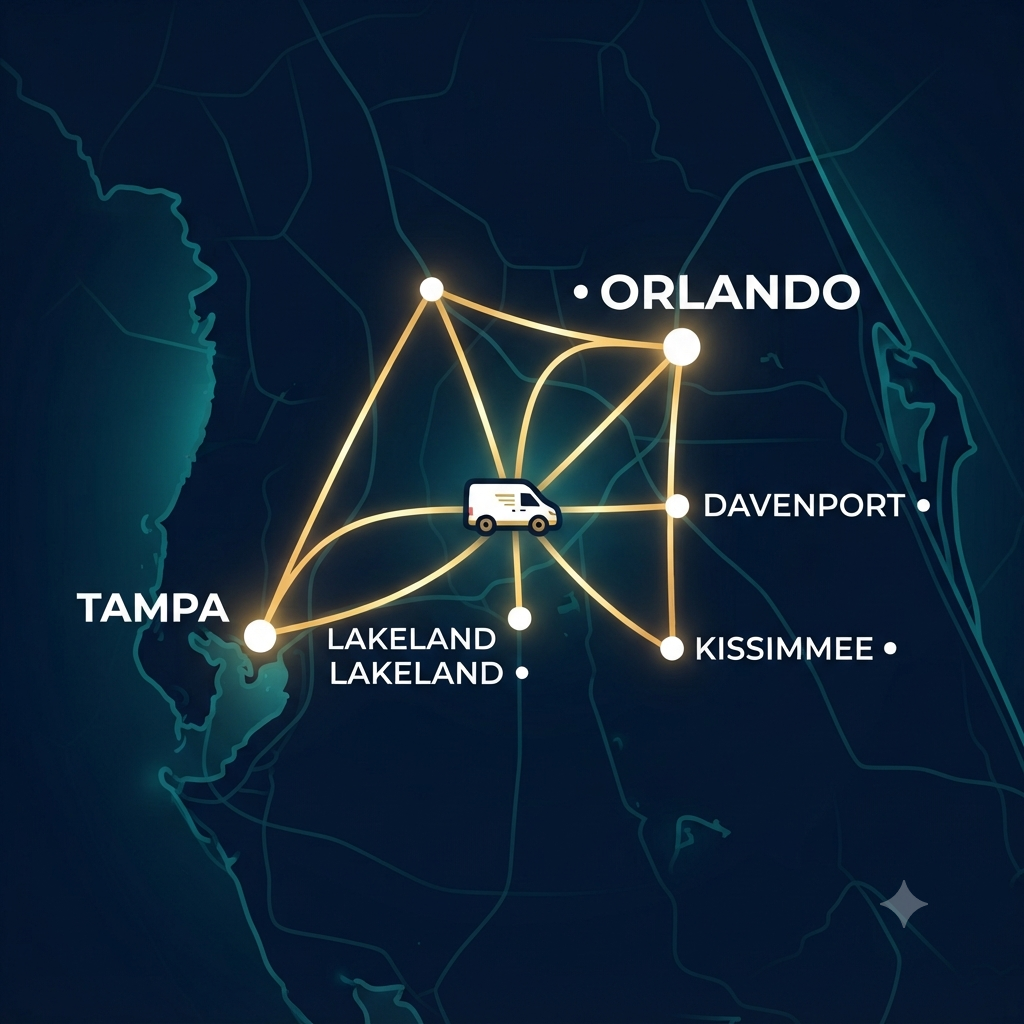
The Central Florida Route Map — How the Markets Connect
Understanding the geographic relationship between Central Florida markets is the foundation of efficient route building.
The Core Corridor — US-27 and I-4
US-27 runs north-south through the heart of Central Florida's healthcare geography — connecting Lakeland in the south, Davenport and the Four Corners area in the middle, and the southern Orlando suburbs to the north. I-4 connects Lakeland to Tampa in the west and Orlando to the northeast.
A courier based anywhere along the US-27 corridor can reach Lakeland, Davenport, and the Kissimmee South market within twenty to thirty minutes in any direction — making this corridor the most efficient route-building geography in the state.
Market by Market — Distance From Davenport Center
Haines City — 12 miles south on US-27
Lakeland — 22 miles southwest on US-27
Kissimmee South — 18 miles northeast on US-192
Orlando International Airport corridor — 28 miles northeast on US-192
Downtown Lakeland — 25 miles southwest
Brandon / Plant City — 35 miles west on I-4
A courier who builds contracts across three points in that distance map creates a morning route covering 30 to 45 miles total — comparable to a single DoorDash shift in a dense urban market, but generating $120 to $180 per morning instead of $40 to $55.
The Three-Phase Route Building System
Building a full Central Florida route schedule follows a predictable three-phase sequence. Couriers who understand this sequence build full schedules in 60 days. Couriers who do not understand it build one contract and stall.
Phase 1 — The Foundation Contract (Week 1 to 2)
Your first Central Florida contract should be in the lowest-competition market closest to where you live. For most Central Florida couriers that means Davenport, Haines City, or South Lakeland.
One morning specimen route. Five days per week. Estimated income: $480 to $950 per month.
This contract does three things simultaneously. It generates immediate income. It gives you operational experience on a real healthcare route. And it gives you a professional reference — a facility coordinator who can vouch for your reliability — that makes every subsequent outreach conversation significantly easier.
Do not move to Phase 2 until the Phase 1 contract has been running smoothly for at least two weeks.
Phase 2 — The Geographic Extension (Week 3 to 6)
After two weeks of reliable Phase 1 service — ask your first client directly:
"Do you know any other facilities in the area that might benefit from what we provide?"
That referral question — asked at the right moment in an established relationship — produces Phase 2 contracts faster than any cold outreach approach. Most Central Florida facility coordinators know three to five other facilities within their professional network. One referral converts faster than ten cold calls.
If the referral approach does not immediately produce a second contract — begin cold outreach in the adjacent geographic market. If Phase 1 is in Davenport — Phase 2 outreach goes to Haines City or South Kissimmee. If Phase 1 is in Lakeland — Phase 2 outreach goes to Winter Haven or Plant City.
Two morning routes. Estimated combined income: $960 to $1,900 per month.
Phase 3 — The Schedule Fill (Week 6 to 12)
By week six a courier with two morning contracts has two to three hours of daily dead time between the end of morning routes and the early afternoon. That dead time is where Phase 3 income lives.
Afternoon route types that fill the Central Florida schedule gap:
Home health medication delivery
Runs 1pm to 5pm across Orange, Polk, and Osceola county home health agencies. Pays an estimated $24 to $42 per run. Does not require temperature-controlled equipment beyond standard cooler setup already in use for morning specimen routes.
Pharmaceutical delivery routes
Pharmacy-to-facility pharmaceutical delivery runs in the afternoon window. Pays an estimated $27 to $44 per run. Typically Monday through Friday with occasional Saturday runs for certain client types.
Stat and urgent transport
On-call stat runs fill schedule gaps with premium-rate single runs. Not a route — a supplemental income layer that adds $42 to $65 per run when urgent transport needs arise from existing or new clients.
A courier running two morning specimen routes plus one afternoon home health route earns an estimated $3,200 to $5,500 per month across a Monday through Friday schedule that starts at 6am and ends by 4pm.
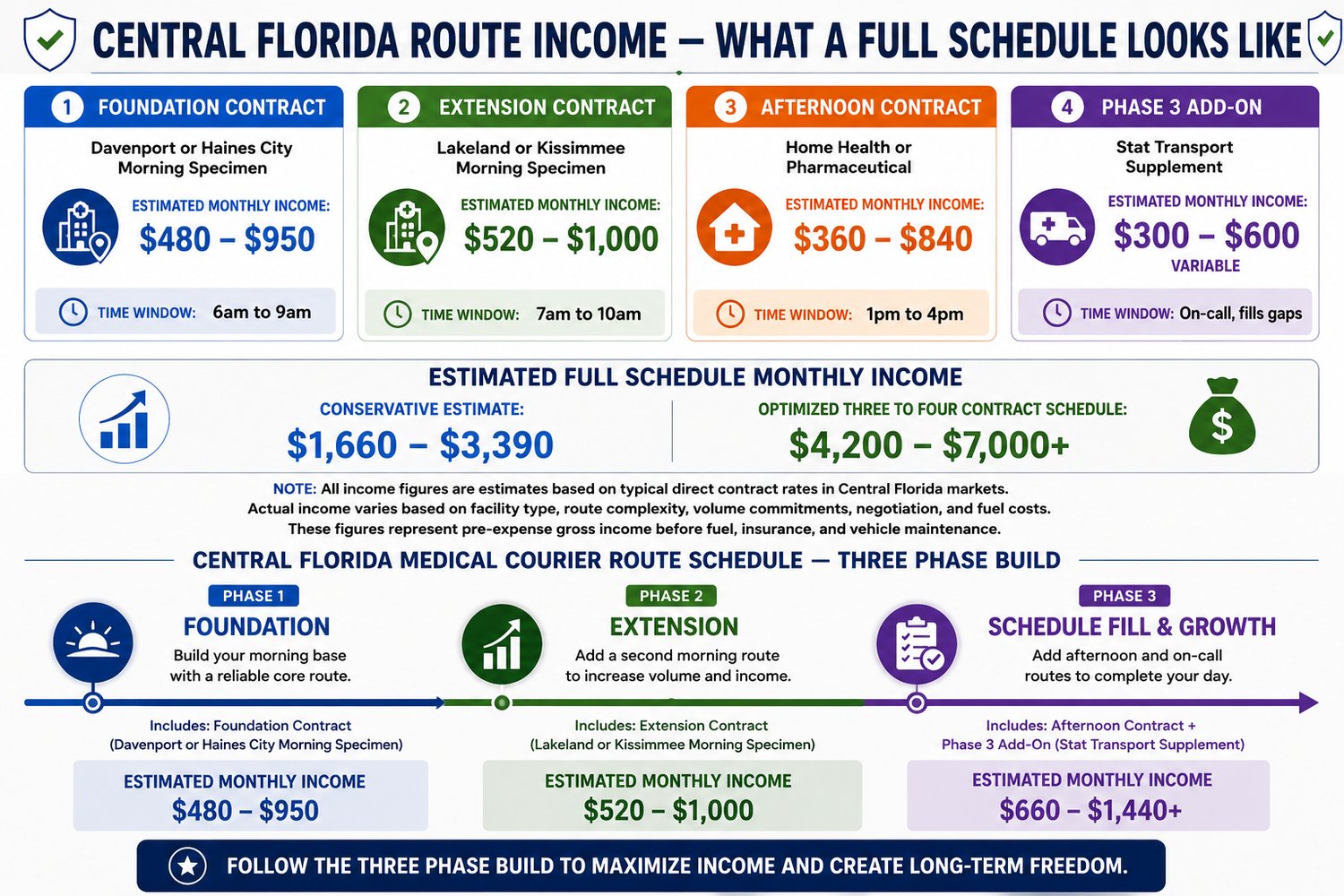
Central Florida Route Income — What a Full Schedule Looks Like
Foundation Contract — Davenport or Haines City Morning Specimen
Estimated monthly income: $480 to $950
Time window: 6am to 9am
Extension Contract — Lakeland or Kissimmee Morning Specimen
Estimated monthly income: $520 to $1,000
Time window: 7am to 10am
Afternoon Contract — Home Health or Pharmaceutical
Estimated monthly income: $360 to $840
Time window: 1pm to 4pm
Phase 3 Add-On — Stat Transport Supplement
Estimated monthly income: $300 to $600 variable
Time window: On-call, fills gaps
Estimated Full Schedule Monthly Income
Conservative estimate: $1,660 to $3,390
Optimized three to four contract schedule: $4,200 to $7,000+
Note: All income figures are estimates based on typical direct contract rates in Central Florida markets. Actual income varies based on facility type, route complexity, volume commitments, negotiation, and fuel costs. These figures represent pre-expense gross income before fuel, insurance, and vehicle maintenance.
Not sure how to price your Central Florida routes before you start outreach? Download the free Medical Courier Quick Start Guide at https://steadyincometools.com/b/medical-courier-quick-start-guide — it includes the rate calculation framework and the first contract pricing guide at no cost.
The Central Florida Route Efficiency Advantage
Central Florida's geography produces a route efficiency advantage that most couriers do not calculate until they see it in their net income numbers.
A courier running three contracts in Central Florida drives an estimated 30 to 50 miles per morning across the Lakeland-Davenport-Kissimmee corridor. A courier running three contracts in Jacksonville drives 60 to 90 miles covering comparable geographic spread. A courier in Miami drives 40 to 70 miles navigating urban density and traffic.
Lower miles per dollar earned means lower fuel cost per route — which means higher net income at the same gross rate. A Central Florida courier earning $32 per run nets more after fuel than a Jacksonville courier earning $36 per run across longer distances.
That efficiency compounds over a full month across every route in the schedule. For the complete income breakdown by market and work structure — medical courier salary: what drivers really earn in 2026 covers the net income calculation that most couriers skip until their first tax quarter.
Expert Tip: When building your Central Florida route schedule across multiple markets — plan your pickup sequence to minimize backtracking rather than maximizing individual facility relationships. A courier who picks up in Davenport, drives south to Haines City, then back north to Kissimmee wastes 25 minutes of fuel and time per morning compared to a courier who sequences stops geographically from south to north in a single continuous arc. Spend thirty minutes with Google Maps plotting the most efficient stop sequence before committing to any multi-facility morning route — that thirty minutes saves 40 to 60 minutes of drive time every single workday.
How to Expand Your Central Florida Route Territory
After Phase 3 is established — a courier running a full Monday through Friday schedule with three to four contracts — the natural expansion direction depends on which markets are already covered.
If foundation is in Davenport and Lakeland:
Expand north into the southern Orlando suburbs — Kissimmee, Celebration, and the ChampionsGate corridor. For the complete Orlando market breakdown — medical courier jobs in Orlando covers the southern Orlando entry points that connect most naturally to a Davenport base.
If foundation is in Lakeland:
Expand west into Plant City and Brandon — the eastern edge of the Tampa Bay market. For the complete Tampa market breakdown — medical courier jobs in Tampa covers the Plant City and Brandon corridors that connect most naturally to a Lakeland base.
If foundation is in the Orlando corridor:
Expand south into Kissimmee and the US-192 tourist corridor — which feeds naturally into the Davenport and Four Corners market. For the complete Disney World area market breakdown — medical courier jobs near Disney World covers the unique courier opportunity in the theme park healthcare corridor.
For the complete Florida medical courier guide covering every Florida market and how they connect — read the state-level overview before finalizing your Central Florida expansion direction.
Common Mistakes New Central Florida Couriers Make With Routes
Building one contract and stopping outreach.
The most common Central Florida route-building mistake is treating the first contract as the destination rather than the foundation. One morning contract generates $600 to $900 per month — enough to validate the business model but not enough to replace a full income. Outreach for the second contract should begin during the second week of the first contract — not after the first contract is fully established.
Ignoring the afternoon schedule entirely.
Morning specimen pickup routes are the most common entry point — but the afternoon schedule is where Central Florida couriers add 30 to 50 percent additional income from a vehicle that is already insured, already fueled, and already operational. Home health medication delivery and pharmaceutical routes fill the afternoon gap without requiring any additional compliance documents beyond what morning routes already need.
Sequencing routes inefficiently.
A morning route that backtracks geographically wastes fuel and time that compounds across every workday. Before committing to any multi-facility route — plot the stop sequence on Google Maps and confirm the most fuel-efficient order. This one planning step saves Central Florida couriers an estimated $80 to $150 per month in fuel costs on a three-stop morning route.
Not using referrals between Phase 1 and Phase 2.
Central Florida's interconnected healthcare network means facility coordinators across Polk, Osceola, and Orange counties frequently know each other professionally. One referral from a satisfied Phase 1 client almost always produces a warmer and faster Phase 2 contract conversation than any amount of cold outreach. For the complete referral and contract acquisition approach — how to get medical courier contracts covers the exact referral ask that most couriers never use.
Your Action Steps — This Week
Step 1 — Map your Central Florida base market today.
Identify which Central Florida market is geographically closest to where you live — Davenport, Haines City, South Lakeland, or Kissimmee South. That market is your Phase 1 outreach territory. Do not start in multiple markets simultaneously before your first contract is signed.
Step 2 — Plot your route territory on Google Maps this week.
Draw a 15-mile radius circle around your base market on Google Maps. Every diagnostic lab, urgent care center, and physician office within that circle is a Phase 1 outreach target. Count how many facilities appear. If fewer than 15 appear — extend the radius to 20 miles before building your target list.
Step 3 — Build your Phase 1 target list of 20 facilities before the weekend.
Search Google Maps for clinical laboratory, urgent care, and physician group within your base market radius. Record the facility name, direct phone number, and estimated distance from your home for each. Sort by distance — closest first.
Step 4 — Begin Phase 1 outreach calls Monday morning.
Call the ten closest facilities first. Ask for the lab manager or office coordinator. Use the direct introduction script. Offer a trial week. Do not move to Phase 2 planning until at least three facilities have expressed interest from your Phase 1 outreach.
Step 5 — Plan your Phase 2 geographic extension before Phase 1 is signed.
While Phase 1 outreach is ongoing — identify your Phase 2 market on Google Maps and build a preliminary Phase 2 target list. Having it ready means zero delay between Phase 1 contract signing and Phase 2 outreach beginning.
The couriers running full Central Florida schedules earning $5,000 to $7,000 per month did not figure out the three-phase route building system on their own. They had the target lists, the outreach scripts, the route sequencing guide, and the phase-by-phase expansion plan ready before they made their first call. The Medical Courier Business Starter Kit at https://steadyincometools.com/b/medical-courier-business-system includes the complete Central Florida route building system — the three-phase expansion guide, the Google Maps territory planning worksheet, the route sequencing calculator, and the 90-day Central Florida income projection by phase. Every week you spend figuring out the system from scratch is a week of Phase 2 income you are not collecting.
Directional Close
The Central Florida route system is not complicated once the geographic logic is clear. Lakeland and Davenport are the foundation. Kissimmee and southern Orlando are the natural extension. Tampa feeds from the west. The afternoon schedule fills the income gap that morning-only routes leave open.
Most couriers who fail to build a full schedule do not fail because the market is too competitive or the rates are too low. They fail because they stop at one contract and never build the system that turns one contract into four.
Phase 1 is a start. Phase 3 is an income.
The last article in the Florida cluster covers the most unique courier market in Central Florida — the Disney World and theme park corridor that most couriers overlook entirely. Read medical courier jobs near Disney World to understand how the tourism healthcare market adds a distinct layer to the Central Florida route opportunity.
You Might Also Like
- Medical Courier Jobs in Davenport — the fastest Phase 1 entry market in Central Florida
- Medical Courier Jobs in Lakeland — the strongest Phase 1 foundation in Polk County
- Medical Courier Jobs in Orlando — the Phase 2 expansion target for most Central Florida couriers
- Medical Courier Jobs in Tampa — the western expansion from a Lakeland foundation
Frequently Asked Questions
How do medical courier routes work in Central Florida?
Medical courier routes in Central Florida are scheduled direct contracts between an independent courier and a healthcare facility — specifying pickup locations, timing, days of service, and rate per run. Most Central Florida morning routes cover two to five facility stops between 6am and 10am across a compact geographic corridor. Afternoon routes cover pharmaceutical delivery or home health medication runs between 1pm and 5pm. A full Central Florida schedule combines morning and afternoon routes across two to three markets — generating an estimated $4,200 to $7,000 per month from a single vehicle running Monday through Friday.
How many medical courier routes can one driver run in Central Florida?
Most Central Florida couriers build three to five active direct contracts within 60 to 90 days of landing their first contract — combining two to three morning specimen routes with one to two afternoon delivery routes. The compact geography of the Lakeland-Davenport-Kissimmee corridor allows couriers to service multiple facilities across different markets within a single morning window without excessive drive times between stops. Route capacity is limited by time windows and driving distance — not by market availability, which consistently exceeds what any single courier operation can cover in Central Florida.
What is the most efficient starting territory for Central Florida medical courier routes?
The most route-efficient starting territory for new Central Florida couriers in 2026 is the Davenport and Haines City corridor along US-27 — which provides the lowest competition, fastest first-contract timelines, and the most natural geographic expansion options in multiple directions. From a Davenport base a courier can extend north into Kissimmee, south into Haines City, southwest into Lakeland, and northeast into the southern Orlando suburbs — all within 30 minutes of the starting point. This four-direction expansion capacity makes Davenport the most strategically valuable Phase 1 starting point in Central Florida.
How much do Central Florida medical couriers make running multiple routes?
Central Florida couriers running three to four direct contracts across multiple markets earn an estimated $4,200 to $7,000 per month — combining two morning specimen pickup routes at an estimated $480 to $1,000 per route per month with one afternoon home health or pharmaceutical delivery route at an estimated $360 to $840 per month and occasional stat transport supplements. All figures are pre-expense estimates that vary based on route type, facility, volume, negotiation, and fuel costs. Net income after fuel and vehicle costs typically runs 15 to 25 percent below gross depending on route distances and vehicle efficiency.
How long does it take to build a full Central Florida courier schedule?
Most Central Florida couriers build a full three to four contract schedule within 60 to 90 days of landing their first contract. The three-phase route building system — foundation contract in weeks one to two, geographic extension in weeks three to six, afternoon schedule fill in weeks six to twelve — produces a full schedule faster when each phase begins before the previous phase is fully stabilized. Couriers who wait until Phase 1 is completely settled before beginning Phase 2 outreach typically take four to six months to reach a full schedule. Couriers who overlap the phases consistently reach full schedules in 60 days.
What is the difference between a morning specimen route and an afternoon delivery route in Central Florida?
Morning specimen routes cover daily pickup of blood, urine, and tissue specimens from clinics and physician offices for transport to processing laboratories — typically running 6am to 10am Monday through Friday. Afternoon delivery routes cover pharmaceutical delivery from pharmacies to facilities or patients, home health medication delivery, or medical supply and document transport — typically running 1pm to 5pm. The two route types complement each other perfectly in Central Florida because their time windows do not overlap, allowing a single courier to run both a morning and afternoon route on the same vehicle and the same day without schedule conflict.
How do I expand my Central Florida courier route territory after landing my first contract?
Route territory expansion in Central Florida follows a geographic sequence determined by your Phase 1 starting market. Couriers starting in Davenport expand south to Haines City and east to Poinciana first, then north toward Kissimmee and the southern Orlando suburbs. Couriers starting in Lakeland expand east to Winter Haven and north to Plant City first, then west toward the Brandon and Tampa Bay corridor. In both cases the referral ask — asking your Phase 1 client whether they know other facilities that could benefit from your service — produces Phase 2 contracts faster than any cold outreach approach and should be the first expansion strategy used before beginning geographic extension outreach.
Does Central Florida have enough medical courier demand to support a full-time income?
Yes — Central Florida has sufficient healthcare facility density across Orlando, Lakeland, Davenport, Kissimmee, and the surrounding communities to support multiple full-time independent medical courier operations. The current independent courier supply in most Central Florida submarkets — particularly Davenport, Haines City, and South Lakeland — is significantly below the facility demand that exists. A courier who builds three to four direct contracts across the Lakeland-Davenport-Kissimmee corridor generates an estimated $4,200 to $7,000 per month from routes that run Monday through Friday and finish by early afternoon — a full-time income from a schedule that leaves afternoons partially available for expansion outreach or additional route development.
Sources
- Florida Agency for Health Care Administration (AHCA) — ahca.myflorida.com
- U.S. Bureau of Labor Statistics Occupational Outlook — bls.gov
- Florida Division of Corporations — dos.myflorida.com
- AdventHealth Central Florida — adventhealth.com
- Google Maps distance data — maps.google.com
Comments ()