
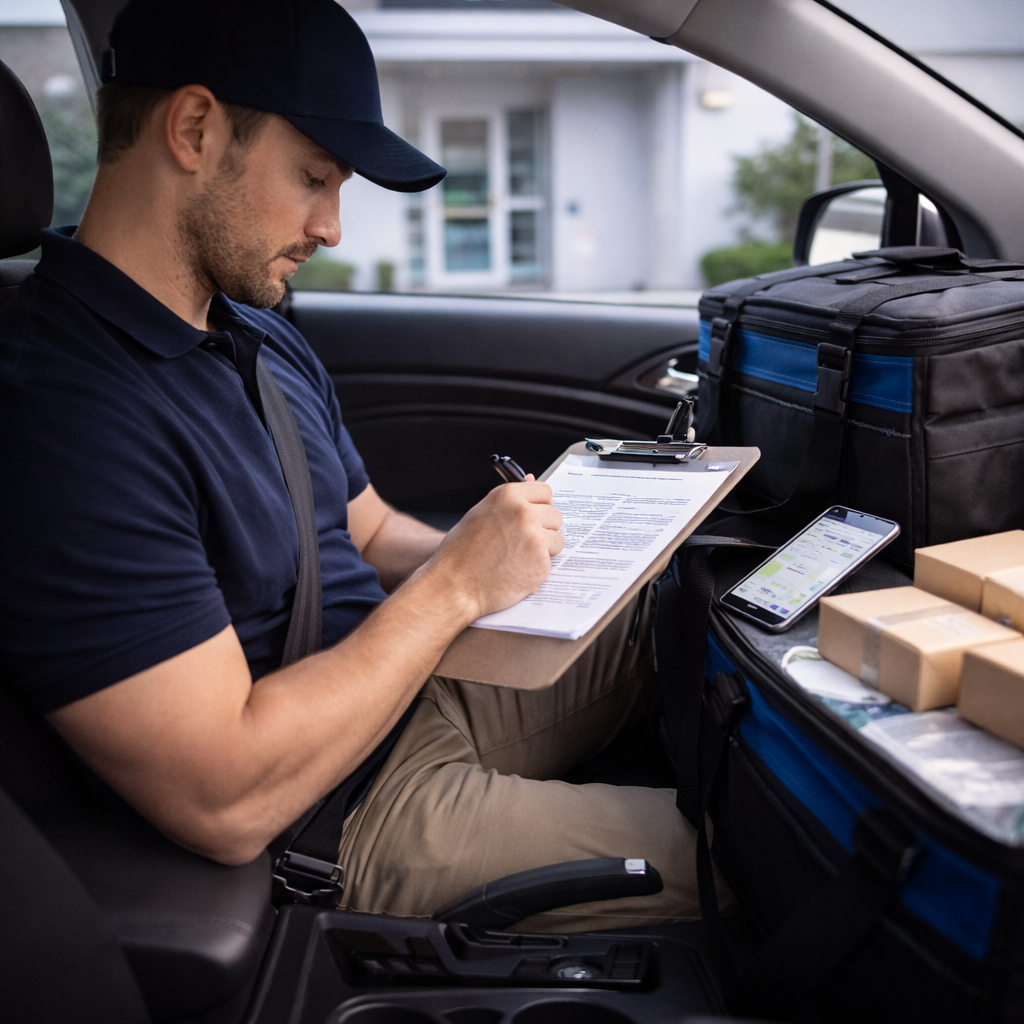
Getting your first medical courier contract is the step that turns everything else from preparation into income. Most people who complete their compliance setup stall here — not because the market isn't there but because direct client outreach feels unfamiliar when you've spent your working life responding to job listings rather than creating your own client relationships.
The good news is that landing your first medical courier contract in 30 days is realistic for anyone who follows a consistent outreach plan. The clients you need are local, identifiable, and actively looking for reliable courier support. You just need to know how to find them, what to say, and how to follow through until one of them says yes.
This is that plan.
Before You Start — Make Sure Your Foundation Is Solid
Before you approach a single client, your compliance package needs to be complete and ready to send on the same day someone asks for it. Nothing slows down a first contract faster than a promising client conversation that stalls because you don't have your documentation ready.
Your compliance package should include:
- Certificate of Insurance (COI) for your commercial auto policy
- LLC registration or business license copy
- HIPAA awareness training certificate
- Background check results
- Driver's license copy
- Any additional certifications you've completed
Have all of these saved as a single PDF you can email within 60 seconds of being asked. For the full requirements checklist and what each item involves, the guide on confirming all your certifications and requirements are in place before you pitch covers every requirement with costs and sources.
Once your package is ready — you're ready to start.
Who Your First Contract Targets Are
Your first contract will almost certainly come from a direct healthcare facility relationship — not a dispatch platform. Dispatch platforms take time to process applications and assign routes. A direct facility conversation can move from first contact to signed agreement in a week when the timing is right.
Your target list for the first 30 days includes:
Independent labs and reference lab satellite sites — Quest, LabCorp, and independent reference labs have specimen pickup routes running multiple times daily. They need reliable independent couriers for coverage gaps, early morning runs, and overflow volume. High contract frequency and consistent demand.
Urgent care centers — Each location generates daily specimen transport needs. A small urgent care chain with three to five locations can represent a meaningful monthly contract for a single courier.
Specialty clinics — Oncology, fertility, orthopedic, and dermatology clinics generate regular specimen and document transport needs. Smaller facilities often have more accessible decision-makers than large hospital systems.
Compounding pharmacies — Custom medication delivery with specific timing requirements. These clients value reliability above almost everything else and tend to build long-term contractor relationships with couriers who deliver consistently.
Hospital satellite facilities — Hospital-owned outpatient clinics and satellite campuses need specimen transport back to the main lab. Less competitive than approaching the main hospital directly and often more accessible decision-makers.
For the full breakdown of which medical courier companies to target for your first contract — including both dispatch platforms and direct facility types — that article covers the full landscape of where to focus your outreach.
The 30-Day Plan — Week by Week
Week 1 — Build Your Target List and Apply to Dispatch Platforms
Days 1 – 2: Build your local target list
Open Google Maps. Search each of these categories within 30 miles of your location and build a spreadsheet with the facility name, address, phone number, and the name of the appropriate contact person where you can find it:
- Independent labs
- Urgent care centers
- Specialty clinics (oncology, fertility, dermatology, orthopedics)
- Compounding pharmacies
- Hospital satellite campuses
Your goal is 25 to 30 facilities on your list. You won't contact all of them in week one — you're building the pipeline you'll work through over 30 days.
Days 3 – 5: Apply to two dispatch platforms
While you build your direct contract pipeline, apply to two dispatch platforms simultaneously for immediate income coverage. Dropoff and CourMed are strong starting points in most markets. Complete their contractor applications, upload your documentation, and follow up if you don't hear back within 48 hours.
Platform applications and direct outreach run simultaneously throughout the 30-day plan. Don't wait for one to resolve before starting the other.
Week 2 — First Outreach Wave
Days 8 – 12: Contact your first 10 targets
Start with your highest-priority targets — independent labs, urgent care chains, and compounding pharmacies. These facilities have the most consistent courier needs and the most accessible decision-makers.
How to contact them:
Call first. Not email. A phone call gets through filters that emails don't. Ask for the lab director, office manager, or operations manager by title if you don't have a name. When you reach them — keep it short:
"Hi, my name is [Name] and I own [Business Name], a licensed medical courier service based in [City]. I'm reaching out because I specialize in specimen transport and pharmaceutical delivery for healthcare facilities in the area. I wanted to introduce myself and find out if your facility has any current or upcoming courier needs — particularly for early morning runs, after-hours coverage, or weekend routes. Would you have five minutes to talk this week?"
If they're not available — ask for their email address and send a brief follow-up email that same day. Your email should include:
- One paragraph introduction of your business and services
- Your coverage area and available windows
- A brief list of your credentials (insured, HIPAA trained, background checked, LLC registered)
- Your compliance package attached as a PDF
- A clear call to action — "I'd love to schedule a brief call at your convenience"
Days 8 – 12: Send 10 introductory contacts
Five phone calls. Five emails to facilities where you couldn't reach the decision-maker by phone. By end of week two you have 10 active outreach threads in motion.
Week 3 — Follow Up and Second Outreach Wave
Days 15 – 17: Follow up on week two contacts
Any facility you haven't heard back from gets one follow-up. A brief email or call:
"Hi [Name], I wanted to follow up on my message from last week about medical courier coverage for [Facility Name]. I understand you're busy — I just want to make sure my information didn't get buried. I'm happy to schedule a quick five-minute call at whatever time works for you."
One follow-up. No more after this until you have a reason to re-engage.
Days 18 – 21: Contact your next 10 targets
Work through the next 10 facilities on your list using the same phone-first approach. You now have 20 active outreach threads in various stages of conversation.
Week 4 — Close, Apply, and Consolidate
Days 22 – 26: Move active conversations toward a decision
Any facility that has responded positively — expressed interest, asked questions, or requested more information — gets a direct invitation to move forward:
"Based on our conversation, I think we'd be a great fit for your [morning specimen runs / after-hours coverage / weekend routes]. I'd like to propose a 30-day trial arrangement so you can evaluate my service firsthand. Can we schedule 20 minutes this week to go over the specifics?"
A trial period offer removes the risk perception for a facility that's interested but cautious about adding a new contractor. Most healthcare facilities are much more likely to say yes to a 30-day trial than to a long-term contract commitment with someone they haven't worked with yet.
Days 27 – 30: Send final follow-ups and evaluate traction
Send a final brief follow-up to any facility that hasn't responded to your initial contact or your first follow-up. Some will convert now. Some won't be ready yet — add them to a 60-day re-engagement list and move on.
By the end of day 30, most couriers who follow this plan have either signed their first contract, have one or two conversations in active negotiation, or have a clear second-month pipeline based on what the first 30 days revealed about which facility types respond best in their market.
What to Do When a Facility Says Yes
Move fast. Healthcare facilities that express interest can go cold quickly if the follow-through is slow.
Send your compliance package the same day they express interest — don't wait until they ask for it. Propose a specific start date. Have your service agreement ready to send — a simple one-page document that outlines your rate, your coverage window, your run schedule, and your liability terms.
The Medical Courier Business System includes ready-to-use service agreement templates, rate proposal templates, and a complete outreach sequence with scripts for each stage of the client conversation — so you're not writing these from scratch when a facility is ready to move forward.
What to Do When You Hear Nothing
Silence is normal — especially from larger facilities where your email goes to a general inbox. Don't interpret a lack of response as rejection. Follow up once. Add to your 60-day re-engagement list. Keep working through your target list.
The couriers who land contracts in 30 days are consistently the ones who contact more facilities — not the ones who wait longer for responses from the same five contacts. Volume of outreach within your defined target list is the variable most directly correlated with first-contract timeline.
Once your first contract is running smoothly — how to structure your side hustle schedule once you have your first contract covers how to manage your time, set client expectations, and build from one contract toward a stable income base.
Frequently Asked Questions
How long does it take to get your first medical courier contract?
Most couriers who follow a consistent outreach plan — contacting 20 to 30 facilities over 30 days with professional follow-through — land their first contract within 30 to 45 days of starting outreach. The timeline depends more on outreach volume and follow-through consistency than on market conditions. Couriers who contact fewer than 10 facilities typically wait longer than those who work through a full 25 to 30-facility list.
Do I need to cold call healthcare facilities to get medical courier contracts?
Cold calling is the fastest path to a first conversation — phone calls get through more reliably than emails for initial outreach. That said, a combination of calls and emails works well. Call first. Email the same day if you can't reach the decision-maker by phone. Follow up once by whichever method you haven't tried yet. Direct outreach to the right contact person is more effective than any passive approach.
What do I say when approaching a healthcare facility for a courier contract?
Keep your initial pitch brief and specific — introduce your business, name the specific service you offer (specimen transport, after-hours pharmaceutical delivery, weekend coverage), mention your key credentials (insured, HIPAA trained, licensed), and ask for a brief conversation. The goal of the first contact is a conversation — not an immediate contract. A specific ask for five minutes is more likely to get a yes than a general pitch for their business.
Should I offer a trial period to get my first medical courier contract?
Yes — and it's one of the most effective tools for converting a cautious but interested facility. A 30-day trial removes the commitment risk for a facility that hasn't worked with you before. Most healthcare facilities that complete a 30-day trial with a reliable courier convert to ongoing contracts because replacing a working relationship requires effort they don't want to invest.
What is the best type of facility to target for a first medical courier contract?
Independent labs, urgent care centers, and compounding pharmacies are consistently the most accessible first-contract targets. They have consistent courier needs, accessible decision-makers, and contract approval processes that are less bureaucratic than large hospital systems. Start with these facility types before approaching hospital systems or large healthcare networks.
What if no one responds to my outreach in the first two weeks?
Two weeks without a response usually means either the contact method isn't reaching the decision-maker or the message isn't specific enough to prompt engagement. Review your approach — are you calling and following up by email? Are you asking for the right contact person by title? Is your email subject line specific enough to get opened? Adjust your approach before assuming the market isn't there. Most markets have enough healthcare facilities to support a medical courier operation — the variable is usually outreach quality and volume.

Comments ()